There is now a proposal to reduce ETH block times to 8 seconds (EIP-7781).
Let’s run some simulations fine-tuned to match the highest volume pool on Uniswap v3, ETH/USDC 0.05%:
- swap fee: 5 bps
- pair volatility: 0.6072 (yearly)
- virtual liquidity depth: $909 million
- swap transaction fees: $2 (bearish demand), $4 (baseline), $10 (bullish), and $0 (as a reference)
An EF researcher claims that it will “make DEXes like Uniswap v3 roughly sqrt(12/8) ≈ 1.22x more efficient”. The simulation results shows that this is not accurate, even if we assume that the “efficiency” of a DEX is exactly equal to the non-atomic arbitrage costs it’s exposed to.
As expected, the LP losses increase as the swap transaction fee goes up:
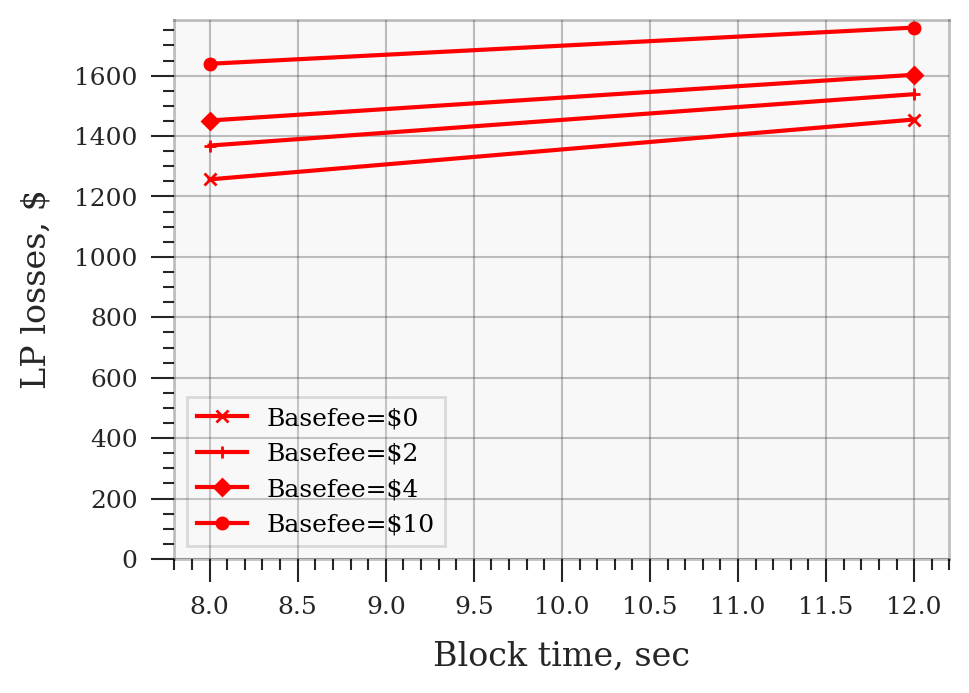
Here are the numerical results quantifying the reduction in LP losses after reducing the block time from 12 to 8 seconds:
basefee=$0 improvement=15.8%
basefee=$2 improvement=12.4%
basefee=$4 improvement=10.4%
basefee=$10 improvement=7.3%
Even for zero basefee, the improvement is less than 22%, because the \sqrt{BT} formula is an approximation, not fully acccurate at low swap fee levels.
For the baseline $4 transaction cost, the improvement is around 10%. It’s still something significant, of course. However, in practice it may even be smaller than than, as the arbitragers will need to increase their profit margins due to an increased likelihood of reorgs at 8 second blocks, so they may decide to skip some of the barely profitable transactions.
Repeatability: The updated code is available here. The file eip7781_get_parameters.py prints up-to-date parameters for the simulations, and simulation_examples_eip7781.py runs the new simulations.