Thanks, I think it would be interesting to test on the asymmetric max and Euclidean norm in Section 5.
Otherwise, as a simple model, it could be valuable to focus strictly on relative elasticities (to assume both resources remain equally utilized at various base fees, if their relative gas cost remains fixed), and map out a probabilistic outcome.
- A probability distribution could be created (best estimate) capturing such elasticities: the change in how much state is created per consumed regular gas unit, when the state gas cost changes and the regular gas cost remains fixed.
- This probability distribution can easily be used to derive the probability of reaching certain equilibrium outcomes at certain scaling levels.
- We define some welfare measure of various equilibrium outcomes (e.g., how bad is it when regular gas is consumed at 23% of the gas limit, etc).
- The expected welfare can be computed by weighing according to the derived probability of various equilibrium outcomes (potentially also involving the probability of shipping certain gas limit changes)
The design that produces the highest expected welfare is used, compensating for nuances we could not capture. It would be akin to doing something like Figure 8 but with real modeling applied. This is quite a bit of work and may therefore not be “worth it” to pursue, although I expect that an LLM could get pretty fair nowadays with a little hand-holding.
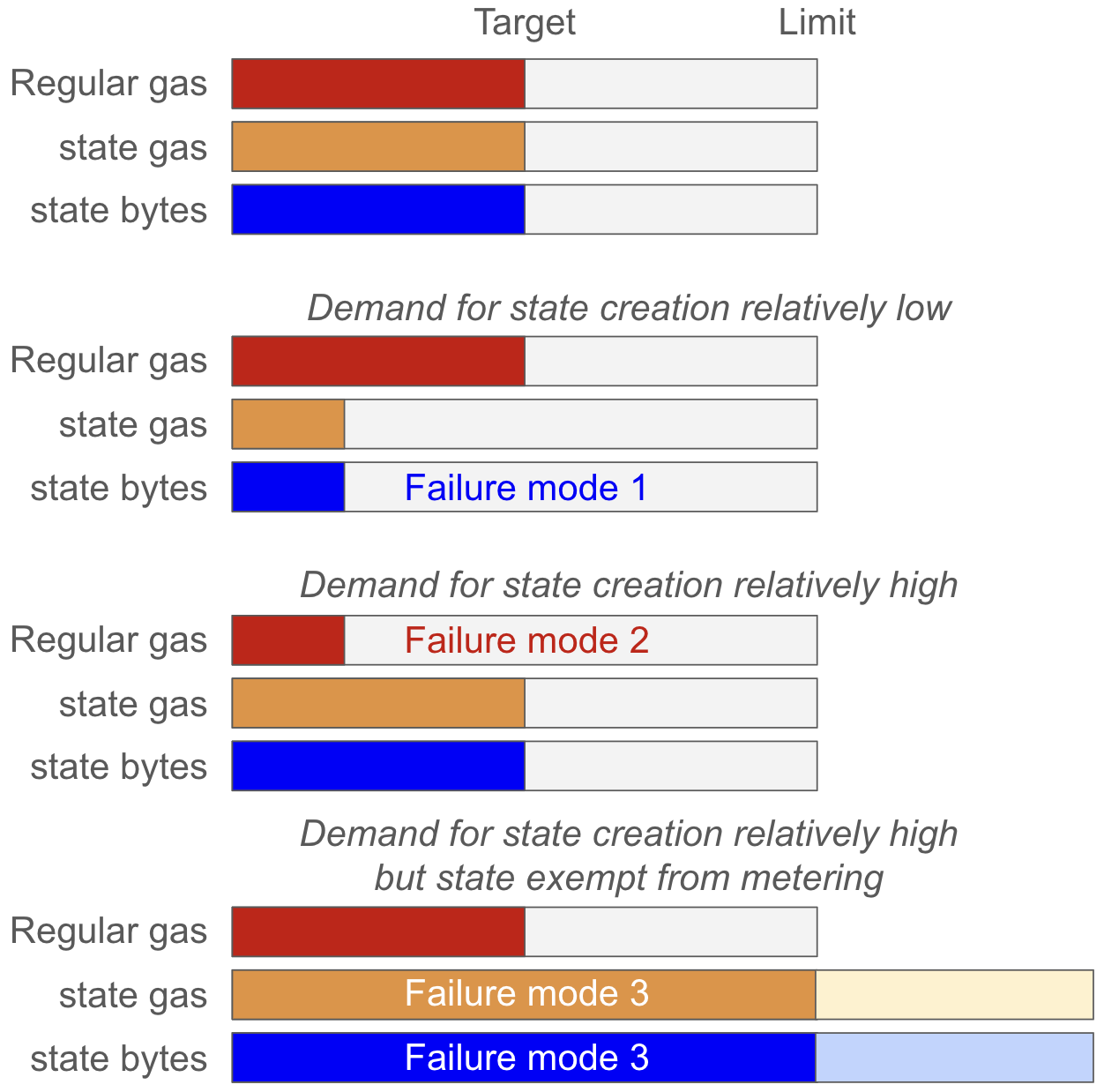
When it comes to the Burst model, it introduces a new Failure mode 3, as illustrated below. Specifically, the long-run demand for state gas may exceed its limit at the given base fee. This complicates block-building greatly and further forces users to pay for state gas via the priority fee, thus degrading UX. It is furthermore not compatible with EIP-7805. Of course, the plan might be to expand the limit (?), but this is also something that influences worst-case outcomes. Generally, if the protocol has no knowledge of demand for state gas, it becomes hard to price state gas. If we could just allow the protocol to have this tiny bit of knowledge—the demand for creating state, then all our problems would have been resolved.
As an aside, a moderate reduction of the influence of state gas on metered gas (1/2, 3/4) seems a little less risky (there is also an interaction here with asymmetric models) and can also be coupled with changes to it.