
TL;DR. We ask whether proposers under ePBS will keep respecting bid cancellations, that is, signing each builder’s latest bid rather than the highest. We propose a common-value auction model and show that, if proposers can commit in advance to respecting or ignoring cancellations, this choice leaves expected proposer revenue unchanged and only shifts risk onto builders. Without commitment, however, respecting cancellations is not equilibrium behavior in the repeated game, since proposers gain from signing the highest bid. Using relay header logs, we find that this gain is small on average (0.9 ETH per day) but concentrated in volatile periods, and that some proposer setups already ignore cancellations, although we can detect this only in aggregate.
Authors: BrunoMazorra and boz1
We thank jcschlegel for his valuable feedback.
Introduction
Under MEV-Boost, Ethereum block builders do not know exactly when the auction ends, so they bid early and revise their bids while it runs. Most revisions are increases, as builders find more valuable blocks or respond to competitors. However, when prices move, some order flow providers, such as CEX-DEX arbitrageurs, may want to resize or cancel their trades. As a result, the value of a block can fall, and its builder may want to lower its bid. Such a downward revision is known as a cancellation.
Traditionally, MEV-Boost relays have respected cancellations. When a proposer requests a block header, its sidecar asks the registered relays and returns the highest of their replies received before a timeout, where each relay serves the highest of the builders’ latest bids. As long as each relay answers the proposer only once per slot, the proposer sees a stale bid only if a relay has not yet processed a cancellation.
Yet proposers can also request headers several times per slot (e.g., through MEV-Boost’s optional timing games feature), to add redundancy and to capture later, more valuable bids before the deadline. A relay may then answer the same proposer with a higher bid first and a lower one later. The proposer can either (i) respect cancellations and consider only each relay’s latest reply, the latest-bid rule, or (ii) ignore them and choose the highest reply, the highest-bid rule.
Today, stock sidecars follow the latest-bid rule. With ePBS, two consensus clients (Prysm and Lodestar) propose to let proposers configure the number and timing of header requests within a slot and, potentially, select the highest bid across replies instead of only the latest one. Making this more accessible could increase the number of proposers adopting the highest-bid rule and effectively eliminate cancellations. Builders would then bear the risk of a stale bid being selected after their block’s value falls, and would have to shade their bids more.
The recent Blockspace Forum post argues in favor of clients and proposers implementing the latest-bid rule (i.e., continuing to respect bid cancellations), claiming that adopting the highest-bid rule would lead to lower proposer revenue and further centralize the builder market. In this post, we ask whether bid cancellations matter: what respecting them changes for proposers and builders, and whether proposers can be expected to keep respecting them. We ask four questions:
- Does the choice of rule change proposer revenue, and who bears the risk?
- Can the latest-bid rule be enforced, or does it rely on voluntary commitment by proposers?
- How large is the proposer’s incentive to ignore cancellations under today’s bids, and when does it arise?
- Do some proposers already act on this incentive, and can we detect them?
We answer the first two questions with a simple auction model and the last two with the header logs of the Ultrasound, Titan and bloXroute relays (August to November 2026). Our answers partly support the forum post. If proposers could commit to a rule, expected proposer revenue would be the same under both, contrary to its revenue claim. However, the highest-bid rule shifts risk from proposers to builders, which could favor larger builders, in line with its centralization concern. Yet without commitment, the latest-bid rule is not a subgame-perfect Nash equilibrium: once bids are in, the proposer gains from signing the highest one. Holding today’s bids fixed, this gain is small on average (0.9 ETH per day) but concentrated in volatile periods, such as the hours after the Binance hack, when builders most need to revise their bids. Some proposer setups already end on the highest bid rather than the latest one, but we can detect this only in aggregate, not for individual proposers. Hence, the latest-bid rule is unlikely to be enforceable. Since stale bids arise from this uncertainty about the deadline, we argue that attention should shift from which bid proposers select to making auction deadlines predictable. In the meantime, clients that implement highest-bid selection should break ties in favor of the latest bid.
Model
We consider a two-period first-price auction with two risk-neutral bidders, i \in \{1,2\}, and a common stochastic time-dependent valuation for the block. Bidders can submit bids at two times, t_1 < t_2, but the auction may terminate before the second bidding opportunity. We interpret each bidder as a searcher-integrated builder; we discuss this simplifying assumption in the model caveats.
Auction deadline. The auction is run by a proposer of type \theta. With probability p(\theta), the auction terminates at t_1; otherwise, it continues until t_2. The deadline is exogenous and independent of bidders’ actions. This captures uncertainty about when the auction effectively ends, arising from network conditions and the proposer’s strategy for timing its final bid request and block signing.
Valuations. Both bidders share a common valuation V_t, observed at time t. The initial valuation V_1 is drawn from a distribution F. If the auction continues, the valuation evolves according to a conditional distribution V_2 \mid V_1 = v \sim K(\cdot \mid v). The realized value V_2 is observed by both bidders at time t_2, before they submit their bids.
Importantly, valuations can increase or decrease between periods, capturing changes in available MEV opportunities. Bidders are ex-ante symmetric and have access to the same information at each period. Common-value auctions are a standard model in auction theory, going back to Wilson (1977), and Engelbrecht-Wiggans, Milgrom, and Weber (1983). Our stochastic common-value setting is inspired by this literature and, in particular, by its application to block building in Moallemi, Pai, and Robinson, Latency Advantages in Common-Value Auctions.
Bidding. At t_1, each bidder may submit a bid b_{i,1} \geq 0. If the auction continues, these bids become observable to both bidders. At t_2, bidders simultaneously choose whether to submit a new bid b_{i,2}, potentially revising their previous bids downwards.
We consider two selection rules:
- Latest bid (L): Only the most recently submitted bid from each bidder is considered.
- Highest bid (H): The highest bid submitted by each bidder across both periods is considered.
At the auction deadline, the bidder with the highest effective bid wins and pays that bid. Ties are broken symmetrically. If no bids have been submitted, the auction ends without allocating the block.
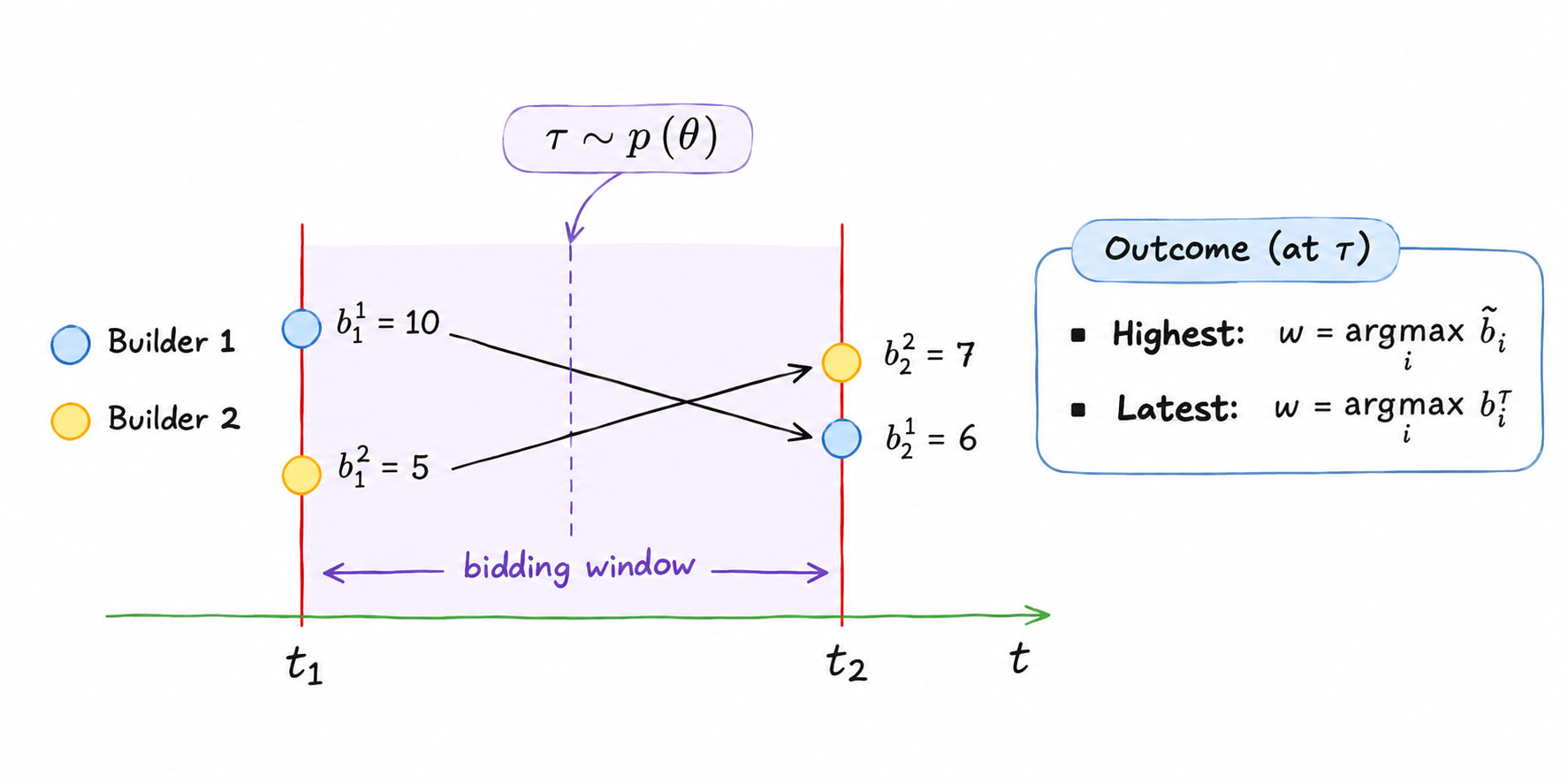
The key distinction between the two rules is how they handle bid revisions. While both allow bidders to increase their bids in response to changes in the common valuation, only the latest-bid rule allows them to revise their bids downwards. Under the highest-bid rule, previous bids remain binding regardless of subsequent changes in valuation.
Model Caveats. Our model makes several simplifying assumptions. First, we treat each bidder as a searcher-integrated builder, abstracting from the auctions and agreements connecting these parties. When proposers do not respect cancellations, these arrangements determine whether the builder, the searcher, or both bear the resulting exposure to stale bids. The terms of payments and cancellation rights may therefore need to adjust. Our model does not take these details into account, although they could affect the outcome of the auction. Second, block valuations across builders are correlated but not necessarily common. Valuations are close to common when builders build on similar order flow, which is largely the case today, as searchers send their bundles to multiple builders. However, builders also have exclusive order flow, idiosyncratic sources of value and private information. Moreover, even when searchers compete for the same CEX-DEX opportunity, a builder values a bundle by the searcher’s payment, not the searcher’s profit, so a common value among searchers does not imply one among builders. Allowing for asymmetric, private valuations could change our revenue results in either direction. Still, the proposer’s gain from ignoring cancellations is concentrated in volatile periods (see the empirical section), when the value of the order flow that all builders receive changes together. We therefore view the common-value model as a reasonable first approximation. Third, in practice, the auction does not end at one of two discrete deadlines, but rather within a continuous time window. We do not expect this simplification to fundamentally change the nature of the strategic problem, but it simplifies its exposition. Finally, ePBS could change the nature of the auction itself, potentially making it a sealed-bid auction. This could substantially alter the equilibrium, particularly when combined with the other factors discussed above.
Equilibrium analysis
We study the symmetric equilibria of both rules and compare their implications for bidder profits and proposer revenue.
Proposition 1. Suppose a proposer selects the highest-bid rule with probability \alpha\in[0,1] and the latest-bid rule with probability 1-\alpha. Suppose furthermore that the probability is known to bidders, but the selection rule is realized independently of bids and valuations. In a symmetric equilibrium:
- Expected proposer revenue is independent of \alpha.
- The variance of proposer revenue is weakly decreasing in \alpha.
- The variance of each builder’s profit is weakly increasing in \alpha.
Moreover, the reduction in proposer revenue variance equals the sum of the increases in builders’ profit variances. The proof is in the appendix.
Interpretation. The intuition is straightforward. When proposers commit to selecting the highest bid, builders anticipate the risk of having an outdated bid selected after the value of their block decreases. Consequently, they bid more conservatively in the first period.
This creates two opposing effects on proposer revenue. On the one hand, early revenue decreases because builders submit lower initial bids. On the other hand, late revenue increases because the proposer can still select an earlier, higher bid following a downward valuation shock. In equilibrium, these two effects exactly offset each other. Contrary to the argument made in the Blockspace Forum post, selecting the highest bid does not necessarily reduce proposer revenue. Builders’ strategic bid shading can exactly offset the additional revenue from selecting higher bids, making the choice of selection rule irrelevant for expected revenue.
Interestingly, while expected proposer revenue remains unchanged, its variance decreases. The highest-bid rule effectively transfers revenue from high-revenue states to low-revenue states, reducing the proposer’s exposure to valuation shocks. However, this comes at a cost: the reduction in proposer risk is effectively financed by builders taking on more risk. Under the latest-bid rule, builders can adjust their bids to avoid losses when block valuations fall. Under the highest-bid rule, they may instead be forced to pay more than their block is worth. Even if their expected profits remain unchanged, they face greater volatility, which may be easier for large, well-capitalized builders to absorb. So, as argued in the Blockspace Forum post, this could increase barriers to entry, favor larger builders, and ultimately contribute to market concentration. However, our empirical results suggest that the amounts involved are small on average (about 0.9 ETH per day), although they are concentrated in a few volatile periods, when the risk for builders is largest.
Thus, when proposers can credibly commit to their selection rule, choosing the highest bid does not increase expected revenue, but it provides a form of revenue insurance.
What happens without commitment?
So far, we have discussed which selection rule block proposers would prefer to commit to. However, in practice, no such commitment exists. Proposers can choose which bid to sign, and following the latest-bid rule can only be sustained through repeated interactions and some form of enforcement.
There are two important considerations.
First, detecting deviations from the latest-bid rule is difficult in practice.1 Even if we observe that a proposer selected an earlier, higher bid, how can we know whether it actually received the updated bid before signing? Network latency and uncertainty about the auction deadline make it difficult to distinguish strategic behavior from communication failures. Identifying which selection rule a proposer follows would therefore require statistical evidence, which is particularly difficult to obtain for proposers with relatively few observations. Our empirical test below illustrates this: it detects that some setups end on the highest bid, but cannot attribute this to individual proposers. Moreover, smaller or pseudonymous proposers may be able to rotate validator keys or re-enter under different identities, making reputation-based enforcement even harder.
Second, even with perfect observability, following the latest-bid rule is not necessarily an equilibrium of the repeated game. To study this, we consider an infinitely repeated version of our auction model and restrict attention to equilibria in which, in each round, builders play a symmetric equilibrium of the one-shot auction given their beliefs about the proposer’s selection rule. Builders can therefore react to a proposer’s past behavior, but only by updating these beliefs.
Proposition 2. Among subgame-perfect Nash equilibria in which builders play a symmetric equilibrium of the one-shot auction in every round, selecting the highest available bid is the unique equilibrium selection rule, up to ties, regardless of the proposer’s type \theta or stake.
Proof sketch. Since builders play a symmetric equilibrium of the one-shot auction in every round, by Proposition 1, expected proposer revenue is independent of the selection rule anticipated by builders, including mixtures. Hence, the proposer’s expected continuation payoff is independent of its current selection. By the one-shot deviation principle, whenever the proposer selects a bid lower than the highest available bid, it can strictly increase its immediate revenue without reducing its expected future payoff. Therefore, selecting a lower bid cannot be part of such an equilibrium. Conversely, always selecting the highest bid, with builders playing the corresponding one-shot equilibrium in every round, is such an equilibrium. \square
The result highlights the following tension: even if a commitment by proposers to the latest-bid rule is desirable for builders and does not reduce expected proposer revenue, following that rule is not rational once bids have been submitted. Builders may respond to deviations by shading their future bids, but this does not reduce the proposer’s expected future revenue. Consequently, adjusting future bids in response to deviations is insufficient to sustain the latest-bid rule.
Of course, additional mechanisms could change this conclusion. Builders or relays might refuse to serve proposers who systematically ignore cancellations, or large staking pools might face reputational costs. More broadly, builders and relays could coordinate to punish block proposers who systematically ignore cancellations.
In the absence of such credible enforcement, proposers have an incentive to select the highest available bid, regardless of which rule they previously announced.
Block contents and tie-breaking
Our model takes block valuations as given, but the selection rule may also affect searchers and block contents. The bid to the proposer is the builder’s, so the risk of a stale bid falls on the builder and the proposer. Searchers are affected only if builders pass this risk on through their arrangements with them (see the model caveats), or if a stale bid also locks in stale block contents. In the latter case, CEX-DEX searchers could size trades more conservatively to reduce risk, leaving DEX prices further away from off-chain prices. These responses lie outside our model: if the bid selection rule changes the underlying valuation process, our revenue-equivalence result need not carry over.
However, a binding bid amount does not necessarily prevent updates to block contents before the proposer signs. Nothing prevents a client that follows the highest-bid rule from breaking ties in favor of the latest valid bid. This allows the builder to submit an updated block while maintaining the proposer’s payment. Otherwise, the builder may need to raise its bid by the smallest permitted increment merely to supersede an older block.
Once a bid is binding, its amount is a sunk cost: the builder owes it whatever the block contains, so it still wants the most valuable contents at current prices. With the latest-on-ties rule, it can act on this, for example by resizing a CEX-DEX trade after prices move and resubmitting at the same bid. The risk of a stale bid then falls on how much builders bid, which our model captures, rather than on what they put in the block, so searchers have no reason to size trades conservatively. Latest-on-ties therefore addresses the concern that highest-bid selection necessarily locks in outdated block contents, without sacrificing immediate proposer revenue. We do not recommend either latest or highest as the primary selection rule. However, clients implementing highest-bid selection should break ties between equally high bids from the same builder in favor of the latest valid submission received before signing.
Empirics
Our model shows that, without commitment, proposers have a gain from ignoring cancellations once bids are submitted (Proposition 2). Even with commitment, when expected revenue is the same under both rules, the highest-bid rule lowers the proposer’s risk by shifting exposure to valuation shocks onto builders (Proposition 1).
In this section, we first measure how large the proposer’s incentive to ignore cancellations is under today’s bids, and when it arises. Holding bids fixed, this gain is also what builders would pay above their latest bids if proposers ignored cancellations. Its size therefore tells us what is at stake on both sides: how much proposers forgo by respecting cancellations, and how much risk builders would bear without them. Next, we test whether some proposers already act on this incentive, and whether we can detect them.
Data and definitions
Data. We use the header logs of the Ultrasound, Titan and bloXroute relays from 1 August to 15 November 2026. For every header a relay served to a proposer, the log records the proposer’s key, the parent block, the block served, its value, and the time the request arrived. We match each slot to its canonical block to see which bid was signed. We do not see headers served by other relays, so all bids below are those served by these three relays. We keep the 686,834 slots (on average 6,419 of the 7,200 slots per day, 89%) whose block came through MEV-Boost and whose proposer requested at least one header from these relays.
Definitions. For each slot, we reconstruct the bid each rule would select:
- Latest-bid pick: each relay’s reply to the proposer’s latest request, then the highest of these across relays, as a stock sidecar does. If a relay answers the same request with several blocks, we take the highest.
- Highest-bid pick: the highest bid served to the proposer at any time in the slot.
In slots where each relay received a single request, the two picks coincide.
How large is the gain from ignoring cancellations?
We first measure this gain under today’s bids, and then ask when it arises.
Measure. We define the proposer’s gain from ignoring cancellations in a slot as the highest-bid pick minus the latest-bid pick. It is the one-shot deviation gain in Proposition 2: we hold bids fixed and assume every served header reached the proposer in time. It is also the extra amount builders would pay, over the latest-bid pick, if the proposer ignored their cancellations. However, it is not the change in proposer revenue if proposers switched rules: builders would then shade their early bids, and by Proposition 1 expected revenue would not change. Hence, the gain summed over slots measures how much cancellations protect builders under today’s bids, not what proposers would earn by switching.
Results. In 584,289 of our 686,834 slots (85%), a relay received two or more requests, and in 116,967 of these (20%), the latest bid is not the highest. Summed over slots, the gain averages 0.90 ETH per day (0.47 ETH on the median day). It is concentrated in a few slots: in the median slot where the latest bid is not the highest, the gain is 0.000025 ETH, while half of the total gain of 96.7 ETH comes from 219 slots (0.2% of these slots), each with a gain above 0.053 ETH (Figure 1).
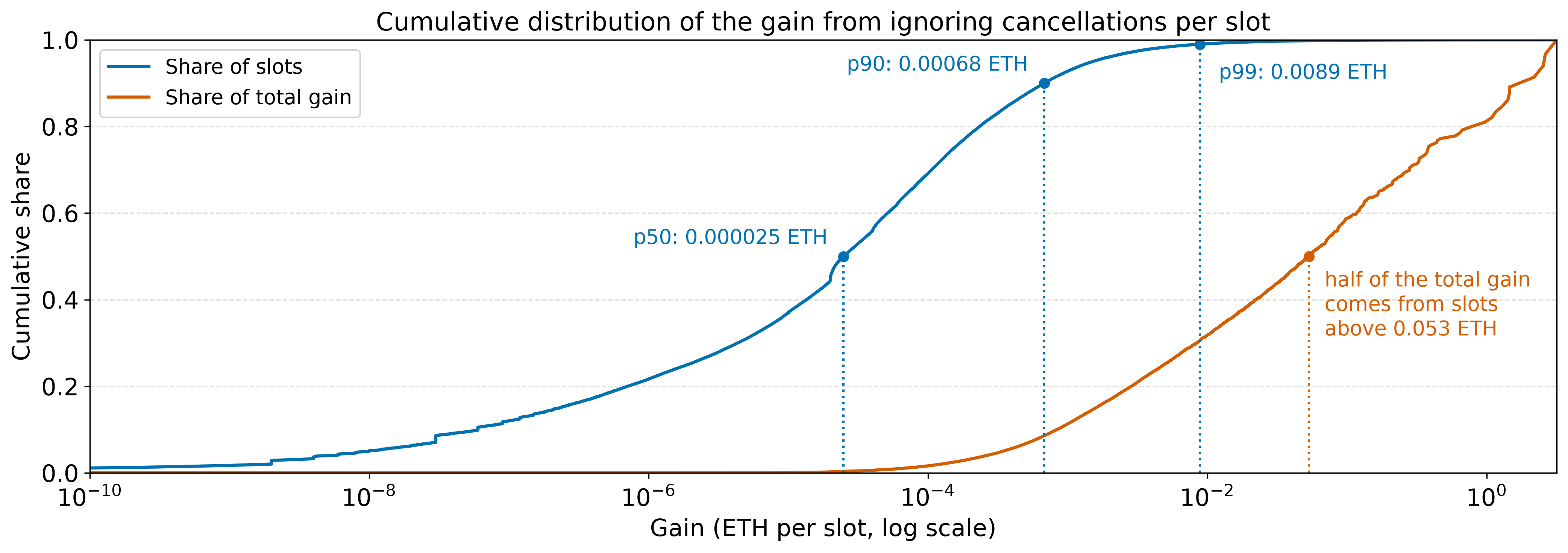
Figure 1: Cumulative distribution of the gain from ignoring cancellations per slot, across the 116,967 slots where the latest bid is not the highest (1 August – 15 November 2026). Blue: share of slots; orange: share of the total gain. The 1,335 slots with a gain below 10^{-10} ETH lie left of the axis.
Over time. Since the gain is concentrated in a few slots, we next ask when these slots occur. On most days, the gain stays close to the median of 0.47 ETH, with a few spikes (Figure 2). By far the largest come after the Binance hack on 29 October at 20:05 UTC, with 12.1 and 14.8 ETH on 29 and 30 October, against at most 4.0 ETH on any other day. The ten hours starting with the hour of the hack, from 29 October 20:00 to 30 October 06:00 UTC, carry 25.5 ETH, 26.4% of the total gain over the 107 days. In these hours, the latest bid is not the highest in 26% of slots with repeated requests, against 20% outside, but the gain per slot is much larger: 0.011 ETH on average, against 0.0001 ETH outside. Summed over the first hour alone, the gain reaches 7.8 ETH, more than on any day outside 29–30 October.
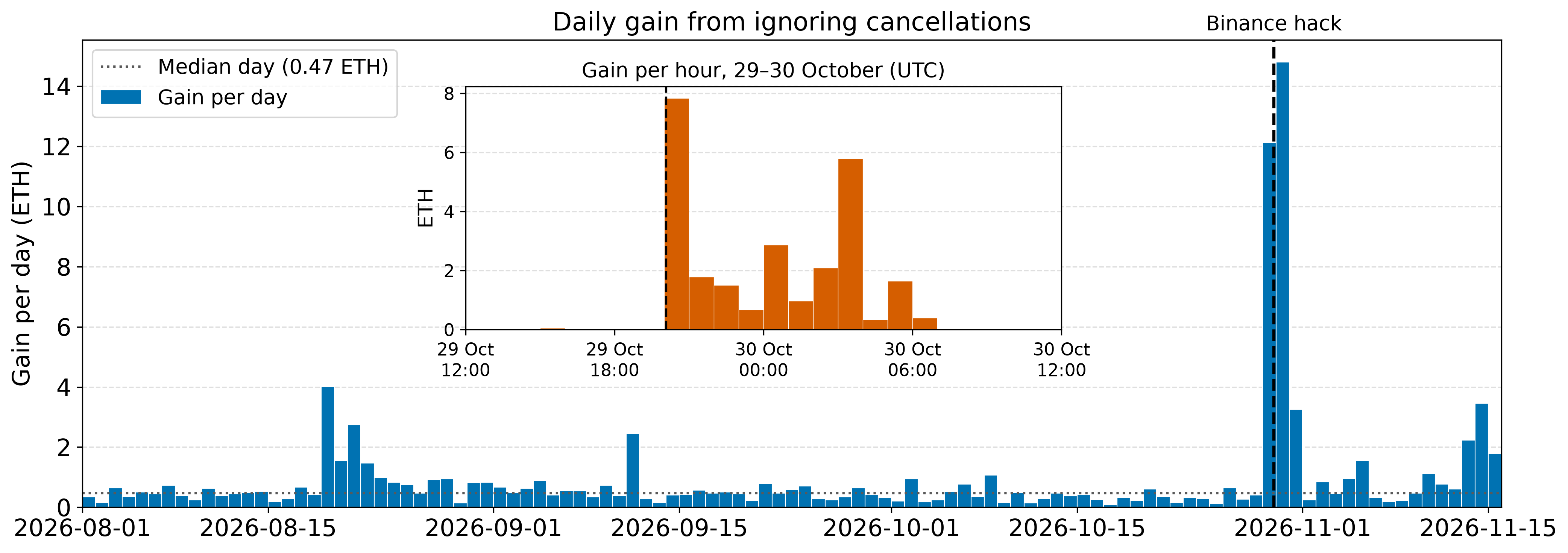
Figure 2: Daily gain from ignoring cancellations, 1 August – 15 November 2026. Dotted line: median day; dashed line: Binance hack (29 October, 20:05 UTC). Inset: gain per hour around the hack.
Price volatility. Beyond the hack, we ask whether the gain is generally larger in volatile markets. Builders lower their bids when the value of their block falls, which for CEX-DEX arbitrage may happen when off-chain prices move. If the gain comes from such revisions, it should be larger in slots where prices were volatile beforehand. For each slot with repeated requests, we compute the realized volatility of the Binance ETHUSDT price over the 12 seconds before slot start, and split these slots into ten groups of equal size by this volatility (Figure 3). The share of slots in which the latest bid is not the highest rises from 15% in the least volatile tenth to 30.5% in the most volatile tenth, which carries 54% of the total gain. Still, the three least volatile tenths carry 12% of the total gain, so volatility explains only part of it.
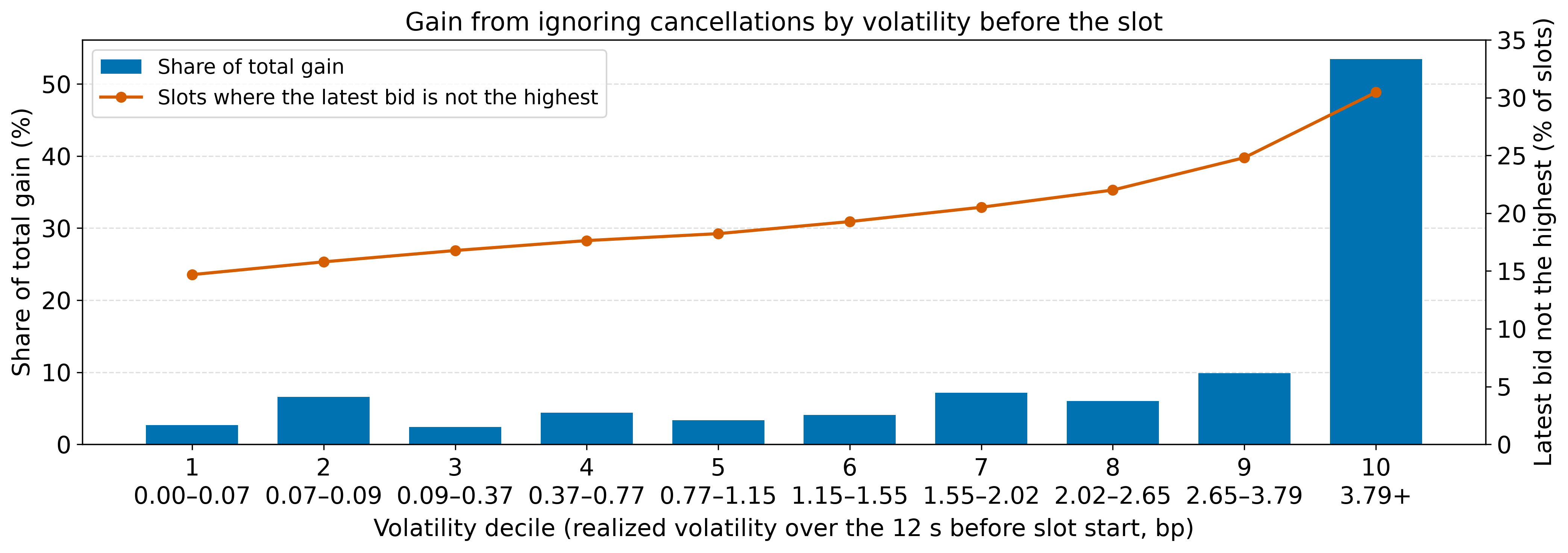
Figure 3: Gain from ignoring cancellations by volatility decile, across the 584,289 slots with repeated requests (1 August – 15 November 2026). Volatility is the realized volatility of the Binance ETHUSDT price over the 12 seconds before slot start. Bars: share of the total gain; line: share of slots where the latest bid is not the highest.
Do proposers already ignore cancellations?
Next, we test whether some proposers already act on this gain. When a proposer signs an older bid that is higher than the latest one, either the newer reply arrived too late or its setup keeps the highest reply by design,2 which is the detection problem from the theory section. To tell the two apart, we assume that a proposer following the latest-bid rule misses a newer reply equally often whether it is higher or lower than the previous one.
Test design. We group a proposer’s requests arriving less than 10 ms apart into one round and compute the latest-bid pick twice: after the second-to-last round (B_1) and after the last round (B_2). When B_2 is higher than B_1 and is the highest bid served in the slot, we call the slot a rise; when B_2 is lower than B_1 and B_1 is the highest bid served, a fall. In a rise, both rules sign B_2; in a fall, the latest-bid rule signs B_2, while the highest-bid rule signs B_1.
Rises are thus our control group: the share of rises in which the proposer signs B_1 measures how often it misses the newer bid for reasons unrelated to its rule (e.g., a late reply). Under the latest-bid rule, such misses do not depend on whether B_2 is higher or lower than B_1, so our null hypothesis is
If B_2 is signed less often in falls (our treatment group) than in rises, this suggests that some proposer setups end on the highest bid rather than the latest one.
Finally, a cancellation processed at one relay but not yet at another could make a proposer that signs the latest bid look as if it kept an older, higher bid. We therefore compare rises and falls only in slots in which B_1 and B_2 are both replies from Ultrasound, whose records confirm that B_2 was served after B_1, and impose further conditions listed in the appendix. In these clean cases, the proposer ends on B_2 only if Ultrasound’s newer reply arrives in time, in both groups.
Results. We find 1,665 clean cases (1,447 rises and 218 falls), on average 15.6 per day. In rises (our control group), the proposer signs the newer bid B_2 in 81.3% of slots. Since both rules sign B_2 in a rise, the remaining 18.7% are misses unrelated to the selection rule, e.g., a reply arriving too late. In falls, the proposer signs B_2 in only 32.6% of slots and keeps the older, higher bid B_1 in 67.4%. This can reflect either a missed newer reply or highest-bid selection, which the test aims to distinguish.
A one-sided Fisher exact test on these counts rejects H_0 (p = 1.7 \times 10^{-46}). To quantify the gap, let \pi be the estimated share of falls attributable to highest-bid selection beyond what misses in the control group explain, i.e., P(\text{sign } B_2 \mid \text{fall}) = (1-\pi)\,P(\text{sign } B_2 \mid \text{rise}). From the counts, \pi = 1 - 0.326/0.813 = 0.60. The gap remains substantial across most alternative specifications, although it is smaller at bloXroute (see the appendix). Hence, our results suggest that some proposer setups in the clean sample end on the highest bid rather than the latest one. We observe that most falls in which the proposer retains B_1 involve Commit-Boost proposers (see the appendix for a breakdown by sidecar).
Next, we examine whether the difference between rises and falls can be explained by timing or the size of the change between B_1 and B_2.
Timing. We measure the lead, the time from Ultrasound serving B_2 to the signed block reaching the Flashbots relay, which is the most time the proposer can have had B_2 before signing. A proposer that signs before B_2 arrives keeps B_1 under either rule. If falls more often had short leads than rises, this alone could produce the gap without any proposer following the highest-bid rule. However, falls end on B_2 in 30–42% of slots in every lead bin, against 79–86% for rises, including leads of 250 ms or more (41.9% against 84.3%; Figure 4). Hence, differences in the measured lead time do not explain the gap.
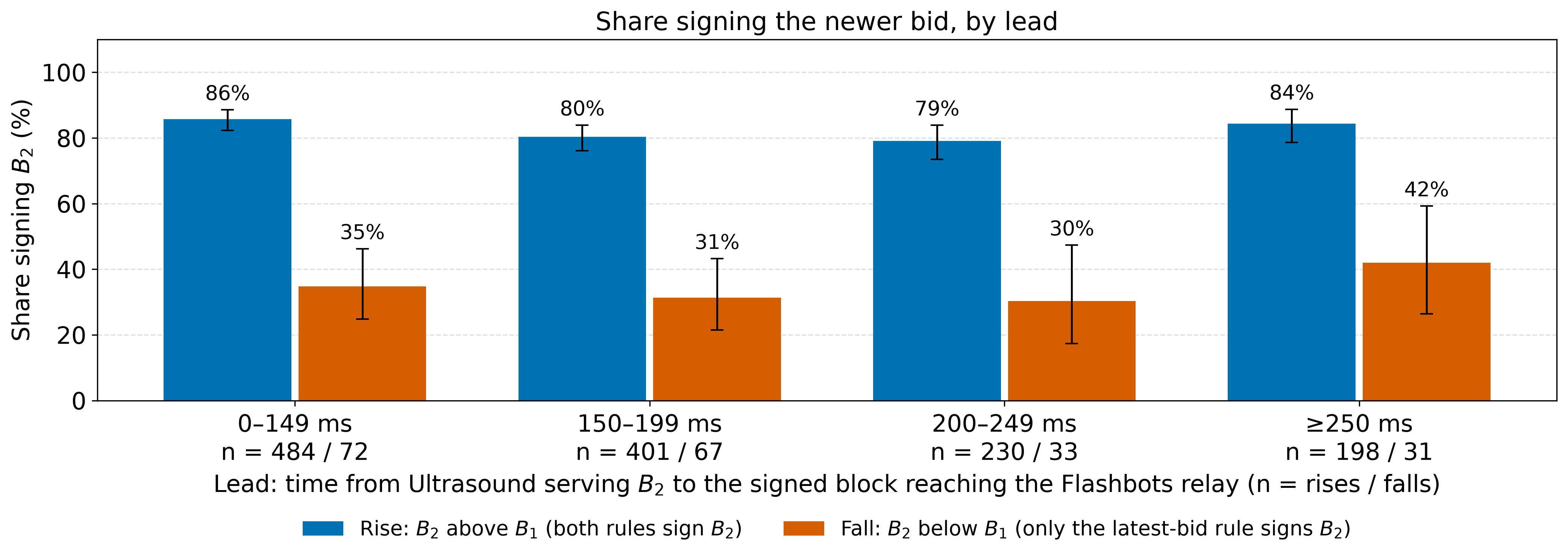
Figure 4: Share of clean cases in which the proposer signs the newer bid B_2, by lead (1,516 clean cases with the Flashbots relay log). Blue: rises; orange: falls; bars: 95% confidence intervals; n: rises / falls.
Size of the change. We bucket slots by the relative size of the change between B_1 and B_2. While rises end on B_2 in 80–82% of slots regardless of how much higher B_2 is, falls end on B_2 less often as the drop grows: 45.1% for drops below 0.02%, against 17.4% for drops of 1% or more (Figure 5). Larger drops do not come with shorter measured leads, so this suggests that some setups may be more likely to keep the highest bid when the drop is larger.
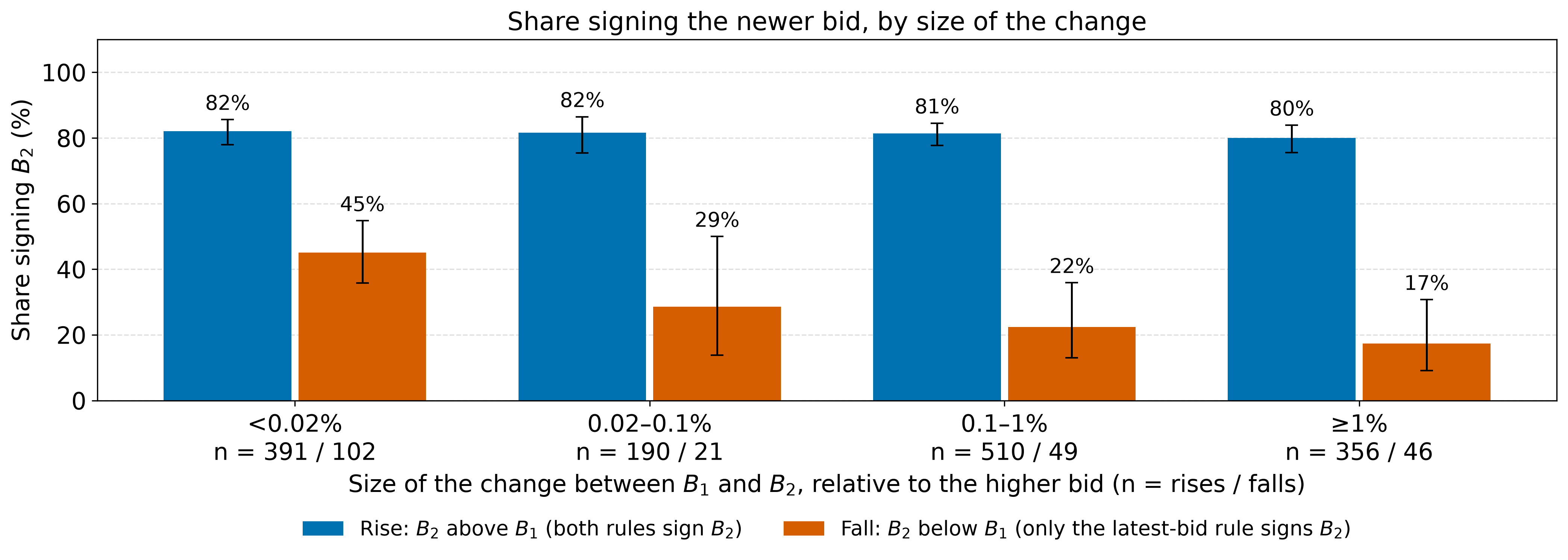
Figure 5: Share of clean cases in which the proposer signs the newer bid B_2, by the size of the change relative to the higher bid (1,665 clean cases). Blue: rises; orange: falls; bars: 95% confidence intervals; n: rises / falls.
Limitations
Both analyses use only the headers served by the three relays we observe. The gain from ignoring cancellations holds today’s bids fixed and assumes every served header reached the proposer in time; the appendix compares served and signed bids. The test covers only a small part of the slots with repeated requests: on average, of the 3,762 slots per day in which a relay received requests more than 10 ms apart, 705 end with a rise or a fall, and in 412 of these the proposer signed one of the two bids we reconstruct; the clean-case conditions then leave 15.6. The test also cannot establish whether an individual proposer keeps the higher bid intentionally. Finally, it treats slots as independent, while one operator can run many keys: the 147 falls in which the proposer kept B_1, which drive the result, come from 141 keys and several client versions, but we cannot tell how many operators run them, so the p-values may be too small and the confidence intervals too narrow.
Discussion
Do bid cancellations matter? In our model, they do not change expected proposer revenue, but they decide who bears the risk of valuation shocks: respecting them leaves it with proposers, and ignoring them shifts it to builders. Holding today’s bids fixed, the gain from ignoring cancellations averages 0.9 ETH per day, but it is concentrated in volatile episodes, such as the hours after the Binance hack, exactly when builders most need to revise their bids. The Blockspace Forum post proposes a natural response: clients and proposers should keep the latest bid, and so continue to respect cancellations. But enforcing this rule is unlikely to work. In our model, once bids are in, a proposer gains from signing the highest one, and builders cannot punish this by lowering their future bids. Nor is it easy to detect proposers who deviate. Our test shows that some setups already end on the higher bid, but it relies on about 16 clean slots per day and cannot tell which proposers do so. Under ePBS, measurement would become more direct, but each builder, or relay if relays remain, would see only its own interactions with the proposer, which turns monitoring into a private-information problem.
An alternative is to stop stale bids from reaching the proposer, rather than relying on the proposer to ignore them. Relays, or builders under ePBS, could answer each proposer only once per slot and send the same bid again if the proposer retries. This would restore what happens today when a proposer sends a single request to each relay. The proposer then never holds two bids from the same source, so the latest bid from each source is also its highest, while preserving redundancy across sources, which is the motivation for the Prysm and Lodestar proposals. This requires authenticated header requests, but it relies on relays or builders, not on proposer compliance. However, the fundamental problem is uncertainty about the auction deadline, and a one-answer rule moves the timing problem rather than solving it. A proposer that can ask each source only once must choose between asking early, to make sure it gets a bid, and asking late, to get a bid that reflects more value. Builders face the mirror trade-off today: they bid early to increase their chances of winning the block, then revise as valuations change, because they do not know when the auction ends. While this uncertainty remains, proposers may have reasons to work around limits on repeated requests.
This suggests shifting attention from policing bid selection to making auction deadlines predictable. With a credible deadline, builders would have less reason to bid before they know the block’s value, so stale bids would matter much less. Until then, the latest-bid rule would suit builders better, since it keeps today’s status quo, in which they can cancel their bids when valuations fall. But it is unlikely to be enforceable, and without credible commitments, it is not rational for proposers to select the latest bid. Therefore, our recommendation to clients that implement highest-bid selection is to break ties in favor of the latest bid. Builders can then still update block contents, for example to resize or drop a searcher’s trade after prices move, as long as they keep the proposer’s payment. This limits the incentive for searchers to size their trades more conservatively, as discussed in the Block contents and tie-breaking section.
Footnotes
1 Under ePBS, builders can communicate with proposers directly, which could make deviations easier to detect. To the extent that builders bypass relays, the ambiguity between a proposer selecting the highest bid across relays and deliberately selecting an outdated bid would largely disappear. This ambiguity forces us to discard many observations in our empirical analysis. However, a new complication emerges: each builder, or relay if relays remain, would observe only its own interactions with the proposer, and these observations would not necessarily be publicly available. Thus, monitoring would shift from a largely public to a private-information problem, making coordinated enforcement more difficult. This could particularly disadvantage smaller builders, who have fewer observations from which to identify proposer deviations.
2 Keeping an older, higher bid requires changing the proposer setup. Either the beacon node calls a stock sidecar several times and keeps the highest header, or a sidecar running timing games keeps each relay’s highest reply instead of its latest, a small change to MEV-Boost or Commit-Boost. Vouch, a validator client that does the sidecar’s job, does the latter with its deadline strategy.
Appendix
Proof of Proposition 1: Revenue equivalence and risk transfer
Proof. Fix the initial common valuation V_1=v and the termination probability p=p(\theta), with 0 < p < 1. Assume valuations are nonnegative and have finite second moments.
In symmetric equilibrium, bidders submit an initial bid b_\alpha\le v, uniquely characterized by
Indeed, if both bidders initially bid b_\alpha, they revise their bids to V_2 at t_2. Under the highest-bid rule, their initial bids remain binding whenever V_2 < b_\alpha. Equation (1) implies that their expected utility is zero. A downward deviation yields zero utility, while an upward deviation to b>b_\alpha yields
Thus, neither deviation is profitable, establishing the symmetric equilibrium.
Let Z_\alpha\sim\operatorname{Bernoulli}(\alpha), independently of valuations and the deadline. The proposer’s revenue is
Expected revenue. Using (1), we obtain
Hence, expected proposer revenue is independent of \alpha.
Proposer risk. Since expected revenue is constant, comparing second moments gives
Moreover, differentiating with respect to \alpha and using (1) yields
Thus, proposer revenue variance is weakly decreasing in \alpha.
Builder risk. Let \Pi_i^\alpha denote builder i’s realized profit. By symmetry and (1), its expected profit is zero. Its variance is therefore
Differentiating and applying (1),
The derivatives hold wherever they exist; continuity gives monotonicity also when the valuation distribution has atoms.
Combining (2) and (3), and observing that builders earn zero profit under the pure latest-bid rule, we obtain
Thus, increasing the probability of selecting the highest bid transfers risk from the proposer to the builders without changing expected revenue. \square
Served versus signed bids
Our gain from ignoring cancellations assumes that every served header reached the proposer in time. To see how much this matters, we compare the highest bid served with the bid the proposer actually signed. In slots with repeated requests whose signed bid we observe, this difference averages 2.00 ETH per day (213.8 ETH in total), against 0.82 ETH per day for the gain from ignoring cancellations on the same slots. The rest comes from slots where the proposer signed a lower bid than the latest-bid pick (1.68 ETH per day), partly offset by slots where it signed a higher one. Signing below the latest-bid pick suggests that some served replies did not reach the proposer in time. This loss stems from latency rather than from the selection rule, since neither rule recovers a reply that never arrives. We therefore use the gain from ignoring cancellations to measure what is at stake in the choice of rule.
Details of the test
Clean cases. We keep a slot if (i) it is a rise or a fall and the proposer signed B_1 or B_2; (ii) no reply behind them is ambiguous (i.e., no request was answered with two different blocks); (iii) both are Ultrasound’s replies, served in order according to its records; (iv) both come from the same Ultrasound region; (v) the block of B_1 was not on offer at a relay we do not see; (vi) no bid was adjusted by the relay; and (vii) the proposer’s key never appears with Vouch. Of the 3,762 slots per day in which a relay received requests more than 10 ms apart, on average 15.6 remain.
Robustness. Recall that \pi is the share of falls in which the proposer signs B_1 beyond what rises explain, i.e., P(\text{sign } B_2 \mid \text{fall}) = (1-\pi)\,P(\text{sign } B_2 \mid \text{rise}). Our stratified specification estimates \pi by maximum likelihood within cells of similar timing (the time of the last request and the spacing between the last two) and size of change, with a separate rise rate per cell. It gives \hat{\pi}=0.615, close to the unstratified estimate of 0.60 in the main text. The stratified exact test gives p = 8.7 \times 10^{-59}, showing that the gap persists after accounting for differences in how rises and falls are distributed across these cells.
The table below varies the sample restrictions and bid ordering to test the robustness of this result.
Rows ordered by request time use the relays’ request times instead of Ultrasound’s records. In these rows, rises sign B_2 less often (75% at Ultrasound and 46% at Titan, against 81% in the clean cases), which may partly reflect a wrong order. bloXroute logs request times for every reply only from 29 August, which limits its sample.
| Specification | Rises / falls | \hat\pi (95% CI) |
|---|---|---|
| Clean cases (stratified) | 1,447 / 218 | 0.615 (0.540–0.680) |
| Last two rounds at least 50 ms apart | 802 / 104 | 0.52 (0.415–0.625) |
| Last two rounds less than 50 ms apart | 645 / 114 | 0.705 (0.605–0.795) |
| Ultrasound, ordered by request time, no region condition | 2,435 / 377 | 0.495 (0.435–0.555) |
| Titan, ordered by request time | 2,658 / 4,539 | 0.500 (0.465–0.530) |
| bloXroute, ordered by request time | 598 / 157 | 0.19 (0.01–0.36) |
| Same relay, any of the three, ordered by request time | 5,691 / 5,073 | 0.565 (0.540–0.585) |
| Any relays, ordered by request time | 9,915 / 11,960 | 0.58 (0.565–0.595) |
Sidecars. The Flashbots relay logged the sidecar of 92% of clean cases. Among these, Commit-Boost proposers sign B_2 in 84.6% of 1,267 rises and 35.8% of 190 falls. MEV-Boost proposers account for only 60 rises and 13 falls: in their slots with a rise or a fall, B_1 and B_2 mostly come from other relays, and Ultrasound received two or more requests in only 16% of these slots, against 64% for Commit-Boost proposers. Stock Commit-Boost keeps the latest reply from each relay. This includes the versions used in 114 of the 122 Commit-Boost falls that end on B_1. Thus, these cases cannot be explained by Commit-Boost itself keeping an older, higher reply from Ultrasound. Instead, either the proposer retained the older bid elsewhere in its setup or the newer reply did not arrive in time (see footnote 2). Vouch keys, which condition (vii) excludes, end on B_2 in 42% of 153 rises and in none of 10 falls, as its deadline strategy keeps the highest bid by design.