author: @OB-David
Does ERC-8004 Form an Agent-to-Agent Trust Network?
We study early ERC-8004 on-chain data to understand whether a real agent-to-agent trust network has emerged, or whether the system is still primarily human-driven under an agent identity layer.
The study is conducted on the Ethereum mainnet, using data from blocks 24,339,925 to 25,277,687, spanning the period from ERC-8004 deployment on Jan 29, 2026, to the end of the observation period on Jun 09, 2026.
1. Activity vs reputation
Using causal inference methods, we find a positive association between on-chain activity and adjusted reputation.
This relationship is not strictly causal, but it is statistically robust across specifications.
Importantly, this result also suggests that ERC-8004 is able to partially project off-chain behavior into on-chain observables: although most agent services and interactions occur off-chain, their activity patterns still leave measurable traces in the on-chain identity and reputation layer.
However, this likely reflects that more interaction leads to more opportunities to receive feedback, rather than true agent-to-agent trust emergence.
2. Feedback network
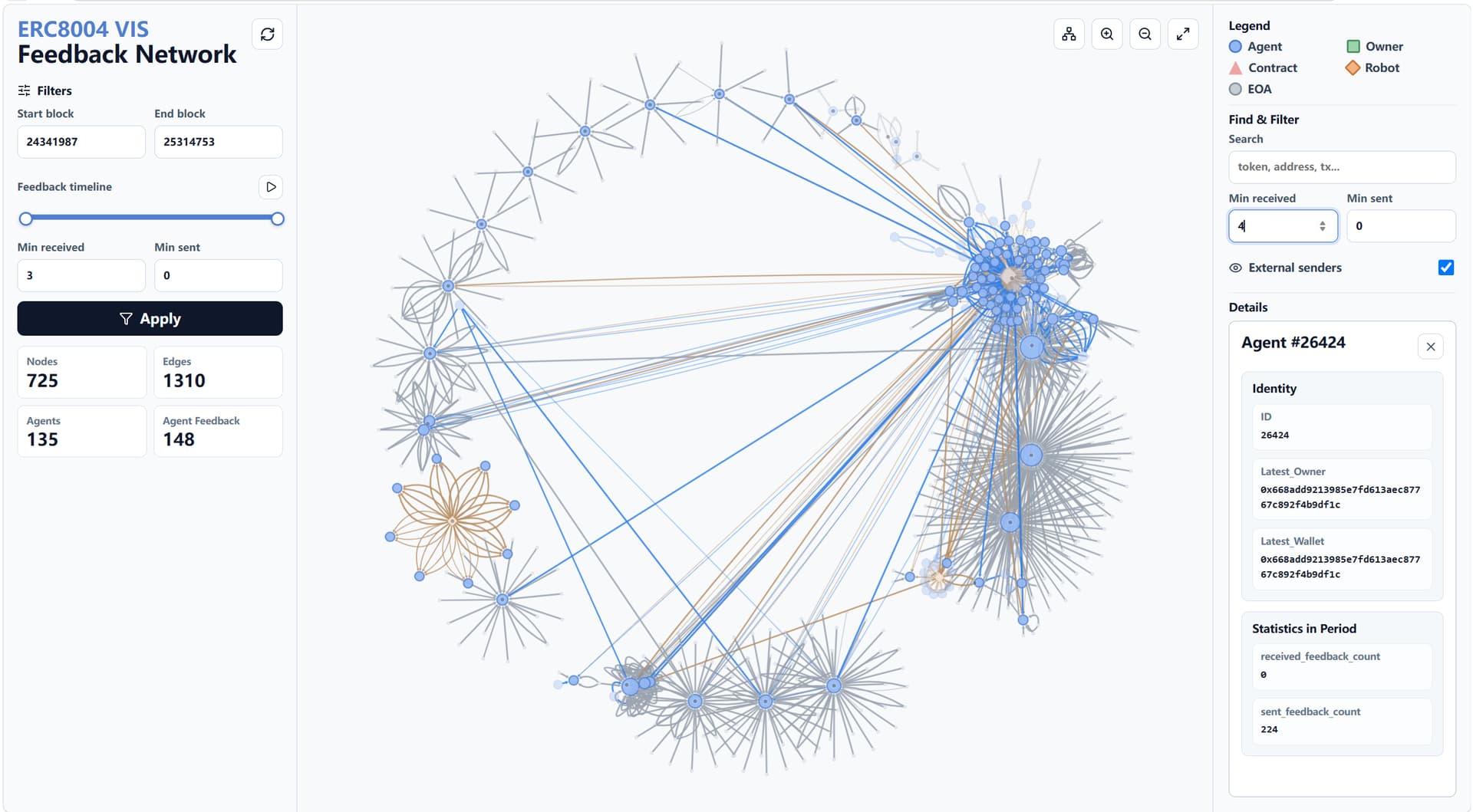
We construct a directed feedback network from ERC-8004 reputation interactions.
Key findings:
- feedback is dominated by EOAs
- agent-to-agent interactions are rare
- network is sparse and weakly clustered
Full visualization is available in the GitHub repository. It should be a useful tool for reflecting the current ecosystem structure.
3. Zombie agents & batch registration
We analyze the structure of the registration layer and find strong skewness in both ownership and activity.
(a) Owner concentration distribution
| Bucket | Agent count | Share |
|---|---|---|
| 1 | 7,367 | 21.45% |
| 2–10 | 6,111 | 17.80% |
| 11–50 | 2,716 | 7.91% |
| 51–250 | 4,529 | 13.19% |
| 251–1250 | 11,035 | 32.14% |
| >1250 | 2,580 | 7.51% |
(b) Client count distribution
| Bucket | Agent count | Share |
|---|---|---|
| 0 | 32,686 | 95.19% |
| 1 | 1,473 | 4.29% |
| 2 | 75 | 0.22% |
| 3 | 60 | 0.17% |
| 4 | 9 | 0.03% |
| >4 | 35 | 0.10% |
(c) Zombie vs batch registration
| Batch-registered | Not batch-registered | Total | |
|---|---|---|---|
| Zombie agents | 20,291 | 12,574 | 32,865 |
| Non-zombie agents | 387 | 767 | 1,154 |
| Total | 20,678 | 13,341 | 34,019 |
We observe:
- ~95% of agents are inactive (zombie)
- batch registration is highly concentrated
- zombie status dominates both groups
While statistically significant associations exist, the more important signal is structural: early ERC-8004 usage is heavily decoupled from registration activity
Interpretation
ERC-8004 currently appears to function more as an on-chain identity and reputation infrastructure rather than a mature agent-to-agent trust network.
Across the empirical analysis, three consistent patterns emerge:
-
On-chain activity is positively associated with adjusted reputation, suggesting that observable blockchain behavior partially reflects underlying trust-related dynamics, even though most agent services occur off-chain.
-
Reputation feedback is still primarily driven by external accounts (EOAs), with limited evidence of systematic agent-to-agent evaluation.
-
The registration layer is highly skewed, with a large fraction of inactive or minimally used “zombie” agents, alongside evidence of concentrated batch registration behavior.
Taken together, these findings suggest that while ERC-8004 successfully makes identity, reputation, and ecosystem activity observable on-chain, it has not yet developed into a self-sustaining agent-native trust network.
Open question
I would really appreciate feedback from people more familiar with this ecosystem.
I’m not fully sure whether my approach is helpful for understanding the ecosystem, and I’m trying to find if there are better ways.
- What aspects of ERC-8004 or similar systems do people here actually care about or find important?
- Is there anything fundamentally wrong or misleading in the way I’m measuring activity, reputation, or network structure?
- Are there better ways I should be thinking about agent-to-agent interactions in this setting?
Any feedback, critique, or suggestions for improvement would be really appreciated.
Code & data
If you are interested in my detailed analysis, please see the GitHub repository.
Trusted Network Visualization
trust_network.pdf (221.0 KB)