Effects of Latency Reduction on Staking Revenue
Cross posted on Optimizing an $100B Market: Effects of Latency Reduction on ETH Staking Revenue
Authors: @MoritzGrundei, @ssh-econ, @sajz and @MedardDuffy.
The authors would like to thank @cortze and @yiannisbot from the ProbeLab team for their comments and discussions. We also want to thank the ethPandaOps team for access and support in using the Xatu databases, as well as the Xatu contributors.
TL;DR
-
Network latency directly impacts validator APR: Faster block propagation increases usable slot time, allowing validators to capture higher MEV bids and improve attestation rewards.
-
Historical analysis shows significant revenue potential: Reducing propagation latency by 50-150ms could translate to approximately 0.66-1.97% higher APR for major validator operators.
-
MEV bid selection is the primary value driver: Additional slot time enables validators to observe and select higher-value bids, with 50-150ms improvements yielding 13-16% average bid value uplift and 150-190 ETH in additional weekly value.
-
Head vote accuracy improves with lower latency: Reducing network latency by 50-150ms can increase network-wide head vote accuracy from 98.6% to 98.8-99.1%, adding 1000-2000 ETH in annual network revenue.
-
Latency optimization addresses more than half the remaining performance gap: With theoretical maximum head vote accuracy around 99.4% (limited by missed slots), latency improvements can eliminate over 50% of the gap between current and optimal performance.
-
Competitive advantage for validators: As staking becomes more competitive, operators who consistently reduce propagation delays will attract more stake while contributing to overall network efficiency.
Introduction
Ethereum validators earn rewards by participating in the network’s consensus process. These rewards are shaped by multiple factors, including validator performance, current network conditions, and, critically, the efficiency with which data (e.g., blocks, attestations) propagates through the network.
In this article, we quantify the impact of network latency, and more specifically block propagation latency, on key performance indicators that directly determine a validator’s annual percentage rate (APR). Our central question is: to what extent do improvements in network latency translate into measurable APR gains for validator operators?
To answer this, we analyze how validators have historically utilized their available slot time. Over time, validators have been able to extract additional value by using proposer slots more effectively. We use this relationship to estimate how increased usable slot time, enabled by lower latency, can improve validator performance and rewards.
We further examine the role of latency in the most time-sensitive component of consensus: attestations, and in particular head votes. By analyzing how faster block propagation improves the timeliness and accuracy of head votes, we assess how latency reductions contribute to consensus quality and, ultimately, validator rewards at the network level.
Finally, we ground these effects economically by analyzing MEV bid dynamics, showing how additional usable slot time can translate into higher-value block proposals.
Throughout this document, APR is evaluated at the level of a node operator managing a fleet of validators, reflecting the aggregated impact of latency improvements across many validators rather than isolated instances.
Validator Rewards
Validator revenue on Ethereum comes from two main sources:
Consensus Layer (CL) rewards
These rewards are paid by the protocol and primarily come from:
-
Attestations: validators vote on blocks proposed by other validators.
-
Block proposals: validators occasionally propose blocks themselves.
To maximize attestation rewards, validators should align their attestations with the chain that ultimately receives the majority of voting stake (approximately 66% of the voting ETH). Achieving this typically requires observing block proposals with low latency, since earlier block reception increases the probability of attesting to the block that will become the canonical head.
Execution Layer (EL) rewards
Execution-layer rewards consist primarily of transaction fees paid by Ethereum users and MEV captured during block construction. In practice, more than 90% (91.6% at the time of writing [9]) of validators rely on external MEV builders (via PBS / MEV-Boost) to maximize execution-layer rewards rather than building blocks locally. For block proposers, these rewards increase the longer they can wait before selecting the payload while still proposing safely on time. Waiting longer allows proposers to observe more bids from builders and select a higher-value block. Together, consensus-layer and execution-layer rewards determine the validator’s total APR [2]:
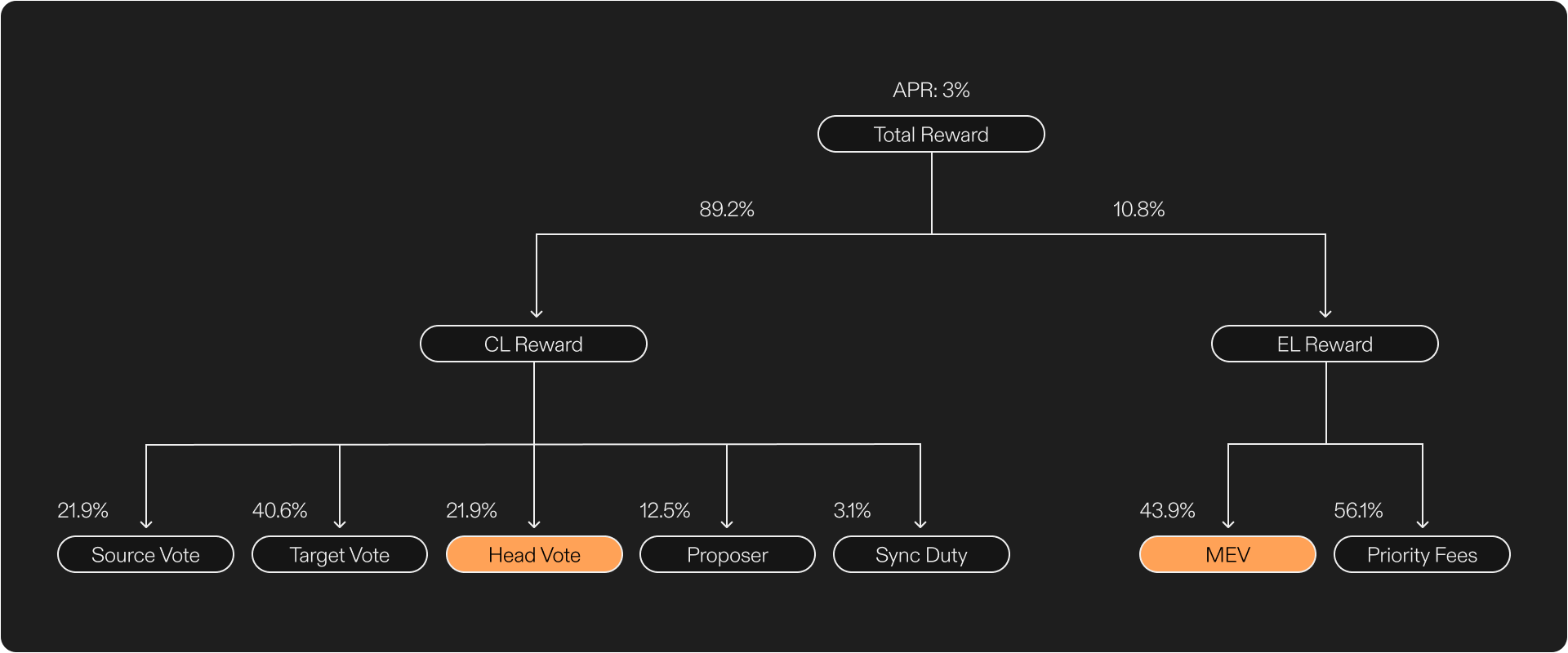
Figure 1: Example of distribution of validator APR across the network. Red boxes highlight reward components that are particularly sensitive to network latency conditions (note that the CL reward split is based on protocol weights, while the MEV, priority fee, and EL/CL split is based on empirical data from Rated).
Phenomenological Usage of Proposer Slot Time
When a validator proposes a block, it must ensure that the block propagates through the network quickly enough for other validators to observe and attest to it. If propagation is too slow, the block may collect fewer attestations or, in the worst case, fail to be included in time, directly reducing rewards. A useful way to study this dynamic is to analyze how validators have historically behaved under different propagation conditions. In practice, validators implicitly balance two competing objectives:
- Propose early, maximizing the time available for propagation and attestations
- Propose late, maximizing revenue opportunities at the proposer, in particular by increasing the chance of seeing higher builder bids
This tradeoff is governed by how long it takes for a block to reach a sufficiently large portion of the network. Determining the optimal balance between proposing early and proposing late is commonly referred to as a timing game [1]. To quantify this constraint, we use the p80 propagation latency, defined as the time required for a block to reach 80% of nodes which we will denote as Q(80\%).
We use P80 propagation as a conservative but practical proxy for the point at which a block has reached enough of the Ethereum network to support at least 40% stake participation before the 4-second deadline where validators need to broadcast their attestations. This 40% of stake should be enough to prevent a further reorg in most cases [10]. The exact relationship between node reach and stake reach is not directly observable, because stake is not evenly distributed across nodes: a single beacon node may serve many validators, and propagation across the network is uneven.
Historical Interpretation: Latency as a Constraint on Slot Usage
From a historical perspective, propagation latency acts as an uncontrollable source of uncertainty that validators must account for when deciding when to propose a block.
- Under higher-latency conditions, validators are forced to propose earlier in the slot to leave sufficient time for propagation.
- Under lower-latency conditions, validators can afford to wait longer, effectively increasing the amount of usable slot time.
Empirical observations show that some validators consistently adapt their behavior within these constraints, tending to propose as late as possible while still remaining within a safe propagation window.
Quantifying Additional Usable Slot Time
To measure how improvements in networking shift this constraint, we compare the propagation performance of the standard Ethereum networking stack (libp2p) with an optimized alternative (mump2p). While libp2p relies on uncoded gossip (gossipsub), mump2p employs erasure-coded gossip with random linear network coding (RLNC). This approach enables more efficient data dissemination, improving both latency and throughput by reducing redundancy and making better use of available network paths.
We define the mump2p advantage as:
This difference directly corresponds to additional usable slot time: a validator can delay its proposal until t + \Delta_{\text{mump2p}} instead of t while still achieving the same end to end p80 latency.
Benefit Through Additional Slot Time Usage
Building on this mechanism, we model how improvements in block propagation translate into validator revenue from a historical perspective.
For a given target p80 latency, we construct a counterfactual: a validator using an improved propagation protocol can achieve the same effective network reach while proposing the block \Delta_{\text{mump2p}} later within the slot. This lets us reinterpret latency improvements as additional usable slot time. Specifically, a validator with improved propagation can attain at time t + \Delta_{\text{mump2p}} the same safety profile that previously required proposing at time t. Using historical data, this implies that the validator can earn the APR historically associated with proposing at that later effective time. In other words, lower latency shifts the validator along the observed relationship between propagation latency and APR, allowing it to capture the rewards associated with greater usable slot time. We attribute this APR shift primarily to end-to-end latency, because it is the main determinant of whether a block is accepted in time and therefore of the validator’s risk-reward tradeoff when choosing when to propose.
Figure 2 illustrates this relationship: each point represents a validator operator, with observed APR plotted against effective block propagation latency ([3,5]). For one selected validator, we additionally sketch the counterfactual APR improvement attainable through reduced p80 latency.
Importantly, the magnitude of this uplift depends on how efficiently a validator is already utilizing its available slot time. Validators that historically prioritized safety by proposing earlier in the slot tend to operate in regions where the empirical APR-latency relationship is steeper. As a result, they exhibit larger potential APR increases for a given reduction in latency. By contrast, validators that already operate close to the optimal timing boundary and efficiently utilize slot time see more limited gains, since they lie in flatter regions of the curve. While additional usable slot time improves APR for all validators, the marginal benefit of latency improvements is highest for those operating under stricter safety and reliability constraints.
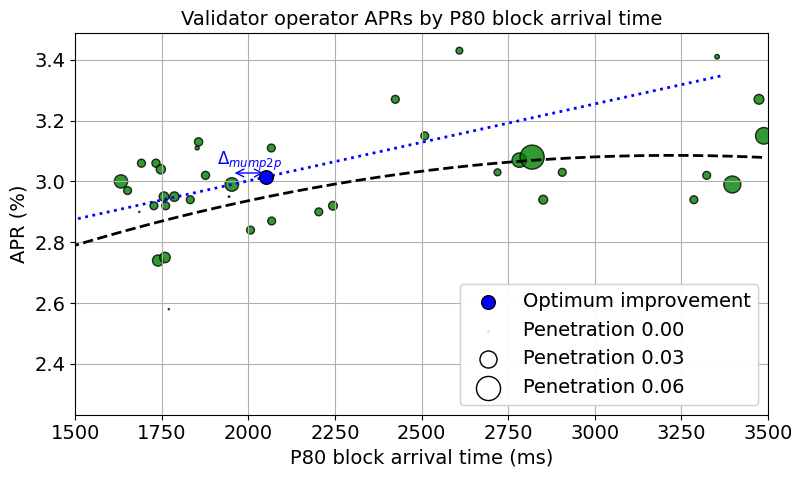
Figure 2. Relationship between validator APR and block propagation latency*.** Each point represents a node operator. For one example operator, the tangent along which the expected uplift is calculated is shown.*
For the 36% of total network stake represented by the largest validator operators analyzed in this study, a historical analysis suggests the following relationship between additional usable slot time and APR uplift:
| Additional Slot Time | APR uplift |
|---|---|
| +50ms | +0.66% APR |
| +100ms | +1.31% APR |
| +150ms | +1.97% APR |
Each additional 50ms of usable slot time corresponds approximately to a 0.6-0.7% increase in average validator revenue, with gains scaling approximately linearly over this range. In other words, even relatively small improvements in propagation latency translate into measurable, percentage-level increases in APR.
MEV Bid Selection as the Primary Driver of Slot Time Value
One of the primary mechanisms through which validators convert additional slot time into value is MEV bid selection. As builders are given more time within a slot, they can assemble more profitable blocks and are therefore willing to submit higher bids to the proposer. This creates a direct link between available slot time and execution-layer rewards: the additional time \Delta_{\text{mump2p}} can be monetized by selecting a higher-value bid later in the slot. The latency advantage thus allows validators to remain in the bidding process longer before committing to a block, increasing the likelihood of observing and capturing higher-value bids that would otherwise arrive too late.
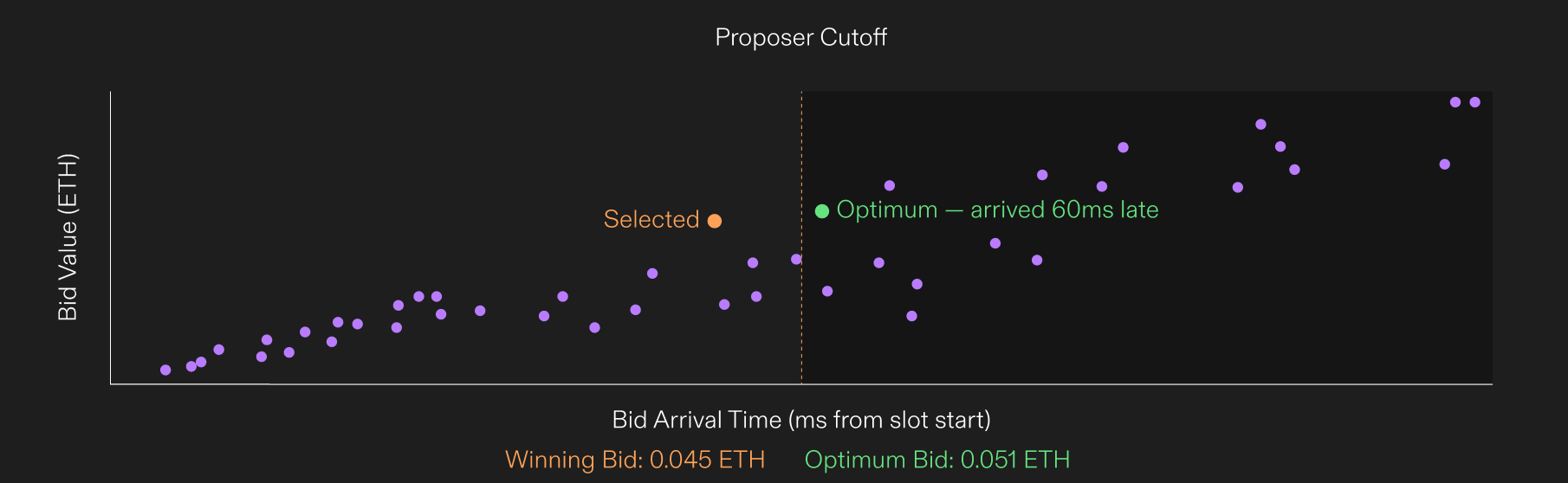
Figure 3. Example bid value trace for a single slot, showing the bid selected by the validator and a higher (missed) bid that arrived just 60 ms after the proposer’s cutoff.
Empirical Evaluation
To better understand this effect, we recorded bid traces from major MEV relays over a week period (03/12-03/19/2026) and evaluated the relative gain from selecting a bid slightly later in the slot, corresponding to the additional time enabled by improved propagation.

Figure 4a. Cumulative maximum MEV bid value accrued over one week for various amounts of additional usable slot time, alongside accepted bid values (baseline).
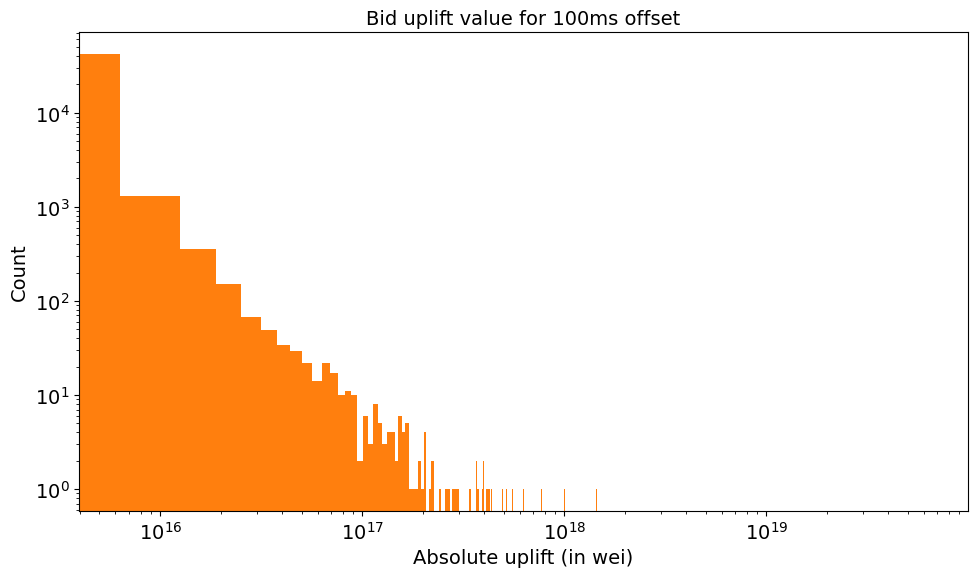
Figure 4b. Distribution of the observed absolute uplift in MEV bid value at a 100ms additional-slot-time offset across major relays (log-log scale).
What This Means in Practice
The results show that even modest increases in usable slot time can translate into meaningful improvements in bid value:
- An additional 50-150ms of slot time leads to an average relative bid value uplift of approximately 13%-16%.
- In 20%-30% of cases, the uplift exceeds 30% for the same 50-150ms increase in slot time.
- Over the course of a week, these additional bidding opportunities accumulate to roughly 150-190 ETH in extra revenue.
- In some instances, significantly larger gains are observed, with uplifts reaching up to 20x, highlighting the highly dynamic and heavy-tailed nature of the MEV market.
Rather than being a purely theoretical advantage, this suggests that improved latency can consistently translate into higher execution-layer rewards without degrading consensus-layer performance, simply by giving validators a slightly longer window to observe and select from the evolving bid landscape. Importantly, this does not entail increased risk. Validators can continue operating within their established safety margins while benefiting from the additional flexibility that faster propagation provides. In this sense, optimizing for lower latency is about removing an existing constraint and thereby enabling validators to capture revenue opportunities that are already present in the network.
Impact of Latency on Head Vote Accuracy
Latency not only affects validator performance in the proposer role, but also has a direct impact when operating as an attester. To produce a valid attestation, a validator must receive the current head in time. If propagation is delayed, it may either attest to an incorrect head or produce a correct attestation that arrives too late to be included in the next slot. Since head votes are only rewarded when they are both correct and included promptly, latency directly affects attestation rewards.
Reward Structure
Over a given period, head vote rewards can be simplified to:
r_{\text{head}} \sim a_{\text{val}} \times a_{\text{net}}
where:
- a_{\text{val}} is the validator’s individual head vote accuracy, that is, the fraction of correct and timely head votes out of assigned attestation duties.
- a_{\text{net}} is the network-wide head vote accuracy, reflecting overall attestation conditions.
This approximation can be thought of as a lower bound as it ignores the (presumably positive) correlation between a_{\text{val}} and a_{\text{net}}, as well as with other CL reward components [6].
Sources of Performance Degradation
This formulation shows that rewards are reduced through two channels:
- Individual performance (a_{\text{val}}): degradation due to late or incorrect attestations
- Network-wide conditions (a_{\text{net}}): degraded head vote accuracy across the network
Empirical Evaluation
We analyze data from a one-month period (February 10 - March 10, 2026) to quantify the impact of network latency on head vote accuracy [3,4].
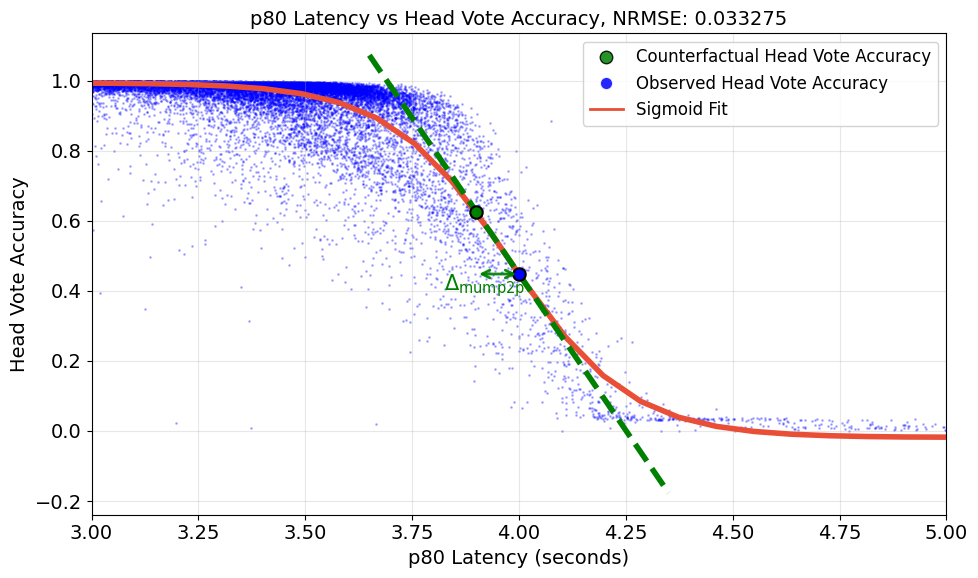
Figure 5a. Relationship between average validator head vote accuracy and p80 block arrival latency. Each point represents the head vote accuracy observed in a slot over one month of data. For an example slot, the tangent indicates the expected improvement in head vote accuracy resulting from a reduction in p80 propagation latency, \Delta_{\text{mump2p}}
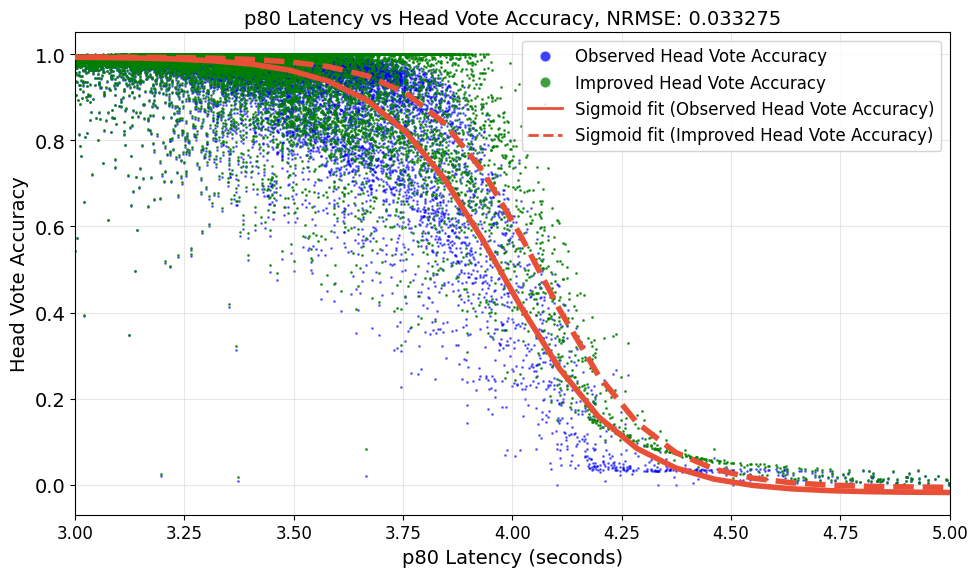
Figure 5b. Head vote accuracy declines with increasing p80 block arrival latency, with a sharp drop near the ~4s threshold; a sigmoid fit captures this relationship and shows how latency improvements translate into higher accuracy.
We observe that network-wide head vote accuracy declines as block arrival latency increases. Notably, we observe a sharp drop once p80 latency approaches the approximately 4s deadline, beyond which validators increasingly fall back to attesting to the previous block. To capture this relationship, we fit a sigmoid curve to the data. This provides a simple model of how improvements in network-wide p80 latency translate into corresponding increases in head vote accuracy, which can be interpreted as a local shift along the curve.
Based on this model, we can estimate the per-slot improvement in head vote accuracy as a function of the baseline libp2p latency in that slot. This is shown in the figure below, where each curve represents the expected gain in accuracy for a given initial p80 block arrival latency.
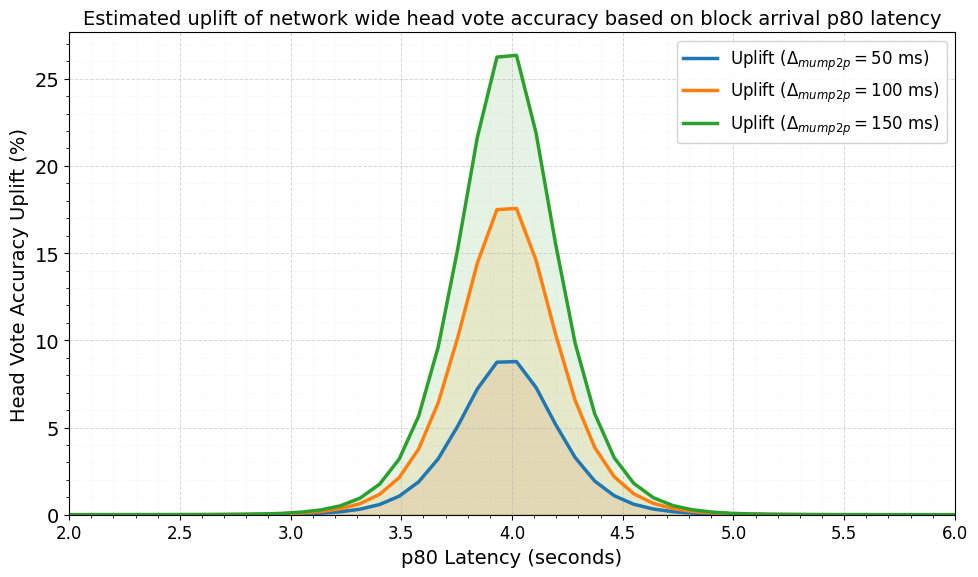
Figure 6. Expected improvement in network-level head vote accuracy resulting from propagation improvements \Delta_{\text{mump2p}}. Each line represents the estimated improvement in head vote accuracy for slots with a given p80 block arrival latency.
Network Level Benefits
We observe that network-wide head vote accuracy is currently around 98.6% (as of March 10, 2026). Our analysis suggests that improving network latency by 50-150ms increases average head vote accuracy to approximately 98.8%-99.1%, translating into an additional 0.1-0.2% of validator revenue (equivalent to 1000-2000 ETH additional annual revenue) when averaged across the network.
Importantly, this represents a substantial portion of the remaining improvement potential. The theoretical upper bound is around 99.4%, constrained by the roughly 0.6% of missed slots, which inherently result in zero head vote accuracy for the previous slot regardless of validator or network performance (inclusion delay is always larger than 1). As a result, latency improvements alone can eliminate more than half of the gap between current performance and the theoretical optimum under current proposer behavior.
Conclusion
We have analyzed the role of network latency as a driver of validator performance, directly affecting both validator APR and validator KPIs.
Faster block dissemination increases the amount of usable slot time, allowing validators to make better economic decisions, most notably by selecting higher-value MEV bids. Historical data shows that validators already optimize within these constraints, and that these constraints can be further relaxed by reducing network latency. Based on our analysis, improvements of 50-150ms could have translated into up to approximately 2% higher annual revenue, without compromising consensus-layer performance or safety margins.
On the consensus side, reduced latency also improves head vote accuracy, addressing one of the key components of validator rewards. Here, we find that latency improvements alone can eliminate more than half of the gap between current performance and the protocol’s theoretical optimum.
Looking Ahead
As staking becomes increasingly competitive, latency optimization will play a central role in validator differentiation. Operators that can consistently reduce propagation delays will not only improve their own performance and thereby attract more stake, but also contribute to overall network efficiency and stability. With ongoing developments such as ethp2p, the Ethereum ecosystem is already moving toward more efficient networking primitives. In this context, solutions that push latency closer to its theoretical limits become increasingly relevant.
While our analysis focuses on validators in proposer and attester roles, block builders are likewise highly sensitive to latency. For builders, lower end-to-end latency effectively increases the usable portion of the slot: a block can be finalized and delivered later while maintaining the same probability of timely inclusion. This additional usable time allows builders to search longer for profitable orderings and bundles, improving the expected value of the blocks they construct. Faster block propagation thereby increasing the realizable value of the builder’s output. To the extent that the builder’s share of the resulting surplus remains stable, this implies higher expected builder revenue.
Resources
[1] Wahrstätter, Anton, et al. “Time to bribe: Measuring block construction market.” https://arxiv.org/pdf/2305.16468.
[2] Rated Network. “APR.” Rated Docs. Accessed March 10, 2026. APR% - Rated | docs
[3] EthPandaOps. “Xatu CBT Schema.” https://ethpandaops.io/data/xatu/schema/cbt/#fct_block_blob_first_seen_by_node, accessed February 23, 2026.
[4] EthPandaOps. “Xatu CBT Schema.” https://ethpandaops.io/data/xatu/schema/cbt/#fct_attestation_correctness_head, accessed February 23, 2026.
[5] Rated. “Get APR.” Rated API Documentation. Validators APR - Rated | docs, accessed February 23, 2026.
[6] Ethereum. Proof-of-stake rewards and penalties. Proof-of-stake rewards and penalties | ethereum.org, accessed March 26, 2026.
[7] Deb, Supratim, Muriel Médard, and Clifford Choute. “Algebraic gossip: A network coding approach to optimal multiple rumor mongering.” IEEE Transactions on Information Theory 52.6 (2006): 2486-2507.
[8] Ho, Tracey, et al. “A random linear network coding approach to multicast.” IEEE Transactions on Information theory 52.10 (2006): 4413-4430.
[9] EthP2P Observatory. “MEV Pipeline.” MEV pipeline | Eth P2P Observatory, accessed March 27, 2026.
[10] Schwarz-Schilling, Caspar, and Michael Neuder. “Timing Games: Implications and Possible Mitigations.” Ethereum Research, December 5, 2023. Timing Games: Implications and Possible Mitigations, accessed March 27, 2026.