by Jihoon Song
Introduction
This article explores how FOCIL could evolve as Ethereum adopts post-quantum cryptography. It examines how the PQ transition could affect the roles of includers, builders and attesters.
IL Committee Selection
IL committee are the first 16 members of beacon committees. FOCIL uses the same rule under PQ Gasper. The design space is still open for PQ Decoupled Consensus. One option is to draw the IL committee from the Available Chain committee. Either way, committee selection should be straightforward.
IL Building
Before the full PQ transition and without signature or proof aggregation, IL transactions can use different signature schemes, including leanSPHINCS. With the 8 KiB limit on transaction bytes per IL, an IL can include one transaction carrying a large hash-based signature, such as a leanSPHINCS signature (7,740 B). ILs can therefore support PQ transactions before the transition is complete. The IL building mechanism itself doesn’t change.
With aggregation, the EL periodically combines mempool wrappers into a recursive STARK proof. When the CL calls getInclusionList, the EL selects transactions from its mempool within the 8 KiB transaction-byte limit. It can start with an existing recursive proof and select a subset of the transactions it covers, or select valid transactions first and generate a proof for their dependencies. When the EL starts with an existing proof, the IL carries the proof and its full dependency list, which can include more dependencies than the IL transactions declare. This avoids generating a new proof for the IL, allowing the EL to respond faster. Either way, the IL can also include transactions without dependencies.
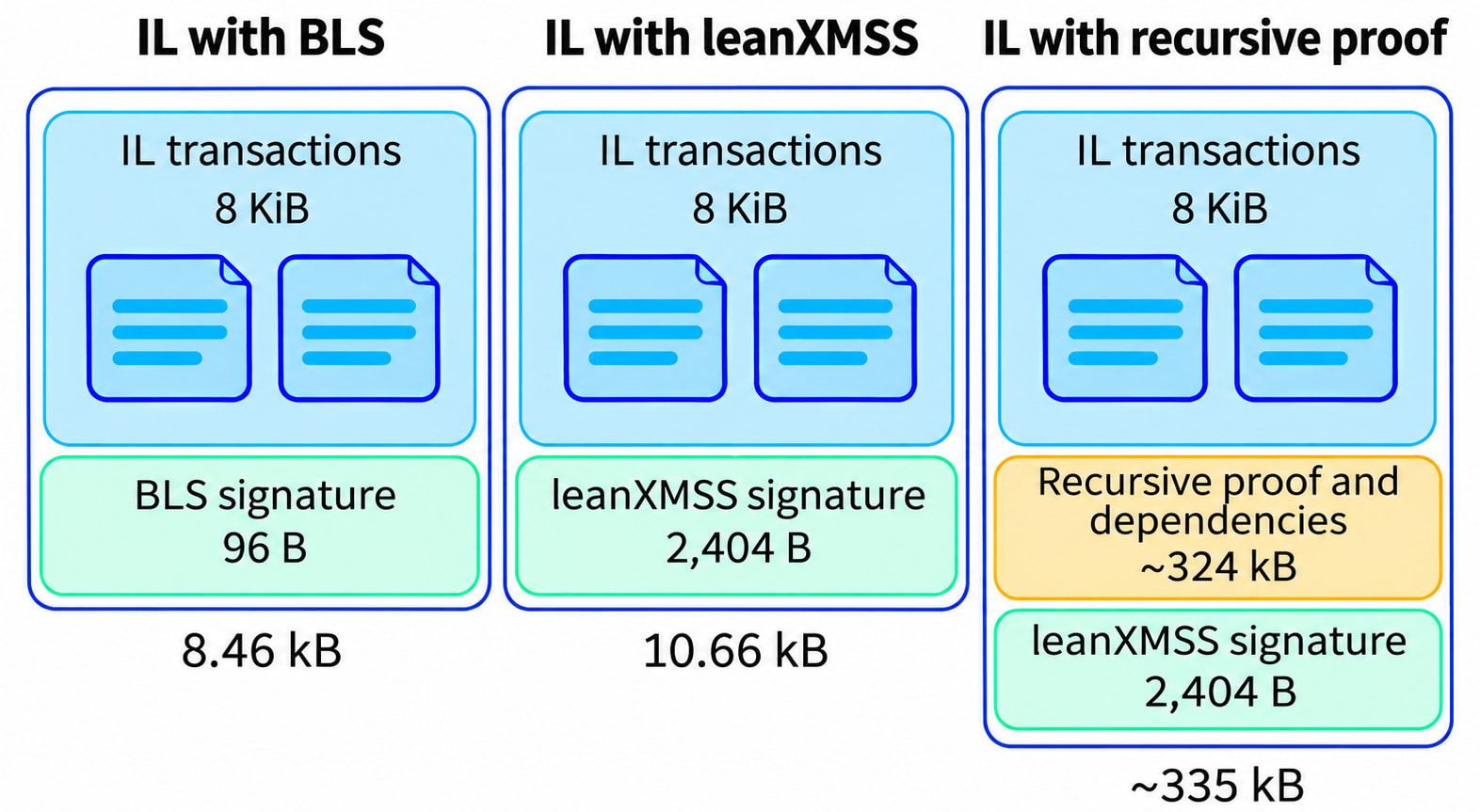
The performance of periodic mempool aggregation and recursive proving for IL transactions should be benchmarked. Alternatively, some includers can choose to produce ILs with raw signatures. In this case, the space a recursive proof would have used can be allocated for more IL transactions, without changing the max IL size. For example, freeing 300 kB of space would allow around 38 transactions carrying a leanSPHINCS signature (7,740 B) each, depending on how large the transactions are.
IL Propagation
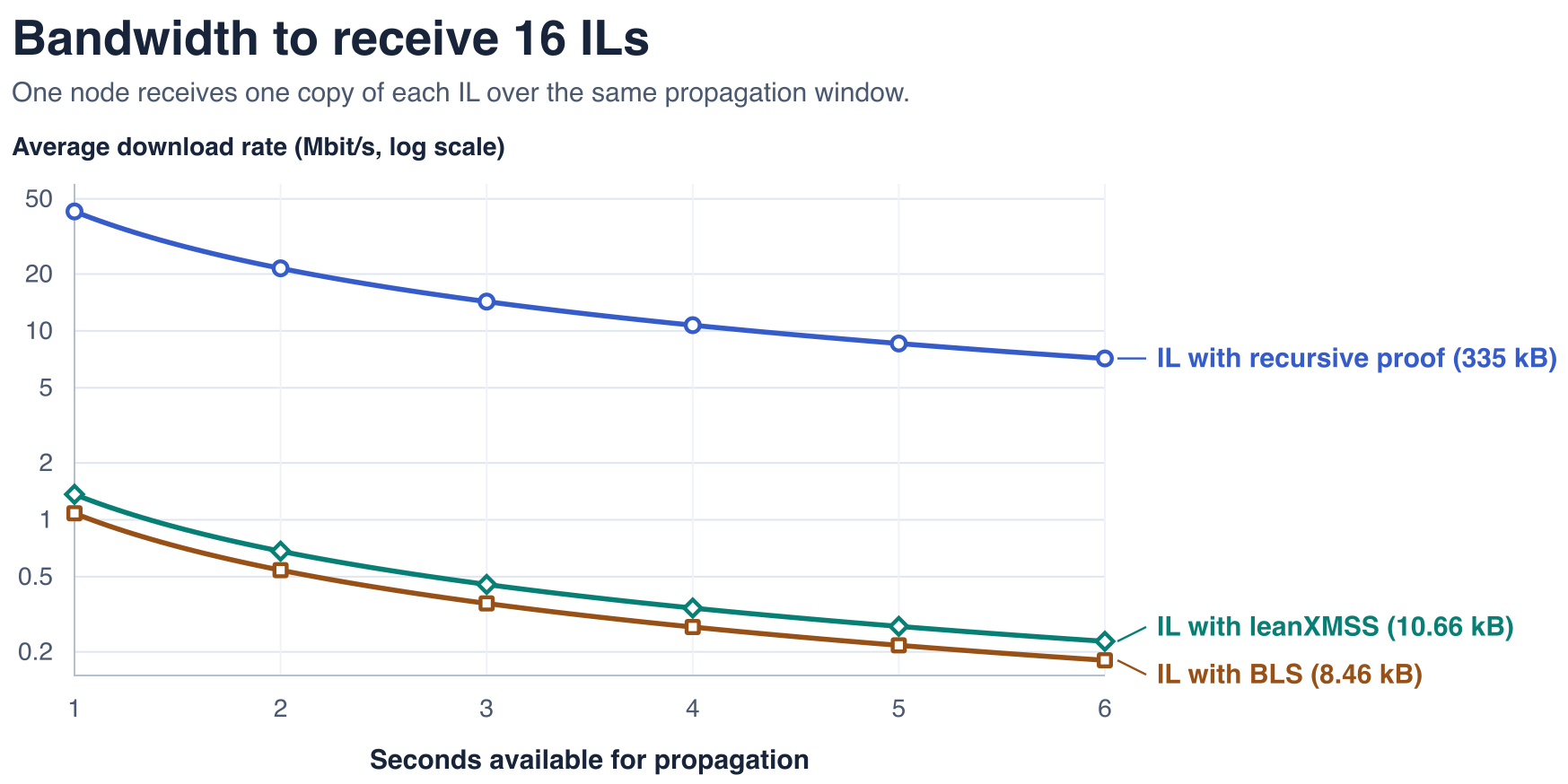
The main bandwidth concern for PQ FOCIL is the increased IL size. The average download rate a node needs to receive all 16 ILs depends on when includers broadcast them. Includers build ILs after receiving and processing a payload for the current slot, or based on their local head payload.
With the IL deadline at 9 seconds, the longest propagation window is 6 seconds if includers begin broadcasting at the attestation deadline of 3 seconds. This is when includers have already received and processed the payload and built their ILs, then broadcast them after confirming their local head with attestations for the current slot. However, in practice, includers will need time to receive and process the payload, or they may need to wait before building against their local head if the payload hasn’t arrived. Thus, we can expect includers to broadcast their ILs 2 to 3 seconds before the deadline.
| Propagation window | IL with BLS | IL with leanXMSS | IL with recursive proof |
|---|---|---|---|
| 1s | 1.08 Mbit/s | 1.36 Mbit/s | 42.88 Mbit/s |
| 2s | 0.54 Mbit/s | 0.68 Mbit/s | 21.44 Mbit/s |
| 3s | 0.36 Mbit/s | 0.45 Mbit/s | 14.29 Mbit/s |
Figure 3. Average download rates for 16 ILs, excerpted from Figure 2.
Let’s compare these download rates with those for attestation aggregates. With 64 committees per slot and a target of 16 aggregators per committee, the nominal count is 1,024 aggregates per slot. In the three months of mainnet data shown in Figure 4, the median was 826 and the average was 826.13 aggregates per slot.
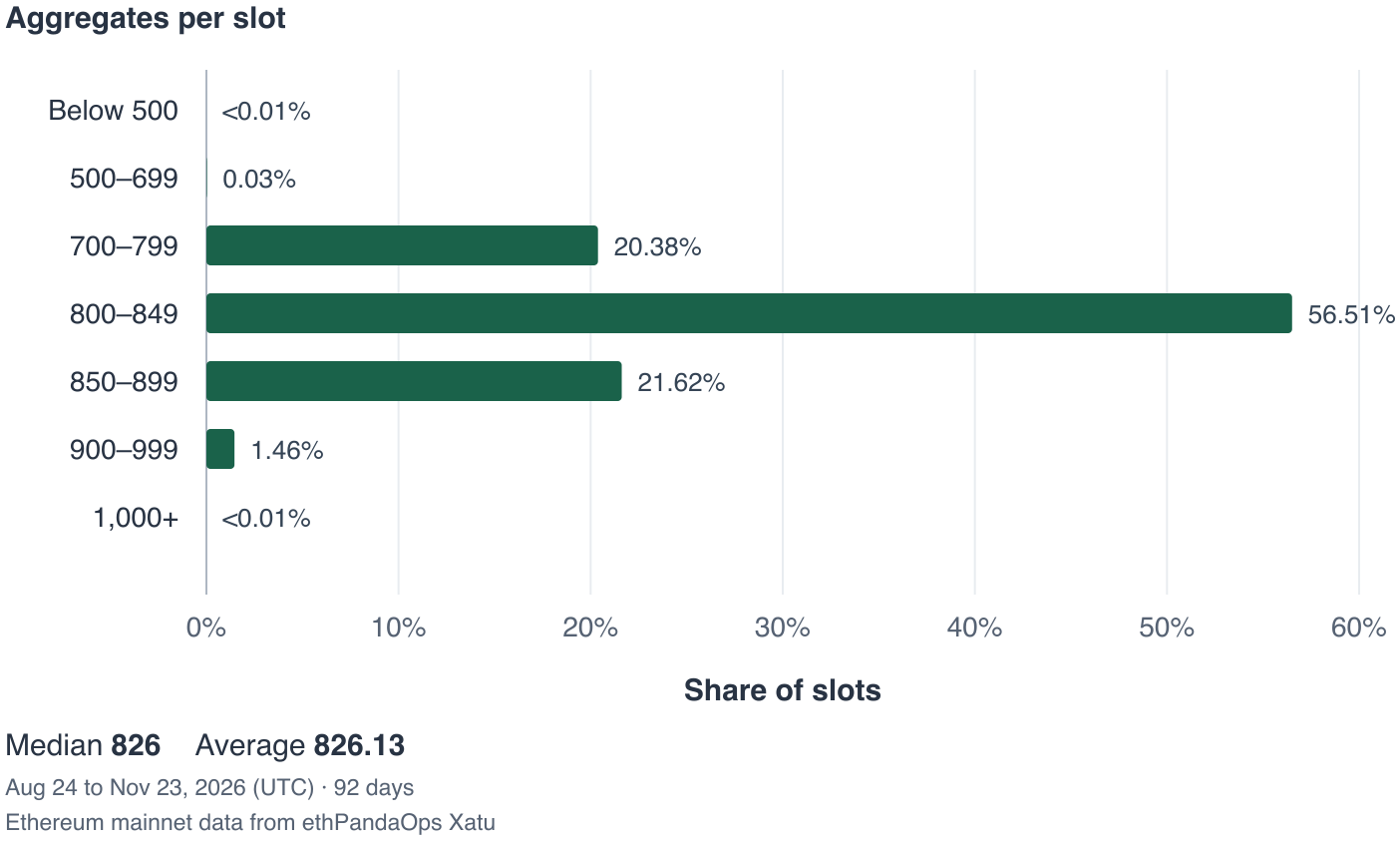
An attestation aggregate is 506 B, so 826 aggregates total about 418 kB per slot. The propagation window for aggregates is 4 seconds in Fulu and 6 seconds in Gloas. The table below shows the download rate averaged over each window.
| Fork | Propagation window | Attestation aggregate |
|---|---|---|
| Fulu | 4s | 0.84 Mbit/s |
| Gloas | 6s | 0.56 Mbit/s |
Figure 5. Average download rates for 826 attestation aggregates.
An execution payload is another point of comparison. The 200M figures are linearly extrapolated from the 60M figures. Without aggregation, the post-PQ estimates include one raw leanSPHINCS signature and public key per transaction and account for the higher calldata gas floor when estimating how many transactions fit. With aggregation, the estimates account for the size and gas cost of one dependency frame per transaction, then add one 300 kB recursive proof per block with dependencies.
| Transaction signatures | Gas limit | Median | Average |
|---|---|---|---|
| ECDSA | 60M | 159.9 kB | 171.1 kB |
| ECDSA | 200M | 530.1 kB | 567.5 kB |
| leanSPHINCS without aggregation | 60M | 420.4 kB | 432.5 kB |
| leanSPHINCS without aggregation | 200M | 1,398.3 kB | 1,438.7 kB |
| leanSPHINCS with aggregation | 60M | 434.9 kB | 443.6 kB |
| leanSPHINCS with aggregation | 200M | 746.8 kB | 775.7 kB |
Figure 6. Different execution payload sizes.
The propagation window for an execution payload is 3 seconds in Gloas. The table below gives the average download rates for receiving one execution payload over the window.
| Transaction signatures | Gas limit | Propagation window | Median | Average |
|---|---|---|---|---|
| ECDSA | 60M | 3s | 0.43 Mbit/s | 0.46 Mbit/s |
| ECDSA | 200M | 3s | 1.41 Mbit/s | 1.51 Mbit/s |
| leanSPHINCS without aggregation | 60M | 3s | 1.12 Mbit/s | 1.15 Mbit/s |
| leanSPHINCS without aggregation | 200M | 3s | 3.73 Mbit/s | 3.84 Mbit/s |
| leanSPHINCS with aggregation | 60M | 3s | 1.16 Mbit/s | 1.18 Mbit/s |
| leanSPHINCS with aggregation | 200M | 3s | 1.99 Mbit/s | 2.07 Mbit/s |
Figure 7. Average download rates for different execution payload sizes.
With the 2-second IL window, 16 ILs with BLS require 0.54 Mbit/s, roughly the same as Gloas’s 0.56 Mbit/s for attestation aggregates over 6 seconds. 16 ILs with leanXMSS require 0.68 Mbit/s, below Fulu’s 0.84 Mbit/s for attestation aggregates. Downloading an execution payload with the 200M gas limit in 3 seconds is expected to require more bandwidth than downloading 16 ILs with either BLS or leanXMSS in 1 second.
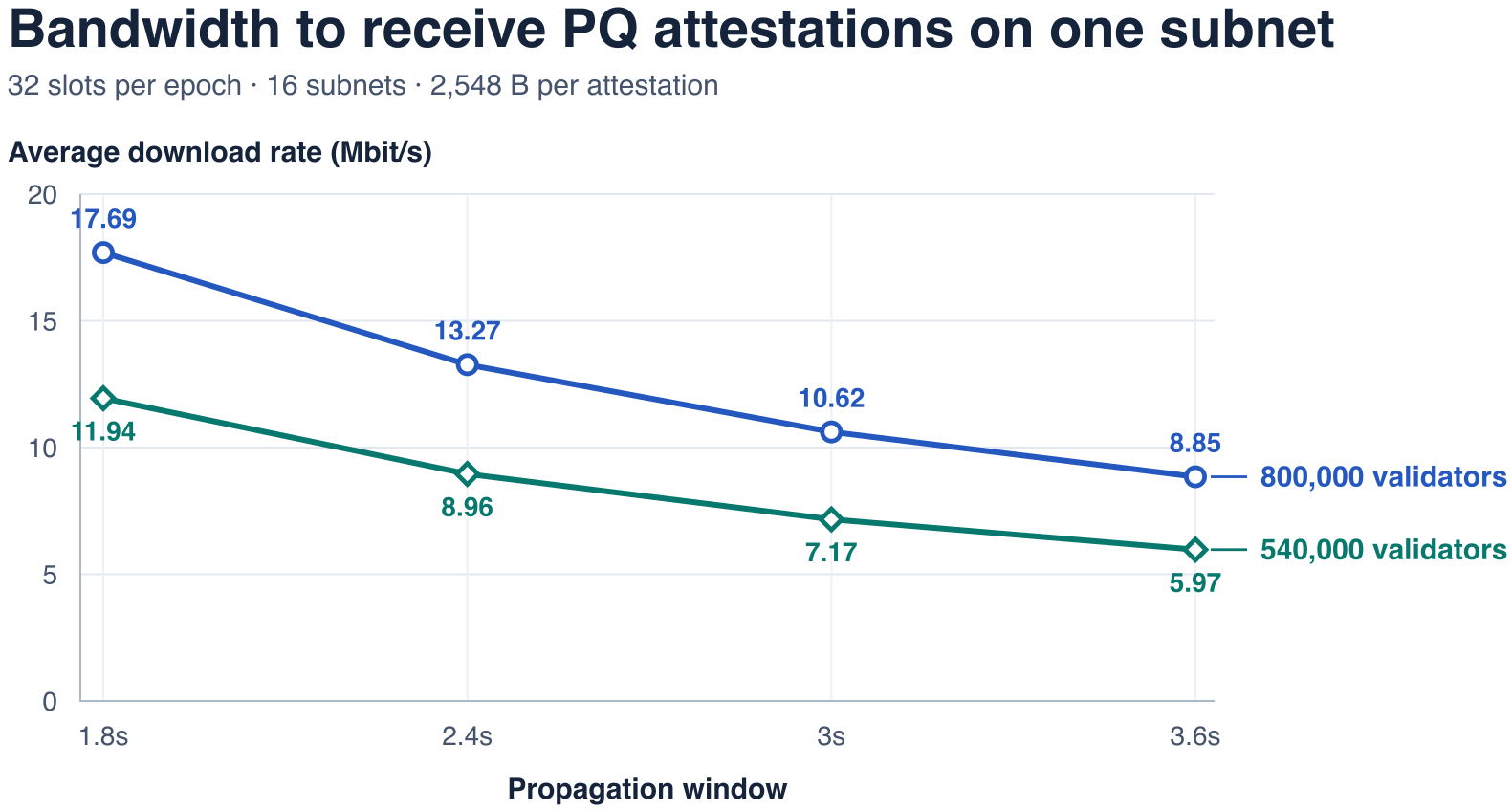
Downloading 16 ILs with BLS along with attestation aggregates in Gloas requires an estimated 1.10 Mbit/s with the 2-second IL window and 1.64 Mbit/s with the 1-second window. Downloading an execution payload with the 200M gas limit in 3 seconds is estimated to require 1.51 Mbit/s. Payload propagation is expected between 3 and 6 seconds into the slot, while aggregates and ILs propagation can overlap between 6 and 9 seconds. The combined rate for ILs and aggregates is comparable to the payload rate, exceeding it by only 0.13 Mbit/s in the 1-second case.
One thing to note is that ILs with leanXMSS will propagate along with PQ attestations and their aggregates. PQ attestation aggregation is still an active area of research, and the current draft suggests that propagating PQ attestations and aggregates require substantially more bandwidth than it does under BLS. 16 ILs with leanXMSS could work in isolation, depending on how much time is available for IL propagation, but disseminating PQ attestations and aggregates on time looks difficult even without IL traffic.
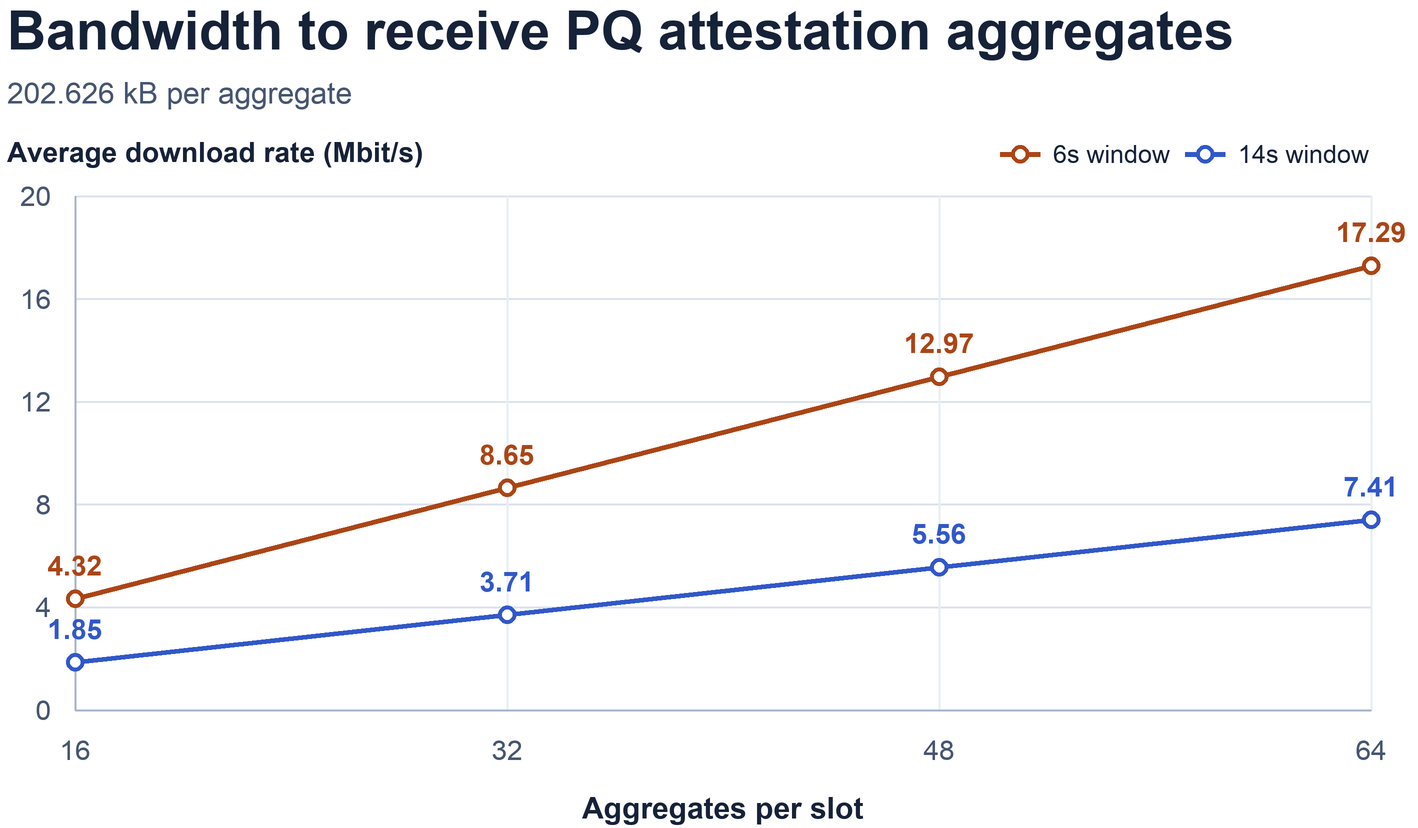
However, propagating 16 ILs with recursive proofs within 3 seconds seems difficult to achieve. One idea is to delay IL enforcement by 1 slot, giving ILs 12 more seconds to propagate. This reduces the average download rate to 2.86–3.30 Mbit/s.
The trade-off is that more IL transactions could become stale. Those that are eligible still benefit from FOCIL’s inclusion guarantee but with 1-slot delay compared to before. Supporting ILs with recursive proofs would build on EIP-8288, which still has many open research questions, and call for further research to make those ILs feasible.
| Propagation window | IL with recursive proof |
|---|---|
| 13s | 3.30 Mbit/s |
| 14s | 3.06 Mbit/s |
| 15s | 2.86 Mbit/s |
Figure 10. Average download rates for IL with recursive proof with 1-slot delay.
Another idea is to reduce the IL committee size. For example, reducing it from 16 to 8 halves the estimated download rate, bringing it down to a more manageable level. A smaller IL committee provides weaker censorship resistance than before, but even a weaker guarantee is better than none.
Meanwhile, PQ Decoupled Consensus could smooth out bandwidth demand over time, thanks to the decoupling of the Available chain and the finality gadget, easing the burden on the P2P network. Several lines of research into P2P optimizations are also underway that could reduce bandwidth use and speed up propagation.
Note: This back-of-the-napkin math didn’t account for gossipsub’s message duplication.
IL Equivocation
In the worst case, IL bandwidth consumption can double if all includers equivocate. This worst-case bandwidth increase overhead should be benchmarked. As a possible optimization for ILs with recursive proofs, nodes that detect equivocation could drop the two equivocating ILs and broadcast an IL equivocation proof consisting of two SignedInclusionListHeader, saving up to 616 kB by replacing the transaction bytes and recursive proof from each IL with their respective hash tree roots.
Payload Building
The CL still provides the EL with IL transactions to include in a payload. Without signature or proof aggregation, the EL builds a payload as before. With aggregation, the EL verifies the proofs carried by the ILs and checks which IL transactions can be included. When finalizing the payload, it generates a single recursive STARK proof for the signature and proof dependencies declared by transactions in the payload, taking the proofs that ILs carry for their transactions as one of the inputs. The EL will have 2 to 3 seconds to generate the payload with the recursive proof, depending on when the IL deadline is set. This should be benchmarked, but by then we should expect proving performance to be good enough for the EL to build the payload within that window.
Payload Processing
As with payload building, the CL passes the payload to the EL for processing, along with IL transactions. Without aggregation, each IL transaction’s signature is verified individually as before. IL transactions are evaluated as specified in EIP-7805 and EIP-8369, regardless of signature type. A hash-based signature might take longer to verify than an ECDSA signature, but verification is still fast. The IL size limit leaves room for only a few IL transactions with large hash-based signatures, so this shouldn’t be a problem.
With aggregation, the EL verifies one recursive STARK proof per IL for the dependencies declared by its transactions. Verifying up to 16 recursive STARK proofs for ILs is unlikely to be a bottleneck during payload processing, and it can be parallelized. When a recursive proof fails verification, the EL ignores the IL transactions that rely on it. The remaining IL transactions are checked as specified in EIP-7805 and EIP-8369. If the proof verifies, the same checks apply to IL transactions without dependencies and to those it covers.
IL Enforcement
FOCIL will still rely on fork choice to reorg execution payloads that failed to satisfy IL constraints in PQ Gasper. It’s too early to tell how exactly FOCIL would work in PQ Decoupled Consensus, as its spec is still being actively developed, but one idea could be letting the Available chain committee enforce those constraints. Encouragingly, taking FOCIL into account while the design is being explored could lead to a cleaner design overall.
Closing
FOCIL remains an additive change to Ethereum through the PQ transition. It can already support PQ transactions while they coexist with non-PQ transactions. ILs with leanXMSS look manageable in PQ Gasper given enough time to propagate, and PQ Decoupled Consensus would make them even easier to handle by spreading bandwidth demand over time. ILs with recursive proofs need more research, but there exist ideas for easing the network burden such as 1-slot delay or a smaller IL committee.
Payload building and processing with ILs need to be benchmarked, especially with aggregation, but the changes are additive. While the design of IL enforcement for PQ Decoupled Consensus remains open as the first version of the spec is being written, there is an opportunity to shape a cleaner overall design by including FOCIL into design discussions.