Abstract
Ethereum governance systems expose substantial execution evidence, including transactions, events, and state transitions, yet authority relationships often remain difficult to observe directly. Observable execution does not necessarily reveal the broader authority structures, delegation paths, dependencies, or continuity relationships that enabled that execution. This creates an authority visibility problem in which reviewers may possess extensive execution evidence while lacking a complete understanding of how authority originates, propagates, and persists through time.
This paper proposes a method for reconstructing authority relationships deterministically from publicly observable governance evidence. Building on the Ethereum Transparency layer(Deterministic Governance Verification for Ethereum ) framework, we describe a reconstruction pipeline that progresses from declared structure and observed execution through relationship reconstruction, execution meaning, and verification. Rather than treating governance activity as isolated events, the framework organizes fragmented evidence into connected representations capable of supporting longitudinal analysis of authority continuity.
The central claim is intentionally narrow: under explicit assumptions and deterministic reconstruction procedures, authority continuity can be reconstructed from available governance evidence and evaluated consistently across observers. The objective is not to claim perfect knowledge of governance intent, but to provide a reproducible foundation for governance analysis, authority transparency, replay-based verification, and machine-assisted evaluation. In this model, governance evidence becomes replayable, authority relationships become reconstructable, and governance assessment becomes more consistent across independent analysis.
Introduction
Ethereum systems expose an extensive body of publicly observable governance evidence. Transactions, execution traces, contract interactions, and other on-chain records provide reviewers with unprecedented visibility into system activity. This level of transparency has contributed to the widespread assumption that making governance execution observable is sufficient to make governance itself transparent. While public execution records significantly improve the visibility of system behavior, they do not necessarily provide a complete representation of the governance structures that produced that behavior.
Execution records describe what occurred within a system, but they do not always explain why particular actions were possible or which authority relationships enabled them. Authority may originate from multiple governance mechanisms, evolve across time, or propagate through delegated control structures that are not explicitly represented within individual execution records. As a result, observable execution and observable authority should not be treated as equivalent forms of transparency. A reviewer may observe an action while still lacking sufficient information to understand the authority structure from which that action emerged.
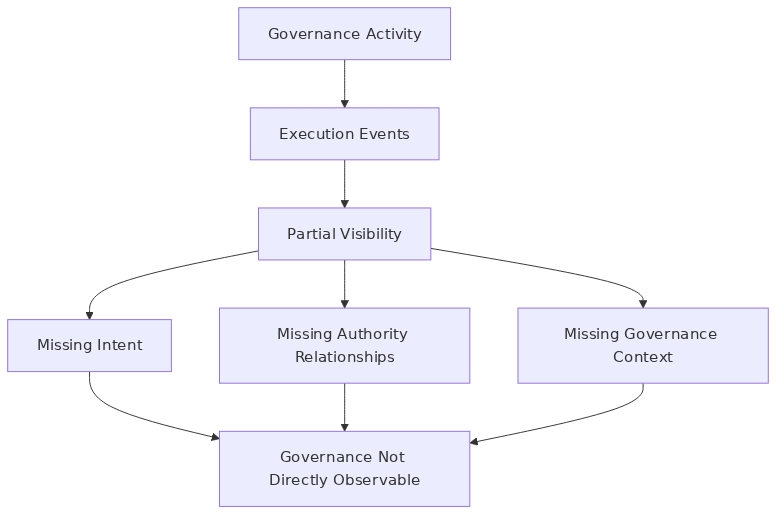
Figure 1 illustrates how observable execution provides only partial visibility into governance activity.
Figure 1. Execution Visibility Produces Only Partial Governance Visibility
This distinction gives rise to what we describe as the Authority Visibility Problem.
Authority within Ethereum governance may be distributed across multiple control surfaces, governance processes, and historical states rather than existing as a single directly observable object. Different records may reveal different aspects of authority, yet no individual source necessarily provides a complete representation of the relationships through which authority originates, propagates, and persists. Consequently, reconstructing governance authority may require correlating fragmented observations across multiple sources and periods of system operation rather than relying on isolated execution evidence alone.
Recognizing authority visibility as a distinct research problem changes the focus of governance analysis. The central question is no longer whether governance activity can be observed, but whether the authority relationships underlying that activity can be reconstructed with sufficient fidelity to support consistent interpretation. Addressing that question first requires a more precise examination of why authority remains difficult to observe directly within Ethereum governance systems. The following section develops this problem by examining the characteristics of the Authority Visibility Problem itself.
1.The Authority Visibility Problem
Observable governance activity does not necessarily imply observable governance authority. Public execution records provide evidence that actions occurred, but they do not always reveal the authority relationships that enabled those actions. Governance authority is therefore a distinct observability challenge rather than a direct consequence of execution visibility. A reviewer may possess comprehensive records of governance activity while still lacking sufficient information to determine how authority originated, who possessed it at different points in time, or how it influenced subsequent decisions. The distinction between observing execution and understanding authority is fundamental because governance transparency depends not only on recording what occurred, but also on understanding the authority structures that made those outcomes possible.
One reason authority remains difficult to observe is that it is rarely represented as a single, directly observable object. Instead, authority is distributed across governance mechanisms, institutional roles, contractual permissions, delegated responsibilities, and historical governance decisions. Individual governance records may expose only a portion of these relationships, while no single source necessarily captures the complete authority structure. Consequently, reviewing isolated governance evidence provides only partial visibility into the institutional relationships that collectively determine how authority is exercised within a protocol.
Figure 2 illustrates how observable governance activity produces only partial visibility, leaving authority relationships, governance context, and institutional continuity incompletely represented.
Figure 2. The Authority Visibility Problem in Ethereum Governance
The challenge is further compounded by delegation. Governance authority often propagates through multiple levels of delegated control rather than remaining attached to a single participant or governance action. Observable execution may therefore identify the immediate actor responsible for an operation without revealing the broader chain of authority that authorized, constrained, or influenced that action. As authority propagates through successive governance relationships, reconstructing the complete authority pathway becomes increasingly difficult using isolated execution records alone.
Authority visibility is also complicated by the fact that governance evolves continuously through time. Governance structures are not static; authority may be reassigned, delegated, constrained, or expanded as protocols mature and governance decisions accumulate. Individual observations therefore provide only temporal snapshots of a continuously evolving institutional system. Understanding authority consequently requires more than observing isolated events. It requires reconstructing authority continuity across multiple governance states in order to determine how present authority emerged from prior governance activity.
These characteristics collectively place a substantial interpretive burden on independent reviewers. Rather than observing authority directly, reviewers must correlate fragmented governance evidence originating from multiple sources, historical periods, and governance mechanisms before forming conclusions about institutional control. The quality of those conclusions therefore depends not only on the available evidence but also on the consistency of the reconstruction process used to relate that evidence. Different reviewers working from the same public records may legitimately arrive at different interpretations if no systematic reconstruction process exists.
The Authority Visibility Problem therefore extends beyond a simple limitation of data availability. Ethereum governance exposes extensive public evidence, yet that evidence alone does not necessarily provide a complete representation of institutional authority. Recognizing this distinction reframes governance transparency as a problem of reconstruction rather than observation. If authority cannot always be observed directly, the next question is whether fragmented governance evidence can be reconstructed systematically into coherent authority relationships capable of supporting consistent analysis. The following section examines why execution visibility alone is insufficient to achieve that objective and why governance reconstruction becomes a necessary foundation for authority understanding.
2.From Structure to Authority
The inability to observe authority directly does not imply that authority cannot be reconstructed. While individual governance actions reveal only isolated instances of execution, those actions occur within governance structures that define who may act, under what conditions, and with which institutional responsibilities. Authority therefore does not emerge from execution alone. It emerges from the relationship between declared governance structures and the execution evidence produced as those structures operate through time.
Declared governance structure provides the constitutional context within which execution becomes meaningful. Governance frameworks define institutional roles, permissions, operational constraints, and relationships between governing entities before any observable activity occurs. These declarations establish the authority framework from which governance actions become possible. Execution records therefore should not be interpreted independently of the structures that authorize them. Without structural context, observable operations remain detached from the institutional arrangements that produced them.
Execution transforms declared authority into observable behavior. Each governance operation represents the exercise of authority within an existing institutional structure, producing public evidence of governance activity. However, individual operations remain localized observations rather than complete representations of governance authority. A single execution event may demonstrate that authority was exercised without revealing how that authority originated, whether it depended upon previous governance decisions, or how it relates to broader institutional processes. Observable execution therefore provides evidence of authority in use rather than authority in context.
Understanding authority consequently requires relating individual observations back to the governance structures from which they emerged. Governance actions are not isolated occurrences but components of broader operational histories connected through institutional relationships and successive governance decisions. Reconstructing these relationships allows individual execution records to be interpreted as parts of a continuous governance process rather than as independent events. Authority begins to emerge not from any single observation but from the connected structure formed when governance evidence is examined collectively.
Continuity provides the final element required for authority reconstruction. Governance authority persists, changes, and propagates through successive institutional states rather than existing only at isolated moments of execution. Each governance action contributes additional evidence that extends the observable history of institutional control. Reconstructing authority therefore requires preserving the dependencies that connect governance states across time, allowing authority transitions to be understood as components of a continuous institutional history rather than disconnected operational events.
Authority reconstruction thus depends upon more than observing governance activity. It requires integrating declared structure, observable execution, and continuity into a unified representation capable of preserving the relationships through which institutional authority evolves. This progression establishes the foundation for the next stage of the paper. Once authority has been reconstructed as a continuous institutional structure, the remaining challenge is to determine what those reconstructed structures signify. The following section addresses this problem by examining how reconstructed authority acquires operational meaning.
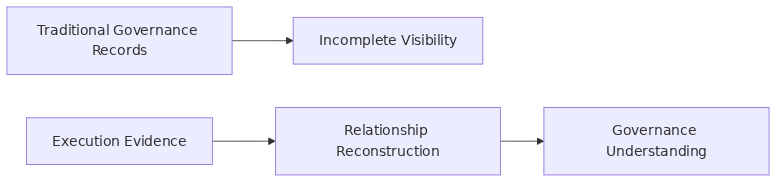
Figure 3 illustrates why governance understanding cannot be derived directly from traditional governance records alone, motivating the reconstruction of authority relationships from execution evidence.
Figure 3. Governance Reconstruction Problem
3.From Reconstruction to Meaning
The reconstruction of authority relationships establishes connected governance structures, but connected structures alone do not fully explain institutional behavior. Relationship reconstruction identifies how governance entities, operations, and authority transitions are connected through observable evidence, yet the existence of these relationships does not by itself explain their significance. Reconstructed authority therefore represents an important intermediate result rather than the final objective of governance analysis. Understanding governance requires not only reconstructing institutional relationships, but also interpreting what those reconstructed relationships indicate about institutional behavior.
This distinction reflects the difference between structural reconstruction and institutional understanding. Reconstructed authority may reveal dependencies, governance lineage, and continuity across successive governance states, but these observations remain fundamentally descriptive. They explain how governance elements are connected without necessarily explaining the institutional significance of those connections. A reviewer may therefore reconstruct a complete authority pathway while still lacking sufficient context to determine what that pathway reveals about governance behavior or institutional control.
Execution meaning addresses this limitation by providing interpretive context for reconstructed governance structures. Rather than introducing additional governance evidence, it organizes reconstructed authority into representations that support institutional interpretation. Dependencies become interpretable as governance relationships. Authority transitions become interpretable as institutional change. Governance continuity becomes interpretable as the persistence or evolution of institutional control. Through interpretation, reconstructed authority becomes capable of supporting consistent governance understanding rather than remaining a collection of connected observations.
Institutional interpretation is therefore not an alternative to deterministic reconstruction but a direct consequence of it. Meaning depends upon the integrity of the reconstructed relationships from which it is derived. If reconstruction fails to preserve the dependencies and continuity present within governance evidence, subsequent interpretation becomes incomplete or inconsistent. Interpretation therefore inherits the quality of the reconstruction process itself, making deterministic reconstruction a necessary foundation for meaningful governance analysis.
Although reconstructed meaning provides a richer understanding of governance behavior, interpretation alone does not determine whether those interpretations remain internally coherent. Different reviewers may still derive different conclusions from identical reconstructed structures unless those interpretations can be evaluated systematically. Institutional understanding therefore requires more than reconstruction and interpretation. It also requires a mechanism capable of assessing whether reconstructed authority and its associated meaning remain consistent with the observable governance evidence from which they were derived.
The progression from reconstruction to meaning completes another stage in the authority reconstruction process. Governance evidence has progressed from isolated observations, to reconstructed authority relationships, and now to interpretable institutional structures. The remaining challenge is to determine whether those interpreted structures remain consistent throughout successive authority transitions. The following section addresses this requirement by examining authority continuity verification as the mechanism through which reconstructed institutional behavior can be evaluated deterministically.
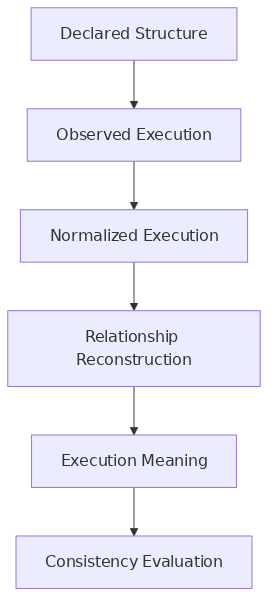
Figure 4 illustrates the dependency-preserving analytical progression through which declared structure and observed execution are transformed into reconstructed relationships, execution meaning, and consistency evaluation.
Figure 4. Architectural Dependency Chain
4.Authority Continuity Verification
The reconstruction of authority relationships and the interpretation of their institutional meaning provide a richer understanding of governance behavior, but understanding alone is insufficient for rigorous analysis. Once governance evidence has been reconstructed and interpreted, an additional question emerges: can those interpretations be evaluated consistently? Institutional understanding may reveal authority transitions, continuity, and governance relationships, yet without a systematic method of evaluation, different reviewers may still reach different conclusions from comparable evidence. The transition from meaning to verification addresses this requirement by establishing a consistent basis for evaluating reconstructed authority.
This distinction reflects the different roles of interpretation and verification within the authority reconstruction process. Interpretation seeks to explain what reconstructed governance relationships indicate about institutional behavior. Verification, by contrast, evaluates whether those interpretations remain consistent with the observable evidence from which they were derived. Rather than replacing interpretation, verification builds directly upon it, providing a structured process through which reconstructed authority can be examined systematically.
Verification therefore introduces a different analytical objective. Earlier stages of the reconstruction pipeline focused on making governance activity observable, reconstructing authority relationships, and interpreting institutional behavior. Verification shifts attention from understanding to evaluation. The question is no longer simply what governance evidence appears to indicate, but whether those conclusions remain internally consistent when assessed against the reconstructed authority from which they emerged. This progression strengthens governance analysis by reducing reliance on subjective interpretation alone.
Within this framework, authority continuity becomes central to verification. Reconstructed authority is not evaluated as a collection of isolated governance events, but as a continuous sequence of institutional transitions preserved across observable governance evidence. Verification therefore examines whether authority relationships remain coherent as governance evolves through time. Consistency is evaluated across the reconstructed authority history rather than within individual observations, allowing governance continuity to become a subject of deterministic analysis.
Although verification increases confidence in reconstructed governance analysis, it does not by itself establish reproducibility. A verified reconstruction demonstrates that conclusions remain consistent with the available evidence, but an additional question remains unresolved. If the same governance evidence were examined again under the same reconstruction procedure, would the same authority history and verification outcome be produced? Answering that question extends beyond verification itself and introduces the final stage of the paper: deterministic authority reconstruction as a verification primitive.
5.Deterministic Authority Reconstruction
The preceding sections established that authority cannot always be observed directly, but that authority relationships can be reconstructed through the systematic interpretation of publicly available governance evidence. Verification strengthens confidence in these reconstructed representations by evaluating whether the inferred authority relationships remain consistent with the evidence from which they were derived. A final question nevertheless remains. Can the reconstruction process itself be performed deterministically so that equivalent evidence consistently produces equivalent analytical outcomes?
Deterministic authority reconstruction requires more than repeatable observation. It requires that the reconstruction procedure preserve the dependency relationships through which authority is established, exercised, and transferred over time. Declared governance structures, observed execution, reconstructed relationships, and interpreted meaning must therefore form a single dependency-preserving analytical process. When equivalent evidence is evaluated under the same reconstruction procedure, the resulting representation of authority continuity should remain consistent across independent evaluations.
This requirement transforms reconstruction from an interpretive activity into a reproducible analytical process. Rather than relying on individual judgement to connect fragmented governance observations, deterministic reconstruction constrains how authority relationships are derived from available evidence. The objective is not to eliminate interpretation entirely, but to ensure that interpretation follows an explicit, repeatable procedure whose assumptions and intermediate relationships remain visible to subsequent reviewers.
Within this framework, authority continuity becomes a property that can be evaluated rather than merely inferred. Because reconstructed authority relationships remain linked to their supporting evidence, reviewers can examine not only the final representation of governance authority but also the dependency chain through which that representation was produced. Reconstruction therefore becomes transparent, reproducible, and open to independent verification.
The significance of deterministic authority reconstruction extends beyond replaying historical governance activity. If equivalent governance evidence consistently produces equivalent authority reconstructions, then reconstruction itself becomes a verification primitive. Independent reviewers applying the same reconstruction procedure to the same evidence should obtain equivalent representations of authority continuity. Verification therefore shifts from comparing subjective interpretations toward evaluating reproducible analytical outcomes grounded in publicly observable evidence.
This does not imply that every aspect of institutional authority is fully observable or that governance intent can always be recovered from execution evidence alone. Instead, the contribution is deliberately narrower. Under explicit assumptions and dependency-preserving reconstruction procedures, authority continuity can be reconstructed deterministically and evaluated consistently across independent observers. In this model, deterministic authority reconstruction provides the analytical foundation upon which reproducible governance verification can be built.
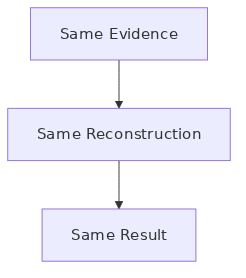
Figure 5 illustrates the deterministic reconstruction principle: equivalent evidence processed through an equivalent reconstruction procedure should produce equivalent analytical outcomes, providing the foundation for reproducible authority verification.
Figure 5.Deterministic Reconstruction Principle
6.Implications
The framework developed throughout this paper establishes deterministic authority reconstruction as more than a method for interpreting governance activity. By preserving explicit dependencies between publicly observable evidence, reconstructed authority relationships, execution meaning, verification, and replay equivalence, the reconstruction process enables authority continuity to be evaluated through a reproducible analytical procedure. This progression extends governance analysis beyond observation alone toward consistent and independently verifiable reconstruction.
One implication of this approach concerns institutional analysis. Governance authority need not be understood exclusively through institutional declarations or privileged access to internal decision-making processes. Instead, authority relationships may be reconstructed from publicly observable governance evidence using an explicit dependency-preserving methodology. Institutional analysis therefore becomes increasingly grounded in systematic evidence reconstruction rather than assumptions derived from isolated governance records.
The framework also changes the role of governance analysis itself. Traditional governance records primarily document observable activity, while deterministic authority reconstruction organizes that activity into structured representations capable of supporting longitudinal analysis. Authority continuity, governance transitions, and institutional relationships become analytical objects that can be reconstructed, interpreted, and evaluated through a documented and reproducible process. Governance analysis therefore progresses beyond descriptive observation toward structured evaluation of authority continuity.
A further implication concerns verification. The execution proof narrative established throughout the ETL publication corpus demonstrates that verification evaluates whether reconstructed conclusions remain consistent with the evidence from which they were derived. Replay equivalence extends this principle by demonstrating that equivalent evidence examined through an equivalent reconstruction procedure should produce equivalent analytical outcomes. Within this framework, deterministic authority reconstruction functions as a verification primitive by preserving reproducibility between observable evidence and reconstructed authority representations.
More broadly, the framework reinforces the distinction between disclosure and understanding that has guided this paper from the outset. Public observability provides the evidence required for analysis, while reconstruction provides the analytical process through which that evidence becomes meaningful, verifiable, and reproducible. Deterministic authority reconstruction therefore strengthens the relationship between evidence, interpretation, verification, and reproducibility without extending beyond the observable governance boundary established by the ETL architecture.
These implications follow directly from the reconstruction methodology developed throughout the paper. They demonstrate the analytical significance of deterministic authority reconstruction while remaining consistent with the methodological boundaries established by the canonical publication corpus. Having established both the framework and its implications, the discussion now concludes by returning to the central research question and summarizing the contribution of this work.
Conclusion
I began by examining a central limitation of governance transparency within Ethereum systems. Although governance activity generates substantial publicly observable evidence, observable execution alone does not necessarily reveal the authority relationships that enable institutional behavior. Authority may be distributed across multiple governance mechanisms, delegated through intermediate structures, and evolve over time, making authority continuity difficult to observe directly from isolated execution records.
Recognizing this limitation, I framed authority visibility as a distinct observability problem. Rather than assuming that governance transparency follows directly from execution transparency, I argued that understanding institutional authority requires a systematic process capable of reconstructing authority relationships from publicly observable governance evidence while preserving explicit dependencies between that evidence and the conclusions derived from it.
To address this challenge, I presented a dependency-preserving reconstruction methodology that progresses from declared structure and observed execution through relationship reconstruction, execution meaning, verification, and deterministic authority reconstruction. Each stage builds upon the preceding stage without introducing unsupported interpretation, allowing reconstructed authority relationships to remain traceable to publicly observable governance evidence throughout the analytical process.
I further demonstrated that authority reconstruction alone is insufficient unless the resulting conclusions can be evaluated consistently. By incorporating verification and replay equivalence into the reconstruction process, authority continuity becomes reproducible across independent observers examining equivalent evidence through equivalent reconstruction procedures. Deterministic authority reconstruction therefore establishes a reproducible foundation for evaluating authority continuity rather than relying upon observer-specific interpretation or privileged institutional knowledge.
The principal contribution of this work is my demonstration that authority continuity can be reconstructed deterministically from publicly observable governance evidence when reconstruction follows a structured, dependency-preserving, and reproducible analytical process. Under these conditions, authority relationships become suitable for consistent reconstruction, independent verification, and longitudinal institutional analysis while remaining grounded in observable evidence.
The scope of this contribution remains intentionally bounded. I do not claim to reconstruct institutional intent or infer authority beyond the observable evidence available for analysis. Instead, I establish a reproducible framework through which authority continuity can be reconstructed, evaluated, and verified . In doing so, I provide a foundation for more consistent authority analysis within transparent digital institutions while preserving the principles of evidence traceability, deterministic reconstruction, and independent verification.