Description
In Ethereum PoS, many reorganization attacks manipulate validators’ views of the head, causing their attestation weight to be distributed across different branches and potentially triggering a reorganization. This shows that the head plays a critical role in consensus security. Meanwhile, head votes also account for a significant part of attestation rewards and must satisfy a strict timing condition to be rewarded, making them particularly vulnerable to loss. However, the role of the head in consensus security and validator incentives has not been studied in a unified way.
Background
Head Vote.
Validators attest to the block they consider the head according to LMD-GHOST. Unlike source and target votes, the head reward depends strongly on whether the validator observes the correct block in time.
Attestation Timing.
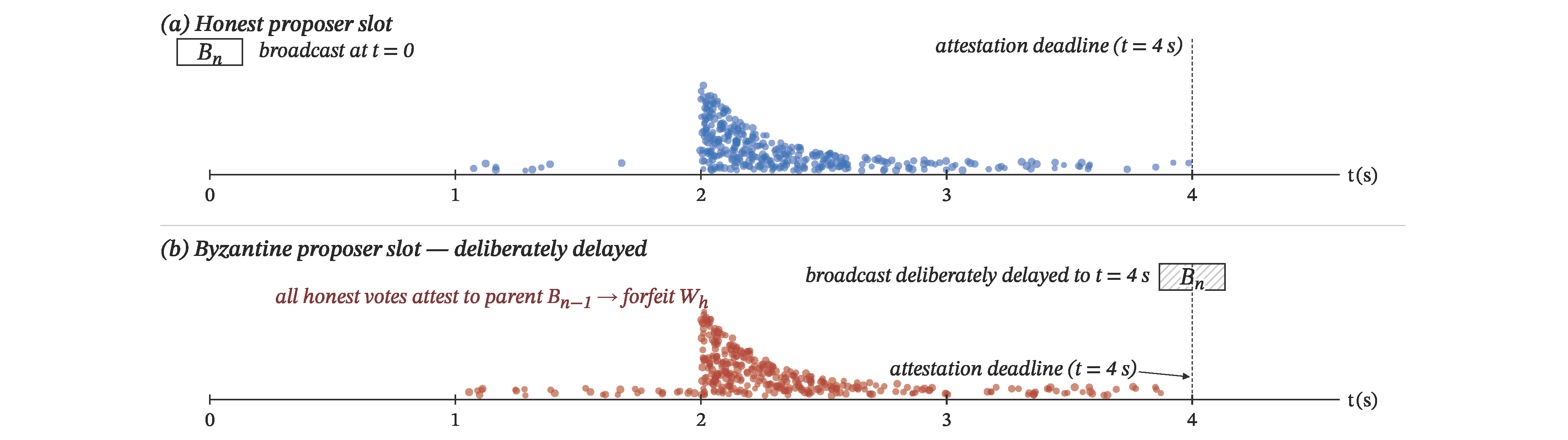
In each 12-second slot, validators normally attest before 4 seconds after the beginning of the slot. Therefore, a proposer that controls when its block is released can influence the local view used by honest attesters.
Proposer Boost.
Ethereum gives the current-slot block additional temporary fork-choice weight for 40%. This mechanism is intended to minimize an ex ante reorg attack and balancing attack, but it also affects the outcome when competing branches are deliberately created.
Attack Scenario
We consider two timing-based attack scenarios that exploit the role of the head vote in Ethereum PoS.
-
Head-vote timing game . An adversarial proposer delays the broadcast of its block within a plausible network-delay range and releases it close to the attestation deadline. Honest validators that have not received the block and continue to regard its parent as the head and therefore vote for the parent, causing them to lose the head component of their attestation reward once the delayed block becomes canonical. Importantly, such delayed delivery cannot be reliably identified by the protocol as malicious behavior, since a late block may also result from ordinary network propagation delay.
-
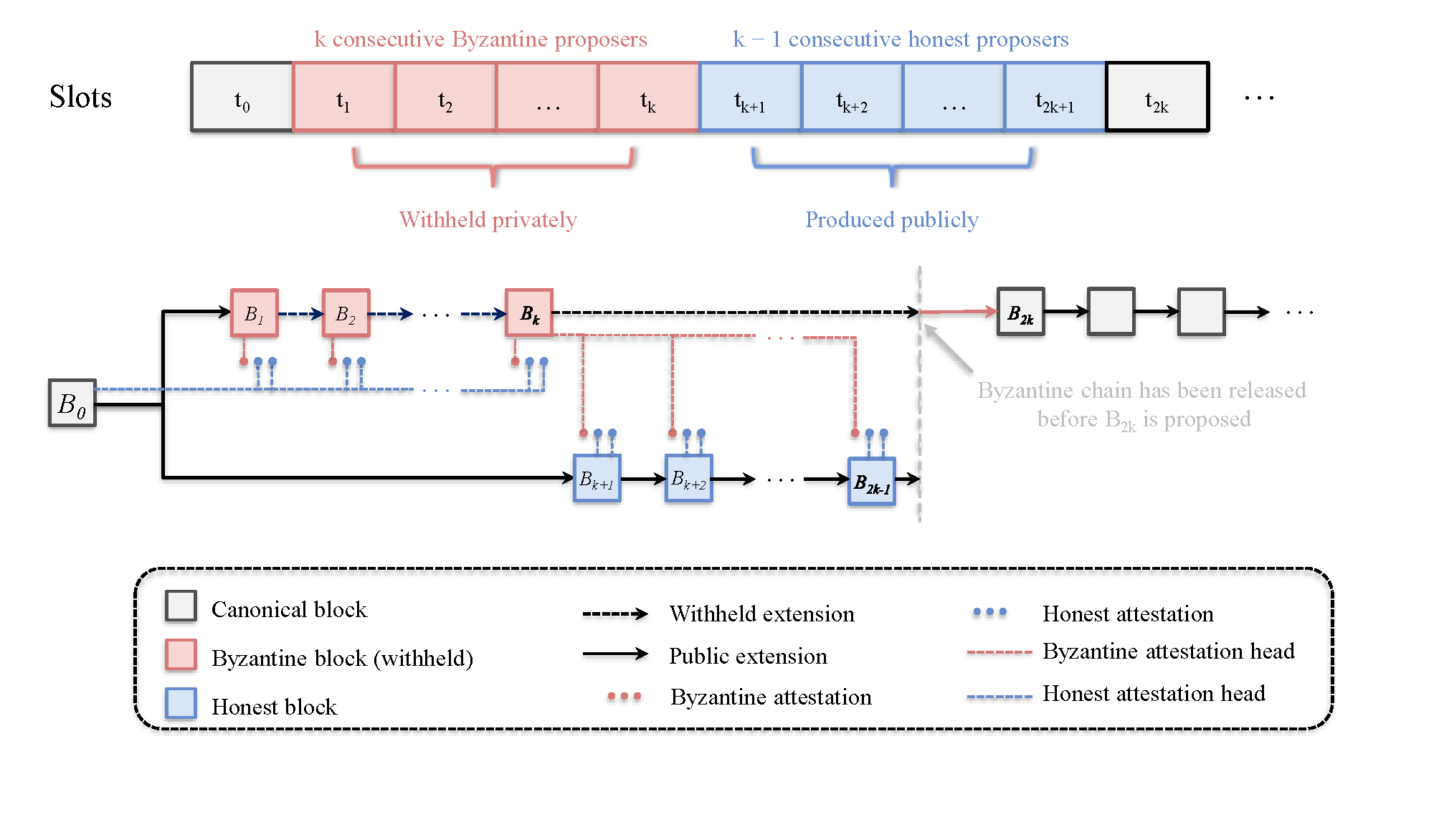
K-block attack. We further generalize the attack to consecutive adversarial proposer slots. When the attacker controls k consecutive proposers, it can privately extend a competing branch while withholding these blocks from honest validators. The private branch can isolate subsequent honest blocks and, once released, become the canonical chain and trigger a reorganization. As a result, honest validators may cast head votes for blocks that are later removed from the canonical chain, again causing the loss of their head-vote rewards.
Impact
Our Prysm experiments show that this timing manipulation produces a persistent reward asymmetry.
the head-vote timing game produces a 15.06% average total reward loss for honest validators. The same block-visibility asymmetry can also affect HLMD-GHOST directly: under k-block withholding, coordinated adversarial proposers and attesters can accumulate enough private fork-choice weight to realize reorganization
To reduce the incentive loss caused by these stale local views, we explore a distance-weighted head reward that gives partial rewards to eligible attestations pointing to recent canonical ancestors, while retaining the highest reward for voting for the freshest canonical head. The mechanism changes only the reward calculation and leaves HLMD-GHOST and proposer boost unchanged. In our experiments, it reduces the timing-game loss from 15.06% to 4.71%, and consistently reduces honest reward losses under the K-block attack. It does not eliminate losses caused by orphaned branches or all reorganization effects, but substantially reduces the reward disadvantage experienced by honest validators.