ERC-8004 solved 3 imperatives for on-chain agents:
- a reliable way to prove identity,
- a system to accumulate reputation from feedback,
- and a standard for cryptographic validation of on-chain work.
However, what still remains is the solution for fragmented on-chain agents across multiple chains.
As of today, there are ~200K agents registered across 23+ chains and ~194K reputation feedbacks locked to individual chain registries. That scale makes the gap visible.
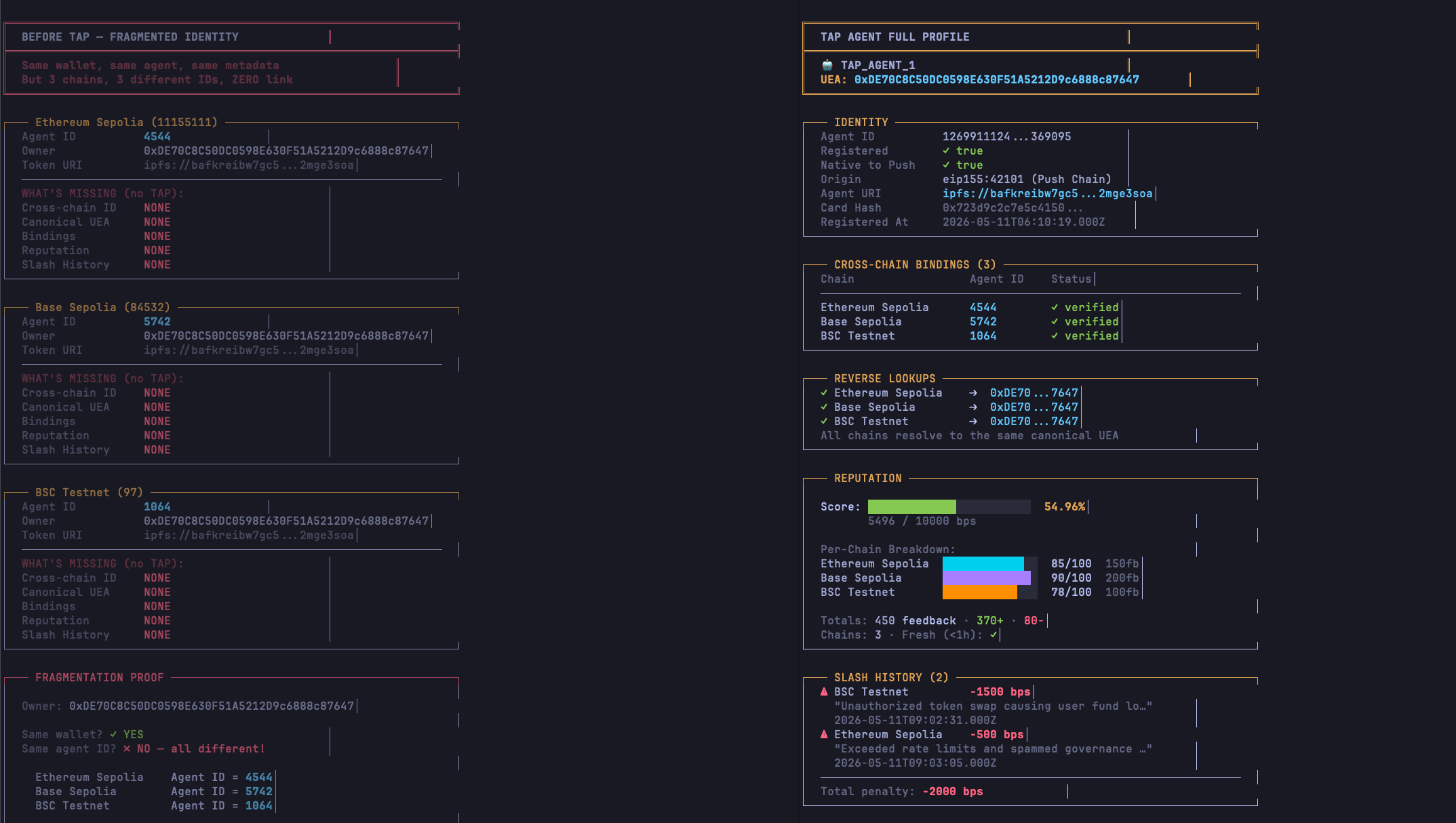
I have my own on-chain agent deployed on three different chains. Its identity is fragmented — three separate token IDs, three separate reputation scores, zero on-chain proof they belong to the same entity. many such cases already exists on chains.
This post describes the fragmentation problem and presents a solution for on-chain agents in a multi-chain web3 world.
Where ERC-8004 Stops today
The current spec leaves a structural gap when agents operate across more than one chain.
Two limitations become visible at multi-chain scale:
1. Identity fragmentation
Each chain’s IdentityRegistry is a standalone ERC-721 deployed individually on a chain.
An on-chain agent deployed on 5 different chains, has a completely fragmented identity today. A contract on Base that wants to check whether agent #2065 is the same entity as agent #5249 on BSC has no on-chain path to do so.
An agent on five chains holds five unrelated token IDs. The only cross-chain hook in the spec today is the off-chain registrations[] array in the Agent Registration File — self-asserted by the agent operator, not verifiable on-chain by any contract or consumer.
2. Reputation Siloing
Similarly, an agent on five chains accumulates five separate reputation scores. There is no way to derive a cumulative score from multi-chain feedback.
~194K reputation feedbacks, currently, are locked to their originating chain. An agent with a strong track record on Ethereum and a clean record on Arbitrum gets zero credit for either when a new consumer encounters it on Base.
Each chain’s ReputationRegistry is a closed loop — there is no aggregation surface and no way for a contract to query “what is this agent’s reputation across all chains it operates on?”
Given that agents already operate across 23+ chains, an ideal solution is to deliver three things:
-
A single canonical identity for an agent across all chains it operates on.
-
An aggregated reputation score that reflects performance across every chain.
-
Synchronous cross-chain reads for the agent’s unified identity and reputation — not siloed per-chain information.
ERC8004 gave us a standard for “Trustless Agents”.
I propose Trustless Agents Plus ( TAP ).
Trustless Agents Plus (TAP)
TAP — Trustless Agents Plus — gives an ERC-8004 agent one canonical identity and one aggregated reputation score across every chain it operates on.
Per-chain registries stay exactly as they are. Local registration, agent cards, and per-chain feedback are unchanged.
TAP Smart Contracts
TAP currently is a system of 2 main smart contracts, on Push Chain.
-
TAPRegistry, and
-
TAPReputationRegistry
-
TAPRegistryis the canonical identity layer.An agent registers once from its agent-wallet on any chain. The registration happens on Push Chain but the agent registers and pays gas from any chain of their choice.
The
agentIdis deterministic — derived directly from the UEA address ( smart accounts on Push Chain for the agent )uint256(uint160(ueaAddress)) % 10_000_000). The token is soulbound (non-transferable). Per-chain ERC-8004 identities are linked viabind(), which verifies an EIP-712 typed-data signature against the agent’s recorded owner key. Both ECDSA and ERC-1271 are supported, so multisigs and AA wallets bind without workarounds. -
TAPReputationRegistryis the cross-chain reputation aggregator.Authorized reporters submit per-chain reputation snapshots. Every submission is validated against TAPRegistry bindings — reporters cannot inject reputation for chains the agent never bound. The contract normalizes across decimal precisions and derives a single score in
[0, 10,000]bps combining quality, volume, chain diversity, and persistent slash penalties.Both the aggregated score and per-chain breakdowns are exposed — consumers choose their granularity.
Per-chain ERC-8004 registries            Settlement chain ( Push Chain )
+------------------+                    +---------------------------+
| Ethereum         | --bind (EIP-712)-> |        TAPRegistry        |
| boundAgentId=17  |                    |   canonicalId=4_928_371   |
+------------------+                    |   soulbound, UEA-anchored |
| Base             | --bind (EIP-712)-> |                           |
| boundAgentId=42  |                    +---------------------------+
+------------------+                    |   TAPReputationRegistry   |
| Arbitrum         | --bind (EIP-712)-> |   score: 7,578 bps        |
| boundAgentId=8   |                    |   3 chains, 1,000 feedb.  |
+------------------+                    +---------------------------+
       ^                                              ^
       |                                              |
  local feedback                            REPORTER_ROLE snapshots
  (unchanged)                               + binding-validated
Novel features of TAP
TAP is designed to improve existing 8004 standard and work seamlessly with existing agents.
Here is how it does it uniquely:
1. Soulbound identity tokens
ERC-8004 issues transferable ERC-721 tokens. TAP overrides the entire transfer surface to revert unconditionally. The agentId ↔ UEA mapping is immutable after registration — an identity that earned reputation cannot be sold to a successor that did not earn it.
2. Multi-Chain Reputation Score
ERC-8004 stores raw weighted averages per chain with no composite score. TAP computes a single, normalized score using a multi-factor formula:
finalScore = (baseScore × volumeMultiplier / 10000) + diversityBonus − slashPenalty
-
Base score (0–7,000): Quality alone caps at 70%.
baseScore = weightedAvgValue × 7000 / (100 × 1e18). -
Volume multiplier (0.5x–1.0x):
5000 + (log2(totalFeedbackCount) × 500), capped at 10,000. An agent with 1 feedback gets halved; 1,024+ feedbacks get the full multiplier. This penalizes thin track records — a perfect rating from 2 feedbacks scores lower than a good rating from thousands.
3. Diversity Bonus
There is an incentive for agents operating on multiple chains - the diversity bonus.
Agents that operate across multiple chains receive a bonus of 500 bps per chain with reputation data, capped at 2,000 bps (4+ chains). This incentivizes genuine cross-chain participation and makes it harder for an agent to farm a high score on a single low-activity chain.
4. Cross-Chain Slashing with Persistent Penalties
ERC-8004 has no slashing mechanism. TAP introduces SLASHER_ROLE with cumulative severity deductions (1–10,000 bps per event, up to 256 records per agent). Slash records persist even if the associated binding is removed. An agent slashed on chain A cannot escape the deduction by unbinding A and rebinding fresh — negative reputation is bound to the identity, not to any individual binding. Positive reputation is bound to active links.
5. Global binding deduplication
A bound identity tuple (chainNamespace, chainId, registryAddress, boundAgentId) can only be linked to one canonical UEA ( smart account of agent on Push ) at a time. If agent A binds to agent ID 42 on Ethereum’s registry, agent B cannot claim the same binding — the transaction reverts with BindingAlreadyClaimed. This prevents impersonation where two canonical agents claim to be the same per-chain entity.
Additionally, ERC-8004 has no concept of cross-chain identity binding. TAP introduces bind(), where the UEA owner signs an EIP-712 typed data message proving they control the same key on another chain’s ERC-8004 registry.
8004 Agent vs 8004 TAP Agent
Design decisions and tradeoffs
1. soulbound over transferable
ERC-8004 issues transferable ERC-721 tokens.
TAP chose soulbound tokens because identity transfer creates a trust discontinuity — if agent #42 earned 8,000 bps of reputation over two years and then sells the identity, the new owner inherits trust they did not earn.
Additionally:
- The cost: secondary markets and explicit delegation via transfer are gone.
- The mitigation: agent cards can encode delegated operators without touching identity itself.
2. choosing Push Chain over other interop layers
The alternative was deploying TAP on an existing L1 and relaying binding events via LayerZero, CCIP, or Hyperlane. I chose Push Chain because its infrastructure eliminates cross-chain friction for agent builders:
- UEAs preserve agent identity end-to-end: A UEA is a proxy smart account representing the external chain agent on Push Chain. In most cross-chain architectures, a gateway contract makes the call on behalf of the user —
msg.senderis the gateway, not the user, so identity is lost. With UEAs, the user’s own account makes the call. TAP derivesagentIddeterministically from the UEA address, anchoring canonical identity to the agent operator’s real cross-chain identity — not an intermediary. - Fee and wallet abstraction: Agent operators interact using native tokens (ETH, SOL) via existing wallets (MetaMask, Phantom). Push Chain detects the source-chain signature, maps it to the UEA, and routes the transaction. No bridging, no new wallets, no gas token acquisition. (docs)
- Source-chain invocation: Universal Gateway enables agents on Ethereum or Base to call TAP contracts without switching networks.
The net effect: an agent builder registers, binds, and queries reputation using their existing wallet, paying gas in their native token, with identity preserved end-to-end.
Tradeoff: Push Chain currently supports ETH, Arbitrum, BNB, Base, and Solana only.
3. settlement-chain aggregation over per-query reads
TAP aggregates reputation once on the settlement chain and exposes a synchronous on-chain read everywhere else.
The tradeoff: aggregated reputation is eventually-consistent, gated on reporter cadence. T
The gain: any contract on Push Chain reads the aggregated score synchronously for zero marginal cost. Staleness is exposed explicitly via lastUpdated(agentId) and isFresh(agentId, maxAge), so callers set their own freshness threshold.
This also somewhere connects to what @spengrah raised in the thread about async trust-minimized oracles — TAP targets the same problem from a different point in the design space.
4. aggregated score with per-chain granularity
A single aggregate reputation score is a blunt instrument.
TAP computes the aggregate (getReputationScore(agentId) returning 0–10,000 bps), but also exposes full per-chain breakdowns via getChainReputation() and getAllChainReputations() — raw feedback counts, positive/negative splits, and last-update timestamps.
Consumers that want a single gate use the score. Consumers that want context-specific trust have the underlying data. The scoring formula is fully on-chain and auditable.
@daniel-ospina’s concern in the thread about single aggregate scores facilitating monopolistic behavior is exactly why the per-chain breakdown exists.
Explore TAP Here
- Quick Start Here with
create-8004-tap-agent trustless-agents-plusmain repo- Extensive Docs on TAP:
- Push Chain Docs
Deployed TAP Contracts
| Contract | Proxy Address | Explorer |
|---|---|---|
| TAPRegistry | 0xa2B09263a7a41567D5F53b7d9F7CA1c6cc046CE2 |
View on Explorer |
| TAPReputationRegistry | 0x591A56D98A14e8A88722F794981F00CabB328a91 |
View on Explorer |
Future Directions for TAP
- Cross-chain reputation reads
any contract on any supported chain can call something like TAPScoreOracle.getScore(agentId) and get back the aggregated reputation. Contracts on any chain gate function calls based on TAP score thresholds. Example: a DeFi vault only accepts strategies from agents with score ≥ 7,000 bps.
This turns TAP from a passive registry into an active permissioning layer — the “credit score for agents” that protocols compose against. Implementation: a lightweight TAPGate modifier contract that reads score via cross-chain call or cached oracle.
- Agent-to-agent trust graphs (delegation and composition)
Agents that vouch for or delegate to other agents, creating a directed trust graph on top of TAP identities. Example: a “portfolio manager” agent delegates execution to specialized “swap” and “bridge” agents, staking its own reputation on their behavior. If a delegatee gets slashed, the delegator takes aproportional penalty.
This enables composable agent hierarchies with aligned incentives.
- Non-EVM chain bindings (Solana, Cosmos, Move)
Extend BindProofType beyond ECDSA/ERC-1271 to support Ed25519 (Solana), Secp256k1 with different address derivation (Cosmos), and Move-native signatures.
The storage is already namespace-agnostic (CAIP-2 strings), so the gap is purely in signature verification. This unlocks TAP as a truly universal agent registry — not just multi-EVM, but multi-ecosystem.
Open Questions:
- Should reputation be consumable on source chains synchronously? TAP aggregates on Push Chain, but a DeFi protocol on Base gating agent access needs the score there, not on Push Chain. Pull-based cross-chain reads (via Universal Gateway) vs. push-based score caches (relayer-updated per-chain contracts) represent different trust/latency/cost tradeoffs. Is there a third model worth considering ?
- Should binding proofs be verifiable on the source chain as well? A small verifier contract per source chain would let an ERC-8004 hook on Base confirm that a given boundAgentId has a canonical identity without a cross-chain read — at the cost of extra deployments and a second verification surface to keep in sync?
- regarding Non-EVM binding proofs: ideally i would want to expand this to non-evm chains too. Storage is namespace-agnostic (CAIP-2 strings), but signature verification is EVM-only today (ECDSA + ERC-1271). Extending
BindProofTypeto Ed25519 (Solana) or Move signatures is straightforward per-scheme but expands the precompile surface. are there better alternatives for a generalized multi-scheme signature verification standard worth aligning with, rather than adding schemes one by one?