Overview
TrustMesh is a consensus architecture based on emergent dynamics. Its goal is to allow the entire network to eventually converge on a single proposal within each Round. Any node may propose, and through local interactions and dynamical convergence, the network selects a unique proposal. Throughout the process, no node needs knowledge of any global view; blocks do not reference one another, and nodes react purely based on local information.
The current Proof of Concept (PoC) demonstrates that even under adversarial conditions with randomly assigned reputations, the system still exhibits clear attractors and reliably converges. The PoC implementation is available here: TrustMesh
Core Concepts
Round
A Round is the basic unit of a complete consensus process in TrustMesh. TrustMesh intentionally does not prescribe how rounds must be advanced. (In the PoC, rounds are driven by fixed time windows for observability.)
If strong consistency is not required, rounds may execute in parallel. Each round ultimately produces valid history (i.e., consensus results that are never pruned or discarded). In this semantic model, there are no forks that require resolution or pruning.
Reputation
Reputation is the core concept of TrustMesh, and the security of the system directly depends on it. Reputation is stored in each node’s Locally Observed Reputation Table (LORT) and must be bound to verifiable identities (e.g., public keys). Although the term “reputation” is used, it does not represent subjective prestige. To prevent reputation from degenerating into global authority, TrustMesh enforces the following design constraints:
-
Local Privacy
A node’s reputation table must not be shared, broadcast, copied, or exported to any external party. -
Observation-Only Derivation
All reputation values must be derived solely from behaviors directly observed by the node itself, rather than imported from third-party recommendations or external reputation feeds. -
Purpose-Driven Rule Construction
Reputation update rules must be defined according to the concrete purpose and service model of the network.
Consensus Process
1. Proposal Generation
At the beginning of each round, nodes construct and broadcast proposals. Nodes do not score their own proposals, as self-scoring provides no meaningful information and introduces attack surfaces. However, the system requires an initial perturbation; otherwise, all proposal scores would remain zero.
Receiving nodes may therefore apply a configurable base score, conceptually equivalent to assuming that the proposer assigns an initial score to its own proposal. (In the PoC, this is simplified by letting proposers self-score and self-sign with an immutable value; this can be losslessly mapped back to a base-score mechanism.)
Every node may produce a valid proposal in every round. TrustMesh fully removes the distinction between leaders and voters: all nodes possess both the right to propose and the right to score proposals.
2. Proposal Reception & Scoring
Upon receiving a proposal, a node examines its signature set and applies reputation-weight dilution to each scoring signature based on its local reputation table (unknown nodes have zero weight). The sum of all diluted scores constitutes the node’s local score for that proposal at that moment.
This scoring process relies exclusively on local information and does not require any global view.
In the current PoC, linear weighting is used. Consider the following local reputation table:
| Name | Reputation | Score |
|---|---|---|
| NodeA | 2677 | 500 |
| NodeB | 7906 | 1000 |
| NodeC | 3845 | 490 |
The total reputation is:
2677 + 7906 + 3845 = 14428
The resulting weights and weighted contributions are:
| Name | Weight | Weighted Score |
|---|---|---|
| NodeA | 2677 / 14428 ≈ 0.19 | 500 × 0.19 = 95 |
| NodeB | 7906 / 14428 ≈ 0.55 | 1000 × 0.55 = 550 |
| NodeC | 3845 / 14428 ≈ 0.27 | 490 × 0.27 = 132.3 |
The resulting local score is:
95 + 550 + 132.3 = 777.3
The node then adds its own score signature to the proposal and broadcasts it. Other nodes repeat the same process independently.
In the PoC scoring model, local proposal scores are theoretically monotonic non-decreasing. Missing signatures contribute zero. Scores must be non-negative. For the same proposal, a node only accepts score updates that are greater than or equal to its previous score; lower scores are treated as outdated and ignored. Under these rules, signature set growth and updates can only increase or preserve local scores.
3. Final Synchronization & Termination
Once the network is already highly converged and only minor perspective divergence remains (in the PoC, this is determined by a fixed time window), the proposal with the highest local score is selected as the Winner and stored. This is the simplest termination behavior.
Some nodes may still select a different Winner due to local perspective variance. A final synchronization mechanism can eliminate this residual divergence. To better observe natural convergence, this mechanism is not implemented in the PoC and is provided for theoretical reference only.
In final synchronization, each node broadcasts exactly one local Winner and ceases scoring. Nodes collect Winner announcements from peers and rank them using local weights, excluding their own previously selected Winner from the ranking. If the top-ranked Winner changes, an updated announcement is broadcast. Once the ranking stabilizes, the top-ranked proposal is finalized and stored.
Experimental Results
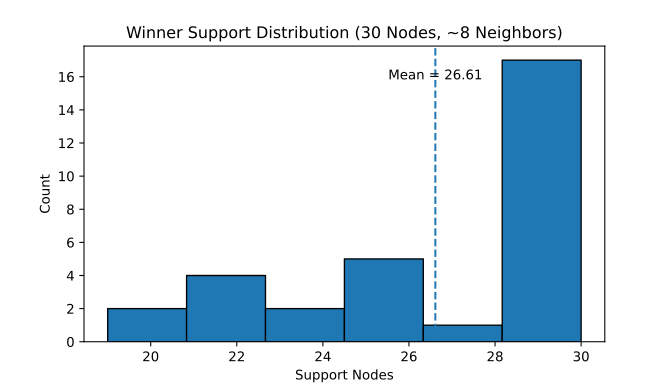
The following figure shows PoC results under random reputation, 30 nodes, 60-second rounds, and an average of 8 neighbors, across 31 rounds. Each node submits one proposal per round, and reputations are re-randomized at the start of every round.
-
On average, 26.61 out of 30 nodes (88.7%) converged on the same proposal.
This was achieved using only local information, without synchronized voting or global chain structures. -
In all rounds, the Winner’s supporters outnumbered all other proposals combined.
This indicates strong amplification of advantage and majority dominance. -
Even when multiple proposals coexisted, the final Winner maintained overwhelming dominance.
Minority clusters form only local stable points and do not disrupt global convergence. -
Earlier experiments with 21 nodes showed lower convergence probabilities under identical parameters.
This suggests that TrustMesh may exhibit increasing stability as network size grows.
FAQ
Q: Is TrustMesh similar to RAG-style consensus systems?
A: No. TrustMesh differs fundamentally from RAG, IOTA, and similar systems.
RAG and most DAG-based systems aim for approximate correctness and probabilistic optimality. They allow many parallel candidate branches, but ultimately must resolve and discard a significant portion of them, incurring real network cost.
In TrustMesh, each Round is a complete and independently valid consensus process. Parallel execution does not create prunable forks; every round produces usable consensus results.
Q: Can attackers accumulate reputation via Sybil identities and later “burn” it to attack?
A: TrustMesh mitigates this from two directions.
First, reputation growth is strongly bound to real effort.
Reputation is purely local; nodes cannot observe or control any global reputation value. To become highly reputable across many nodes, an actor must engage in long-term, sustained, and genuine interactions with many independent peers. Sybil identities cannot rapidly inflate reputation via self-assertion or internal loops. Reputation decay mechanisms (e.g., time-based decay for inactivity) may further limit long-term Sybil farming.
Second, reputation influence is intentionally weakened rather than amplified.
Reputation participates only as normalized weight. As a node’s local reputation table grows, the marginal influence of any single high-reputation node is increasingly diluted. Unlike stake, reputation grants no direct leadership or decision authority; it merely accelerates convergence and suppresses Sybil noise.
Thus, reputation in TrustMesh is difficult to accumulate and impossible to convert into one-shot attack power.
Q: How does TrustMesh handle double-spending?
A: This work focuses on non-consistent consensus systems rather than monetary ledgers.
In scenarios such as notarization, execution result selection, or parameter agreement, duplicate inclusion across rounds is harmless and deduplicable, so double-spending does not arise.
In principle, TrustMesh could enforce strong consistency via additional validity checks, but this would require global ordering or arbitration, destroying parallelism and is therefore out of scope.
For monetary systems, a single linear history remains an efficient and reasonable design. Any attempt to parallelize transaction state ultimately reintroduces expensive global consensus via arbitration or trusted timestamps. Strong consistency is a scarce and costly resource and should be minimized and decoupled from non-consistent execution layers.
Q: Can TrustMesh rapidly punish malicious behavior?
A: Yes—more flexibly than stake-based systems.
Because reputation is not bound to money, its reduction rules can be far more sensitive.
For cryptographically provable misbehavior (e.g., double proposals within the same round), nodes may broadcast evidence. Peers independently verify the evidence and locally reduce the offender’s reputation. No global slashing, synchronized punishment, or system rollback is required, preserving parallelism and forward progress.
Call for Participation
If you believe TrustMesh is worth further investigation, please help improve it.
This includes critical feedback, theoretical challenges, experimental reproduction, code contributions, or simply sharing the idea with others.
TrustMesh is still exploratory, and its development depends on rigorous discussion and collective effort.
E-mail: yangzhixun-@outlook.com
Github repo: GitHub - Chacka-Lab/TrustMesh: TrustMesh: Consensus as Emergence, Security from Behavior · GitHub