I’d like to open a research question that emerges from observing institutional domain registration patterns in the context of US stablecoin regulation 2025/2026 — and that touches on a philosophical tension I consider particularly relevant for this community.
Background
The GENIUS Act (July 2025) and the ongoing OCC/FDIC/NCUA rulemaking processes are establishing, for the first time, a coherent regulatory vocabulary for tokenized financial infrastructure — PPSI, DVP Settlement, RLN, DLT Repo, Asset Interoperability, Permitted Reserves. Simultaneously, we observe that institutional actors are beginning to register both the .com and the .eth variant of these regulatory key terms.
The core thesis
In my recently published working paper (“Twin-Domain Convergence Identity: A Framework for Institutional Namespace Standards in Regulated Digital Asset Infrastructure”), I argue that the .com/.eth pair does not emerge by coincidence, but reflects a structural necessity for institutions that must simultaneously serve two incompatible audiences operating on two incompatible rails:
-
Web2 audience: Compliance teams, regulators, General Counsel — operating on DNS rails, requiring legally referenceable, human-readable identities
-
Web3 audience: Software architects, protocol engineers, smart contract developers — operating on ENS rails, requiring machine-readable, composable endpoints
Neither identity alone solves the problem. A .com domain without .eth cannot be addressed in smart contracts. A .eth domain without .com has no legally referenceable Web2 identity for regulatory filings.
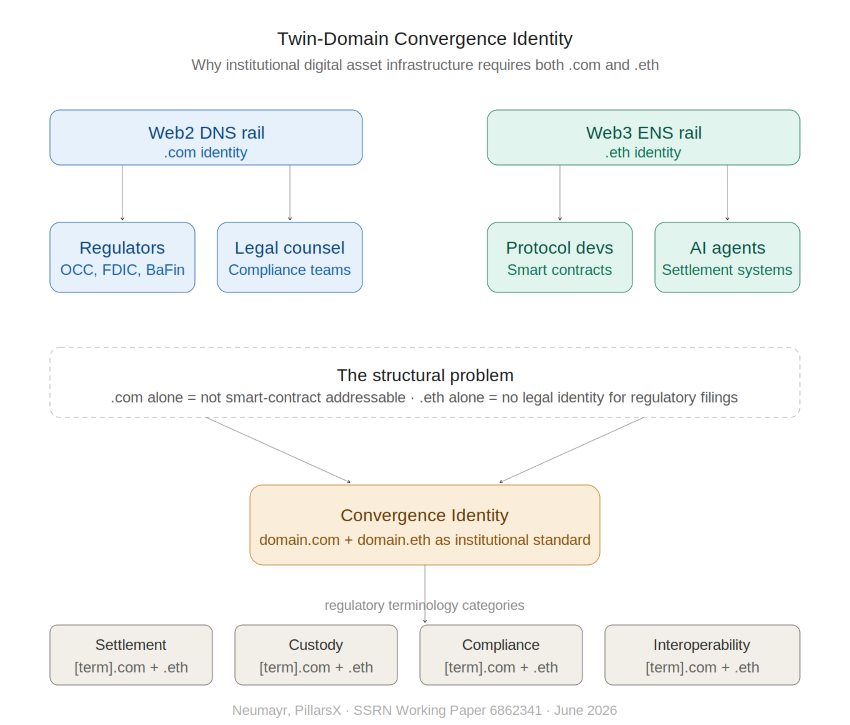
Figure 1: The Twin-Domain Convergence Identity framework — institutional digital asset infrastructure simultaneously serves two incompatible audiences on two incompatible rails, requiring both .com (DNS) and .eth (ENS) as a paired identity standard. Neither alone resolves the dual requirement.
The obvious tension — and why I don’t want to ignore it
Vitalik positioned clearly in early 2026: Ethereum is not a platform for institutional adoption for its own sake. “Dollar tokenization” and serving institutional narratives were explicitly described as distractions from Ethereum’s core mission. The Ethereum Foundation sharpened its mandate toward decentralization, self-sovereignty, and privacy — Kohaku, Account Abstraction, censorship resistance.
I consider this tension real and important to name for this community:
My thesis describes an institutional use of ENS that may operate against Vitalik’s vision — not because it is technically incompatible, but because it instrumentalizes ENS as a namespace layer for regulated, compliance-bound infrastructure. Regulators, OCC examiners, and General Counsel will address ENS domains in a context the Ethereum Foundation may not be actively pursuing.
At the same time, I argue that Kohaku and the privacy infrastructure Vitalik is funding — FHE, ZK-proofs, on-chain privacy — is precisely the technological foundation that makes institutional adoption trustworthy. Confidential computing on Ethereum is both Vitalik’s core theme and the technical basis for institutional settlement privacy.
The question is therefore not whether institutional use exists — it already does. The question is whether the ENS protocol and the Ethereum Foundation want to actively shape this use, or whether it emerges organically without a governance framework.
Three open research questions
-
ENS protocol level: Are there technical impediments preventing ENS domains from achieving the same institutional acceptance as DNS domains in regulated contexts? W3C DID compatibility, legal enforceability, governance risks?
-
Namespace governance: Who should define and standardize regulatory key terms as ENS namespaces — the Ethereum Foundation, ICMA, BIS, or does this emerge organically through market registrations? And is organic emergence consistent with Ethereum’s decentralization mission — or a governance vacuum?
-
Duality of decentralization and compliance: Can ENS simultaneously serve Vitalik’s vision of censorship-resistant, decentralized infrastructure and the requirements of regulated institutions for controlled, legally secured namespace identities — or is this a fundamental contradiction?
The paper is available here: https://papers.ssrn.com/abstract=6862341
I look forward to critical feedback — particularly on whether this community views institutional use of ENS as an enrichment or a contradiction of Ethereum’s core values…
-Rolf Neumayr