What If Smart Contracts Could Trade on ‘Binance’? Introducing the DeCeFi Paradigm
DeCeFi is a paradigm where on-chain users and smart contracts can directly access CEX-level execution and deep liquidity without leaving the blockchain.
TL;DR
-
DeFi is programmable, but execution is weak. CEXs are powerful, but not callable. Smart contracts cannot directly call high-performance trading engines like Binance or advanced order-book venues such as Hyperliquid. Expressive execution and on-chain programmability have never truly met.
-
128.trade introduces DeCeFi, where smart contracts are first-class citizens. Any contract on any chain can invoke exchange-grade spot and perpetual trading through a verifiable gateway, without bridging assets or switching networks.
-
128.trade is trading infrastructure, not a venue. By making execution callable, trading becomes a composable DeFi primitive that protocols can use to hedge, rebalance, and allocate capital with real execution.
Learn more at https://www.128.trade.
Background and Motivation
Trading and DeFi Never Truly Met
Decentralized Finance is programmable by design, while trading on the best venues is expressive and performant. Yet over the past decade, these two systems have evolved in parallel without ever truly converging.
Smart contracts today can lend, borrow, swap, stake, and compose increasingly complex financial logic. Yet they cannot directly execute trades on high-performance markets such as Binance or advanced on-chain venues like Hyperliquid. At the same time, the deepest liquidity and most expressive trading engines remain isolated venues, fundamentally inaccessible to on-chain programs.
This separation is often blamed on UX, latency, or throughput. In reality, it reflects a deeper architectural limitation: trading was never designed as a callable component of the DeFi stack.
The Core Limitation Is Callability, Not Performance
Most discussions around DeFi trading focus on gas costs or fragmented liquidity. These issues matter, but they are secondary.
The fundamental limitation is simple: trading engines are not callable by smart contracts. High-performance execution systems, such as centralized exchanges and order-book-based DEXs alike, operate outside DeFi’s programmable environment. They offer spot and perpetual markets, advanced order types, and deep liquidity, but they cannot be invoked as part of on-chain logic.
As a result, trading remains an external activity coordinated by users or off-chain bots, rather than a native building block that protocols can depend on directly.
Why Existing DEX Architectures Cannot Close the Gap
Current DeFi architectures solve only half of the problem, leaving a structural void that prevents true autonomous execution.
-
AMMs: Programmability Without Power
Automated Market Makers are fully programmable but executionally primitive. Relying on passive liquidity curves, they cannot natively express leverage or complex triggers. They offer a playground for code but lack the “muscles” for professional trading. -
Order-Book DEXs: Built for Humans, Not for Code
Performance-driven venues (like Hyperliquid) offer rich semantics but are designed as applications for users, not infrastructure for protocols.- The Signature Barrier: These platforms are built around EOA (Externally Owned Account) signatures. They require a human clicking a button or a bot using an off-chain API key.
- The “API” Dead End: While they provide sophisticated backend APIs for off-chain bots, they offer no on-chain entry points for smart contracts. A vault or DAO cannot “sign” transactions in the way these venues require, effectively locking out decentralized code.
-
Isolated Islands vs. Callable Primitives
Because they prioritize human-centric UIs, these venues behave like isolated destinations. They cannot be “summoned” or composed into a larger DeFi strategy.
This creates a persistent trade-off: AMMs provide programmability without power, while Order-book DEXs provide execution while treating smart contracts as second-class citizens.
The DeCeFi Vision: Trading as a Sovereign “Syscall”
If the current barrier is built around EOA signatures and isolated applications, the solution requires a fundamental shift in architecture. What if the boundary between on-chain logic and high-performance execution simply dissolved?
We call this new paradigm DeCeFi (Decentralized-Centralized Finance).
“DeCeFi is a paradigm where on-chain protocols and smart contracts command CEX-level execution and deep liquidity as First-Class Citizens. In this world, the trading engine is no longer a destination you visit; it is a Smart-Contract Callable infrastructure, the ‘Trading Lego’ of DeFi that your code invokes to build complex, composable financial strategies.”
System Architecture: How Callable Trading Works
Our design philosophy is to elevate the smart contract into a First-Class Citizen of the global market. By utilizing a unique Oracle-driven execution model, any smart contract on any chain can directly command CEX-level execution and deep liquidity, transforming professional trading into the ‘Trading Lego’ of DeFi—a fully composable building block for the decentralized world.
At a high level, we separate trading into two tightly coupled layers: a deterministic execution engine and a cross-chain access layer that makes this execution safely callable from smart contracts.
A Deterministic Trading Engine as the Execution Core
At the core of the system is a high-performance trading engine that operates as a deterministic state machine. All trading actions—placing and canceling orders, opening and closing positions, funding payments, margin updates, and liquidations—are processed through a single canonical execution pipeline.
Determinism is a foundational property. Given the same prior state and the same ordered set of requests, the engine always produces the same result. This allows execution to be audited, replayed, and verified independently. It also enables the engine to be run by multiple nodes under consensus, forming the basis for decentralized integrity and future proof systems.
From the engine’s perspective, every action is simply a request. Whether that request originates from a low-latency API client or from a smart contract on another chain is irrelevant once it enters the execution queue. This unification ensures that all consumers share the same liquidity, the same execution logic, and the same state transitions.
Making Execution Callable via an Oracle-Style Gateway
Smart contracts cannot directly interact with off-chain, high-performance trading engines. To make execution callable, we introduce an oracle-style gateway—designed for execution rather than data.
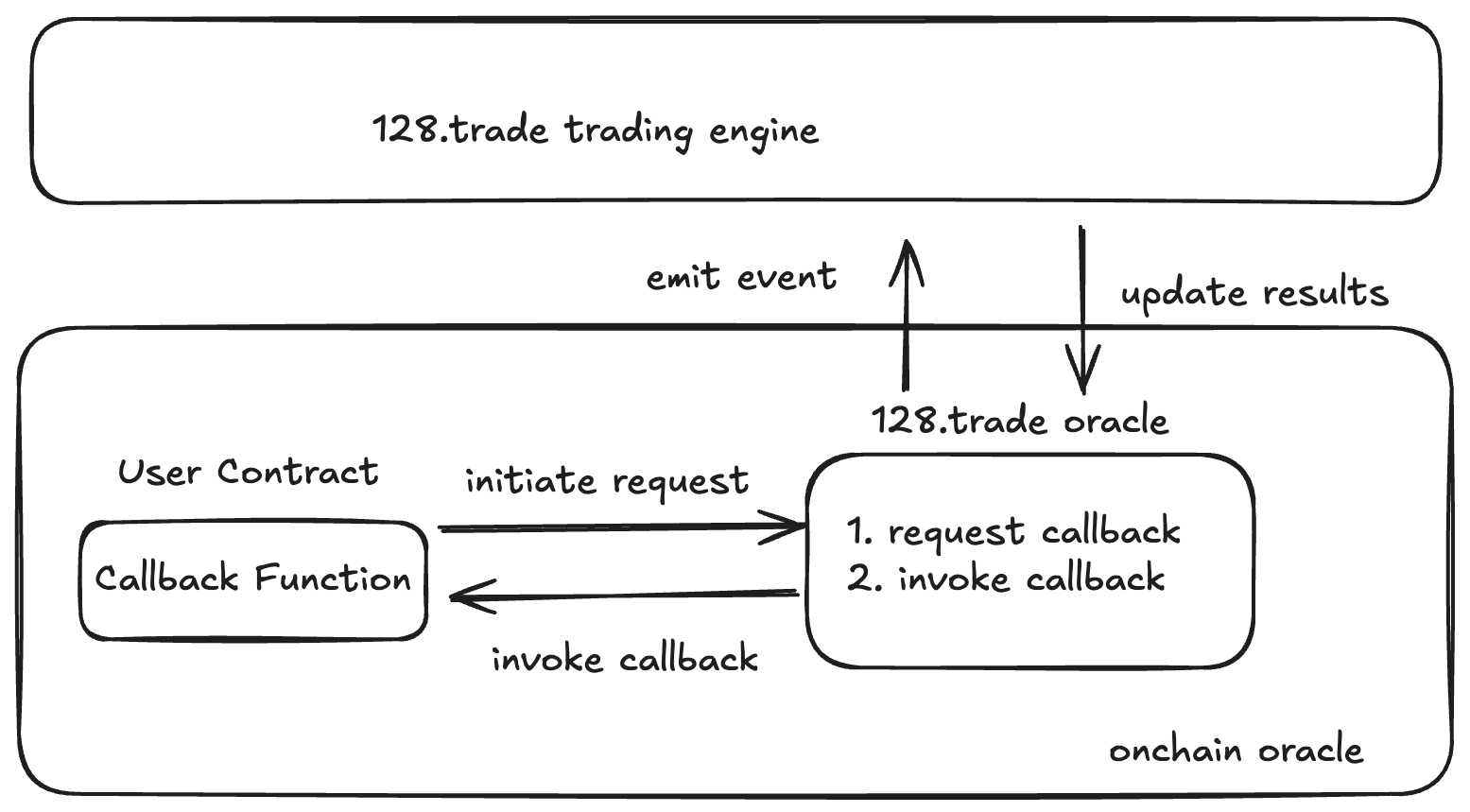
The diagram above illustrates the core execution flow, from on-chain request to verified execution and on-chain settlement. For a more intuitive, end-to-end walkthrough of this process—including how contracts, relayers, and the trading engine interact in practice—we provide a UI/UX demo of the execution workflow at: https://www.128.trade/how-it-works
At a high level, the workflow looks like this:
-
On-chain intent.
A smart contract calls a gateway function (e.g. place an order, open a position, subscribe to a strategy).
This does not execute a trade on-chain. Instead, it emits a canonical request event that encodes execution intent, parameters, and origin-chain context, along with a unique request ID. -
Request forwarding.
A decentralized relayer network monitors gateway events, validates their provenance, and forwards authenticated requests to the trading engine.
From the engine’s perspective, these requests are indistinguishable from API-based orders and enter the same deterministic execution queue. -
Deterministic execution.
The trading engine processes the request—matching orders, updating margin, applying funding, or triggering liquidations—and produces a deterministic execution result. -
Proof-backed callback.
The execution result is returned asynchronously to the originating chain via a callback, accompanied by a cryptographic proof bundle (e.g. threshold signatures or execution attestations).
The gateway verifies the proof, enforces idempotency and replay protection, and only then applies the result on-chain. -
On-chain materialization.
Verified results are materialized as on-chain state: position NFTs, vault shares, balance updates, or contract callbacks.
This architecture allows any smart contract, on any supported chain, to invoke exchange-grade trading—spot, perpetuals, limit and trigger orders—without bridging assets, switching networks, or trusting a single operator. Execution becomes a callable system primitive, with correctness enforced on-chain.
From a builder’s perspective, trading shifts from an external dependency into a callable syscall. Smart contracts express execution intent, the trading engine performs deterministic execution, and verified results materialize back on-chain through callbacks. Protocols no longer integrate with venues; they compose execution directly into their logic.
The example below illustrates how this works in practice. A smart contract can place a perpetual order by calling placePerpOrder, which submits an execution request to the trading engine via the oracle layer. Once the order is executed, the result is returned asynchronously, and developers can handle it inside their own contract logic by implementing the corresponding callback function.
function placePerpOrder(PerpOrderParams calldata params)
    external payable override returns (bytes32 requestId) {
    // submit a perpetual order request to the trading engine via the oracle
    requestId = oracle.submitRequest{value: value}(params);
    return requestId;
}

function onPlacePerpOrderResult(...) external onlyOracle {
    // handle the execution result of the perpetual order
    // custom logic defined by the contract developer
}
One Engine, Two Worlds
The same trading engine simultaneously serves two fundamentally different consumers. On one side, traders, market makers, and automation systems interact through low-latency APIs optimized for performance. On the other, smart contracts and protocols access the engine through a trust-minimized, proof-backed gateway.
Both access paths converge on the same execution layer. They share liquidity, execution semantics, and state transitions. This is what transforms trading from an isolated venue into shared infrastructure.
What This Unlocks for DeFi
Making high-performance trading callable by smart contracts unlocks a set of capabilities DeFi has never had before.
-
Smart contracts gain direct access to exchange-grade trading.
Contracts can place spot and perpetual trades with Binance-level execution semantics, including limit orders, trigger orders, leverage, and advanced order logic. Trading is no longer an off-chain activity coordinated by users or bots — it becomes a programmable function protocols can call directly. -
Trading state becomes on-chain and composable.
Exchange-native objects such as spot balances, perpetual positions, subaccounts, and strategy portfolios can be represented as on-chain assets. Positions and subaccounts are no longer locked inside venues — they can be collateralized, lent, staked, or embedded into structured products. -
Protocols gain active execution and new design space.
Vaults and funds can trade directly instead of relying on approximations. Lending protocols can hedge and manage risk with conditional execution rather than over-collateralization alone. At the same time, entirely new protocol classes become possible — including fully on-chain funds, AMMs with active hedging, and autonomous trading agents managing capital with verifiable guarantees.
The result is not another exchange, but a shift in architecture. Trading becomes shared infrastructure rather than a destination — a core execution layer that protocols compose just like data and liquidity.
Competitive Landscape: Venue vs Infrastructure
Most existing projects improve trading venues.
128.trade redefines trading as infrastructure.
Comparison with Existing Models
| Project | Category | What It Provides | Structural Limitation | 128.trade Difference |
|---|---|---|---|---|
| dYdX / Aster / Lighter | Perp DEX | On-chain perpetual trading | Single-chain applications, not callable by arbitrary smart contracts | Multi-chain callable execution engine |
| Hyperliquid | Custom L1 trading venue | High-performance orderbook + HyperEVM | Interoperability limited to its own ecosystem | Any-chain integration via oracle-style gateway |
| Uniswap / 1inch | AMM DEX | Fully programmable swaps | Limited execution semantics (no native perps, leverage, trigger orders) | Full spot + perpetual execution with advanced order types |
| Chainlink | Data Oracle | Verifiable off-chain data | Provides information, not execution | Execution oracle — verifiable action, not just data |
Where 128.trade Sits in the Stack
| Layer | Chainlink | Hyperliquid | 128.trade |
|---|---|---|---|
| What it provides | Data | Trading venue | Trading infrastructure |
| Who integrates | Protocols | Traders | Protocols & Traders |
| Distribution model | Protocol-native | App-native | Protocol-native, cross-chain |
| Composability | High | Low | High |
| Growth ceiling | DeFi-wide | Venue-bound | DeFi-wide |
| Monetization | Per-call oracle fees | Trading fees | Execution-layer trading fees |
A New Category
128.trade combines:
- Chainlink’s protocol-level distribution
- Hyperliquid’s execution depth
- CEX-grade liquidity and order semantics
But instead of being a destination, it becomes a callable execution primitive.
We are not building another exchange.
We are introducing a new category:
The Trading Infrastructure Layer.
Looking Ahead
128.trade is under active development, with our testnet launching soon. As the system matures, smart-contract interfaces and core components will be progressively opened to developers, alongside open-sourced contract code.
For a deeper technical dive into the architecture, trust model, and execution guarantees, the full whitepaper is available at https://www.128.trade/pdf/whitepaper.pdf.
We believe trading should be a programmable primitive, not an isolated venue, and this is the first step toward making that real.