Worst-Case Block Size and Calldata Repricing for Glamsterdam
Ethereum’s worst-case block size keeps surfacing as an issue, typically via adversarial constructions rather than honest usage. Average blocks are small; worst-cases are not.
Background
Pre-Pectra, worst-case block size was driven by Snappy compression inefficiencies and cheap calldata (4/16 gas for zero/non-zero bytes).
EIP-7623 (Pectra) addressed this by raising calldata costs to 10/40 gas for calldata-heavy transactions. This introduced a new worst-case construction:
- ~3/5 of block gas spent on EIP-2930 Access Lists
- ~2/5 spent on calldata
- Structured to avoid triggering the EIP-7623 floor → “just enough execution gas to keep paying the lower price”
The issue: access list data is essentially free. This circumvents EIP-7623 and inflates worst-case block size again.
Why This Matters Now
Rising block gas limits and blob counts will further stress propagation. While ePBS (shipping with Glamsterdam) extends propagation time, BALs increase raw block data: counterproductive on this front.
Proposed Repricings (Both EIPs are CFI’d for Glamsterdam)
EIP-7981: Increase Access List Cost
Applies calldata costs to transaction access lists. This closes the circumvention path: gas payment now tracks actual data as if it was calldata.
EIP-7976: Increase Calldata Floor Cost
Two options under discussion:
- As spec’ed: raise pricing from 10/40 → 15/60 gas for calldata-heavy transactions; simple 50% price increase
- Alternative: flat 64/64 gas per byte, eliminating the zero/non-zero distinction
Interaction with ePBS
ePBS might come with a dynamic payload deadline: the PTC enforces tighter deadlines for smaller payloads.
The CL does not want to enshrine a specific Snappy encoding. Flat per-byte pricing (option 2) is better here: the worst-case size becomes more predictable when using the uncompressed payload size.
A possible way forward
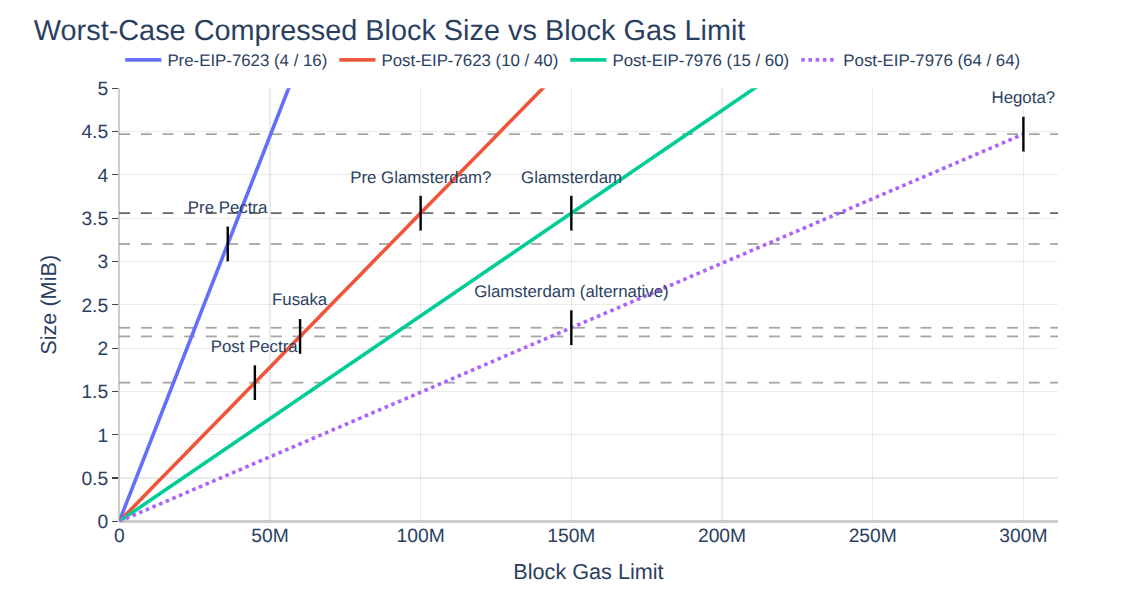
With EIP-7976, as-is (15/60 for zero and non-zero bytes), we can get to a block gas limit of 150 million without exceeding a worst-case block size of 4 MiB. The alternative, arguably, the more aggressive repricing (64/64; no distinction between zero and non-zero bytes), would get us down to a worst-case block size of 2.25 MiB, leaving room for further gas limit increases toward 300 million in the future.
Feedback welcome!