Solving Spam, State Bloat, and Fee Volatility with a Single Parameter

Solving Spam, State Bloat, and Fee Volatility with a Single Parameter

A Minimum Base Fee for Execution Gas: Bounding EIP-1559 from Below at Scale


EIP-1559’s base fee has no lower bound. As capacity scales, the base fee converges to zero whenever demand falls below the 50% target—which becomes the steady state as Ethereum scales L1 directly (gas limits targeting 100–200M by late 2026). This enables near-free spam (demonstrated by the January 2026 address poisoning crisis), collapses the ETH burn, and erodes the protocol’s economic foundations. We propose adding a single parameter: b_{t} = \max(b_{\min},\, f(b_{t-1}, g_t)). Ethereum already implements a floor for blob gas (EIP-4844); execution gas has no equivalent bound. A trustless network requires that misbehavior has a cost; when that cost is zero, economic incentives break down and the protocol cannot keep itself honest.


1. The Problem: Unbounded Decay

The EIP-1559 base fee updates as:

b_{t+1} = b_t \left(1 + \frac{1}{8} \cdot \frac{g_t - T}{T}\right)

where T = G/2 is the target gas. At g_t = 0, the base fee decays by factor 7/8 per block, halving every ~5.2 blocks. From any starting value, b_t reaches negligible levels within tens of blocks of sustained below-target utilization. As L1 capacity outpaces organic demand, the consequences are severe:

  • Near-zero base fees collapse the EIP-1559 burn mechanism, making ETH permanently net inflationary
  • They eliminate the cost of spam, enabling industrial-scale address poisoning and phishing contract deployment
  • They erode the security budget by shifting validator revenue entirely to MEV extraction
  • They accelerate state bloat as junk transactions create permanent storage entries across every full node

At 15 TPS (pre-scaling Ethereum), the ~7.5 TPS target was routinely exceeded by organic demand. At projected capacities of 1,000–10,000+ TPS post-Fusaka and beyond, the target becomes 500–5,000 TPS. As Buterin acknowledged on February 3, 2026, the rollup-centric roadmap “no longer makes sense”—L1 is scaling directly, with gas limits expected to reach 100–200M by late 2026. But this L1 scaling exacerbates the base fee problem: more L1 capacity means the 50% target becomes even harder to sustain, and the base fee spends more time decaying toward zero.

The problem only gets worse from here. The 2026 roadmap includes Glamsterdam (mid-2026) with parallel execution and block-level access lists pushing the gas limit toward 100–200M, with Stańczak suggesting up to 300M by year-end. Each capacity increase widens the gap between target and organic demand, accelerating base fee decay. The pattern is already empirically visible: Dencun (March 2024) began the revenue decline; Fusaka (December 2025) collapsed it. Without a floor, Glamsterdam and subsequent upgrades will lock in near-zero fees as a permanent structural feature—not a temporary low-demand phase, but a mathematical inevitability of scaling capacity faster than demand.


2. Consequences

Revenue Collapse

Post-Fusaka, Ethereum hit an all-time high of 2,885,524 daily transactions (January 16, 2026) while daily ETH burned collapsed from a 7-day average of ~150 ETH in November to ~35 ETH in January—a direct manifestation of unbounded base fee decay at increased capacity.
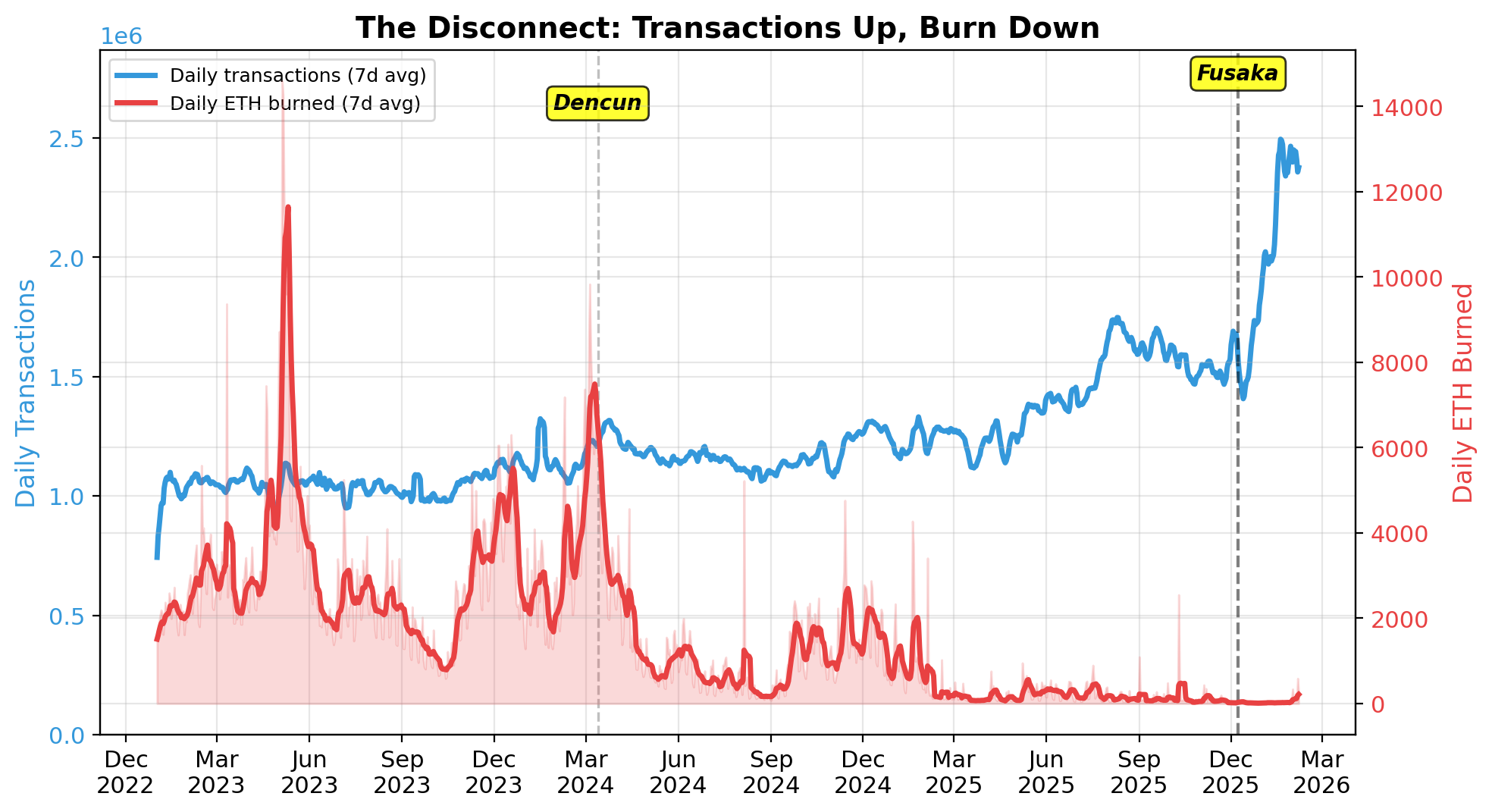

Fig 1: Daily transactions vs daily ETH burned, Jan 2023–Feb 2026. Each capacity upgrade (Dencun, Fusaka) accelerates the disconnect between activity and burn.

Daily fee revenue averaged $12.9M in Q1 2024; by January 2026 it averaged $452K—a 96.5% collapse. The average transaction fee fell from $10.78 to $0.20 over the same period. Average daily burn declined from 3,665 ETH in Q1 2024 to 35 ETH in January 2026—a 99% decline—while average daily transactions rose from 1.15M to 2.26M. This is not merely a burn problem: the entire fee economy has evaporated.

Burn Rate Collapse and Supply Dynamics

EIP-1559 burns the base fee. As b_t \to 0, burn → 0 regardless of transaction volume, and ETH becomes net inflationary. As of February 2026, the daily ETH burn is approximately 35 ETH, offsetting roughly 1.3% of daily issuance (~2,720 ETH/day at 35.8M staked ETH). At current volumes (~2.5M daily transactions, ~100K average gas), the baseline burn approaches zero as b_t \to 0. Demand spikes—such as the February 2026 market crash—temporarily restore meaningful burn, but these are transient: the base fee decays back to near-zero within blocks of demand subsiding. The steady-state burn under scaled capacity is negligible, and the mechanism provides no guaranteed minimum.

Adversarial Exploitation

Let an attacker send M adversarial transactions, each consuming g_a gas units (~45,000–65,000 for a standard ERC-20 transfer). Attack cost:

C_{\text{attack}} = M \cdot g_a \cdot b_t

When b_t \approx 0, C_{\text{attack}} \approx 0 for any M. The January 2026 address poisoning attack — M \approx 10^7 per day, g_a \approx 45,000–65,000 gas — cost attackers effectively nothing at prevailing base fees, while generating $740K+ in documented victim losses at ~0.01% conversion.

Address poisoning is only one attack vector enabled by near-zero fees. Others include:

  • Airdrop scam tokens and wallet drainers. Attackers deploy malicious contracts that airdrop worthless tokens to thousands of wallets. Users who interact with them trigger calls that drain their wallets. Deployment cost scales linearly with b_t and approaches zero with it.
  • State bloat. Every transaction that creates accounts or writes storage imposes a permanent cost on every full node. Ethereum’s chain data exceeds 3 TB, with state doubling every 12–18 months. Near-zero fees leave this externality unpriced.
  • Phishing contracts. He et al. (SIGMETRICS 2025) documented 37,654 malicious contracts, 171,984 victims, and $190.7M stolen. Deployment cost per contract approaches zero as b_t \to 0.

The common thread: every attack that depends on sending many low-value transactions becomes cheaper as b_t \to 0. At current base fees, there is no economic deterrent proportional to attack volume.

Security Budget

When b_t \approx 0, validator revenue shifts from fees to MEV extraction. The community has invested significant effort mitigating MEV’s centralizing effects—Flashbots’ MEV-Boost, enshrined PBS (EIP-7732), and MEV-burn proposals—yet near-zero base fees make MEV the dominant revenue source by default, undermining those efforts.

Second, persistent zero burn makes ETH permanently net inflationary. At current issuance (~993,000 ETH/year) with negligible burn, ETH faces continuous dilution pressure. Lower ETH price means lower cost to accumulate an attacking stake, weakening the link between network usage and ETH scarcity that underpins the economic security model.

State Growth

Ethereum’s chain data now exceeds 3 TB, with state doubling approximately every 12–18 months. In December 2025, the Ethereum Foundation’s Stateless Consensus team warned that unchecked state growth threatens censorship resistance: if “only a small set of sophisticated operators can afford to store full state,” the network’s decentralization guarantees erode. Full nodes already require 4–8 TB NVMe SSDs.

Near-zero base fees remove the economic deterrent against storage-creating transactions. Address poisoning alone generates millions of new account entries per day—each permanently stored by every archive and full node. State expiry and statelessness are the long-term solutions, but neither is deployed; in the meantime, the externality is unpriced.


3. Empirical Motivation: January 2026 Address Poisoning

In January 2026, Ethereum recorded 2.89M daily transactions (ATH, January 16). Analysis by Sergeenkov and Coin Metrics demonstrated this was driven predominantly by address poisoning:

  • Attackers deployed contracts distributing sub-$1 stablecoin dust to millions of addresses
  • 67% of new addresses (3.86M / 5.78M) received dust as their first stablecoin transaction
  • Post-Fusaka, stablecoin dust rose from 3–5% to 10–15% of transactions; affected addresses rose from 15–20% to 25–35%
  • 116+ victims lost $740K+; one individual lost $509K
  • Academic study (arXiv:2501.16681) documented 270M+ poisoning attempts
  • ScamSniffer reported a single victim losing $12.25M on January 31

4. Precedent: Blob Gas Floor

EIP-4844 specifies MIN_BLOB_GASPRICE = 1 wei. The community has concluded this is too low: EIP-7762 proposes ~$0.01; EIP-7918 bounds blob fees by execution cost. Fusaka itself implemented EIP-7918’s blob floor. The rationale—preventing fee collapse, enabling price discovery—applies identically to execution gas, which remains the only fee market without a floor.

Cross-chain Context: Tron

Tron provides a useful benchmark. According to Arkham’s TRON Stablecoin Ecosystem Report (Jan 9, 2026), Tron hosts over $80B in stablecoin supply, processes $20B+ in daily USDT volume across 2M+ transactions, and dominates 60–80% of stablecoin transfers above $1,000. Growth CAGRs exceed 50% across volume, transactions, and active addresses since 2021—all with a meaningful fee floor.

As of 03:15 UTC on February 9, 2026 (GasFeesNow):

Chain USDT Transfer Fee
Ethereum (ERC-20) $0.0034
Tron (TRC-20) $1.78–$3.72

Ethereum is currently 500–1,100× cheaper than the chain widely regarded as the low-cost stablecoin rail. It has eliminated any meaningful cost barrier to spam.

A 1 gwei floor would raise a USDT transfer (~65K gas) to ~$0.13—still 14–29× cheaper than Tron—while restoring minimal spam resistance.


5. Proposal

Specification

Introduce MIN_BASE_FEE (b_{\min}):

\boxed{b_{t+1} = \max\left(b_{\min},\; b_t \left(1 + \frac{1}{8} \cdot \frac{g_t - T}{T}\right)\right)}

One parameter. No changes to transaction format or wallet behavior. Above b_{\min}, the mechanism is unchanged.

Properties

  1. Minimal change. One constant. No format or encoding changes.
  2. General. Addresses any attack vector depending on near-zero cost.
  3. Preserves EIP-1559 dynamics. Unmodified above the floor.
  4. Bounds supply trajectory. Minimum burn compresses inflation/deflation range.
  5. Consistent with blob market. Extends an existing protocol pattern.

Mechanism Design

Roughgarden’s DSIC, MMIC, and OCA-proofness are preserved: above b_{\min}, the update rule is unchanged. When the floor binds, the base fee is a protocol-enforced fixed price—users pay the posted price (DSIC), proposers include transactions paying ≥ b_{\min} (MMIC), and no party can collude below the enforced floor (OCA-proofness).

Calibration

A 1 gwei floor makes a standard transfer (21,000 gas) cost a few cents ($0.04–0.06 at current ETH prices)—within demonstrated tolerance—while raising the cost of 10^7 daily poisoning transactions to ~650 ETH/day. This static parameter provides an immediate safety bound while minimizing complexity; dynamic adjustments remain an area for future work (see Open Questions below).

At the current base fee of ~0.047 gwei (Etherscan, 22:08 UTC Feb 8, 2026), common transactions cost fractions of a penny. A 1 gwei floor raises costs to levels that remain trivial for users but meaningful for spam:

Transaction Gas Current (~0.047 gwei) With 1 gwei floor
ETH transfer 21,000 $0.002 $0.04
USDT/USDC transfer 65,000 $0.006 $0.14
Uniswap swap 150,000 $0.015 $0.31
NFT mint 200,000 $0.020 $0.42
Complex DeFi 400,000 $0.039 $0.83

For context, a USDT transfer on Tron costs $1.78–$3.72 (GasFeesNow, 03:15 UTC Feb 9, 2026), and Tron processes 2M+ stablecoin transactions per day with 50%+ annual growth (Arkham)—demonstrating that users readily pay meaningful fees when the service is reliable. Even the most gas-intensive common operation on Ethereum at a 1 gwei floor ($0.83) remains cheaper than the simplest transfer on Tron.

Spam Resistance

A floor establishes a minimum attack cost: C_{\text{attack}} \geq M \cdot g_a \cdot b_{\min}, where M is the number of adversarial transactions, g_a is the gas consumed per transaction, and b_{\min} is the floor base fee. For the January 2026 address poisoning attack — M \approx 10^7 per day, g_a \approx 45,000–65,000 gas — at b_{\min} = 1 gwei:

C_{\text{attack}} \geq 10^7 \times (45,000\text{–}65,000) \times 10^{-9} = 450\text{–}650 \text{ ETH/day} \approx \text{\$900K–\$1.3M/day}

At ~0.01% conversion and ~$740K in total documented losses, a 1 gwei floor makes the attack clearly uneconomical at any plausible ETH price.

Burn Restoration

The annualized burn rate B at a constant base fee b with N daily transactions of average gas \bar{g}:

B = 365 \cdot N \cdot \bar{g} \cdot b

At N = 2.5 \times 10^6 and \bar{g} = 10^5 gas:

b_{\min} (gwei) Daily burn (ETH) Annual burn (ETH) Issuance offset
1 250 91,250 11%
3 750 273,750 33%
5 1,250 456,250 55%
9 2,250 821,250 99%

These are lower bounds on burn. When b_t > b_{\min}, the floor does not bind. Backtesting against actual 2025 data using daily gas consumption derived from Etherscan confirms this: with a 1 gwei floor, actual burn already exceeded the floor on 141 of 365 days, so the floor would only have bound on the remaining 224 days—adding ~19,000 ETH of burn (approximately $38M at current prices). A 3 gwei floor binds on 307 days, adding ~101,000 ETH; a 5 gwei floor binds on 333 days, adding ~197,000 ETH.

Using January 2026 transaction volumes (2.26M/day average) and ~100K average gas per transaction, even a 1 gwei floor guarantees ~226 ETH/day—6× the actual burn. A 3 gwei floor guarantees ~678 ETH/day (25% of issuance); a 5 gwei floor guarantees ~1,130 ETH/day (42% of issuance).
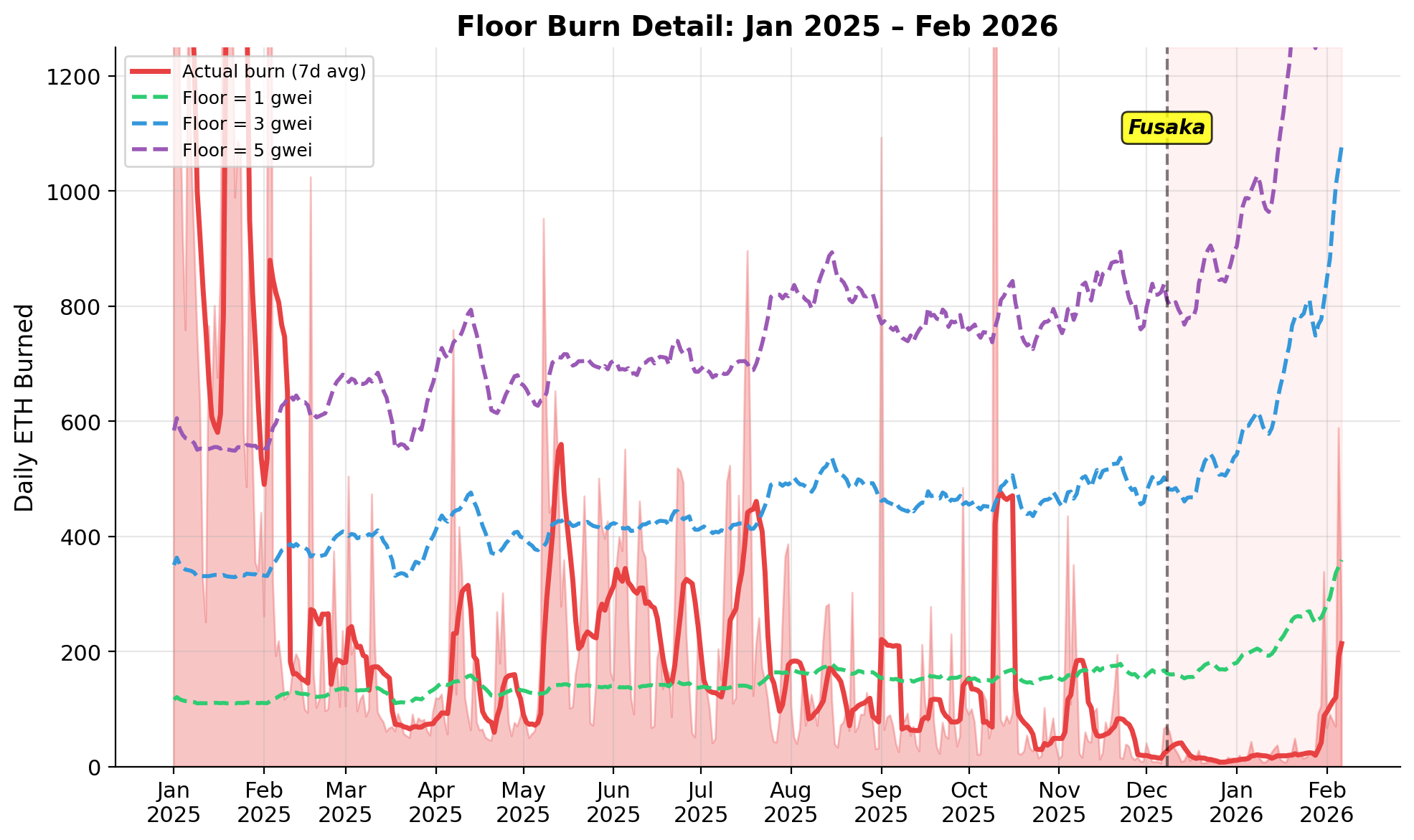

Fig 2: Actual daily ETH burn vs minimum burn under floor levels of 1, 3, and 5 gwei. Floor burn computed from actual daily gas consumption.


6. Who Benefits

A common objection to fee floors is that they impose costs on users for the benefit of token holders. In practice, a well-calibrated floor is positive-sum across all stakeholders:

  1. Users. The primary beneficiaries. Address poisoning, dust spam, and state bloat all impose costs on users—lost funds, polluted transaction histories, degraded wallet UX, and slower state access. A 1 gwei floor makes a standard transfer cost a few cents while making large-scale spam campaigns uneconomical.
  2. Validators. When b_t \approx 0, validator revenue shifts entirely to MEV extraction and consensus rewards. A floor restores a fee revenue component, reducing dependence on MEV and improving staking economics predictability.
  3. ETH holders and supply dynamics. EIP-1559’s burn mechanism was designed to link network usage to supply reduction. A floor restores this link by bounding the burn rate from below. At January 2026 transaction volumes, even a 1 gwei floor offsets ~9% of issuance; a 5 gwei floor offsets ~43%.
  4. L2s. Buterin recently argued that L2s should not be “Ethereum but cheaper” but should specialize—privacy VMs, app-specific execution, institutional finance, gaming, AI inference. A floor fee directly enables this transition. When L1 fees → 0, L2s cannot differentiate on price or features. A 5 gwei L1 floor (~$0.80/tx) restores a clear price signal: L2s charge $0.01–$0.05 and remain 15–80× cheaper, giving them room to fund specialized features from sequencer revenue rather than racing to zero.
  5. Application developers. Near-zero fees attract spam that degrades the on-chain environment applications depend on. DEX interfaces polluted with dust tokens, lending protocols with spam collateral events, and wallets cluttered with poisoning artifacts all impose development and UX costs.
  6. Node operators. Every spam-created account and storage slot is a permanent addition to Ethereum’s state, which every full node must store and serve. The EF’s Stateless Consensus team warned in December 2025 that state bloat threatens censorship resistance. A floor prices the state externality.
  7. Institutional participants. Ethereum ETFs attracted $9.9B in inflows in 2025, with BlackRock’s ETHA exceeding $11B in AUM and its staked Ethereum ETF (ETHB) filed in December 2025. Institutions require predictable cost modeling, clean on-chain state, and a sound underlying asset. Near-zero fees undermine all three: fee volatility “impedes transaction cost predictability and hinders institutional adoption” (see also Roughgarden 2021); spam-polluted transaction histories create compliance risks; and permanent net inflation erodes the value of ETH held as collateral or treasury. Notably, Madrigal-Cianci et al. propose addressing fee unpredictability by building a derivatives market (gas options priced via Monte Carlo simulation) on top of the volatile base fee. We argue that a structural fix—bounding the base fee from below—is preferable instead of layering financial complexity on the underlying problem: a derivatives market requires the volatility to function and helps only sophisticated actors who can hedge, while a floor eliminates the pathological regime at the protocol level for all users.
  8. ZK provers. As Ethereum transitions to ZK-proven execution, provers invest in specialized hardware (GPUs, FPGAs, ASICs) and need predictable economics. A floor ensures meaningful fee revenue exists in the system regardless of utilization. Moreover, ZK proving enables more aggressive L1 scaling — blocks can be verified without re-execution — which pushes gas limits higher and accelerates base fee decay. The floor becomes more necessary as the proving market matures, not less.

The key insight: the current near-zero fee regime is not “cheap Ethereum”—it is unpriced Ethereum, where the costs of spam, state pollution, and fee unpredictability are externalized onto all network participants.


7. Why 1 Gwei Today and Why Dynamic Pricing Matters at Scale Later

At current ETH prices (~$2,080), a 1 gwei floor makes a standard transfer (21,000 gas) cost ~$0.04 — well above one cent, meaningful enough to deter spam at volume, yet trivial for legitimate users.

A static floor becomes increasingly powerful as throughput grows. The annual burn at a 1 gwei floor with N daily transactions of average gas \bar{g} = 10^5 is:

B = 365 \cdot N \cdot \bar{g} \cdot b_{\min} = 365 \cdot N \cdot 10^5 \cdot 10^{-9} = 3.65 \times 10^{-2} \cdot N \text{ ETH}

At current volumes, 1 gwei is conservative. At projected L1 scale, it becomes aggressively deflationary:

Daily TXs TPS Annual burn (1 gwei) vs. ~1M ETH issuance
2.5M 29 91,250 ETH 9% offset (inflationary)
5M 58 182,500 ETH 18% offset (inflationary)
27M ~315 ~1,000,000 ETH ~ breakeven
86M 1,000 3,139,000 ETH 3× issuance (deflationary)
864M 10,000 31,536,000 ETH 32× issuance (hyperdeflationary)

The crossover to deflation occurs around ~315 TPS — a throughput level Ethereum could realistically reach within 1–2 years of Glamsterdam. At 1,000 TPS, even 1 gwei burns 3× issuance per day; at 10,000 TPS (the long-term roadmap target), it burns ~26% of total ETH supply per year from a 1 gwei floor alone.

We propose:

  1. Starting at 1 gwei — the most conservative static value that still solves the immediate spam/burn problem
  2. Planning a dynamic floor as a future upgrade — one that at minimum maintains the per-gas price needed for the protocol’s economic mechanisms to function: spam stays uneconomical, the burn mechanism stays alive, state creation stays priced, and validators retain fee revenue. As throughput scales, that per-gas price can decrease — but it can never be zero.

A static 1 gwei floor is the right first step because it requires minimal complexity and solves the acute problem. But the scaling dynamics above make clear that any static floor will eventually need adjustment as L1 throughput grows by orders of magnitude. The design of a dynamic mechanism is left as future work, but the principle is the same at any scale: the floor isn’t about making ETH deflationary — it’s about ensuring the protocol’s economic mechanisms function at all.


8. Open Questions

  1. Should Ethereum have a minimum execution base fee?
  2. Static vs. dynamic floor?
  3. Should the 50% utilization target be revisited as L1 capacity scales, or is it orthogonal to the floor question?

9. Conclusion

A minimum execution base fee is a single-parameter change that addresses multiple structural problems simultaneously. The floor isn’t about making ETH deflationary — it’s about ensuring the protocol’s economic mechanisms function at all. Spam resistance, burn, state pricing, and validator economics all break at zero. A floor fixes all four.

It restores the EIP-1559 burn mechanism as designed. It raises the cost of phishing contracts that have stolen $190M+ from Ethereum users and prices the 1M+ daily address poisoning attempts that the post-Fusaka fee collapse made economical. It slows state bloat that the Ethereum Foundation itself warns threatens decentralization. It preserves the L1/L2 economic gradient that funds the specialization Buterin now calls for. It reduces validator dependence on MEV extraction. And it brings execution gas in line with blob gas, which already has a protocol-enforced floor.

When the cost of misbehavior is zero, economic incentives break down. A floor doesn’t make Ethereum expensive—it makes it honest.


4 Likes

The network does not use a native token with a stable value like some networks that use stablecoins such as Gnosis. Ultimately, transaction costs will increase to an unacceptable level as the price of ETH rises in the future.

I am in strong agreement with the proposal to have a minimum bound in tx fee, starting with 1 Gwei. Static? Yes. Otherwise a dynamic floor might be as good as what we are having right now, i.e. cheapass fee that encourages address poisoning.

Regarding the worry that such proposal may be detrimental, i.e. causing tx fee to rise exponentially as the price of ETH rises exponentially in the future. This is an intellectual fallacy because it relies on the absolute assumption that ETH price will definitively and absolutely rise exponentially in the future, guaranteed (by some magical and yet unknown factor). What I fear most is if the current setting is kept prevalent to the point whereby the network ultimately become so polluted and defiled by address poisoning (and potentially many other threats arising in the future), that the future scenario whereby the price of ETH rises, if any at all, becomes non-existent.

So please don’t bother about the future that nobody even know about or even absolutely assured of, and start solving the most immediate problem that may soon become terminal, irreversible, and end up with pointless regrets about what we should have done differently, instead of keep peddling about “what if the ETH price will rise exponentially in the future”.

I say, what if the price of ETH will NEVER rise if we keep on making wrong decisions today?

Because the price of ETH is unstable, we cannot be certain whether this floor price will be sufficient to prevent the creation of spam addresses. Imagine that one day in the future the price of ETH returns to its ICO price, then, how much would we have to adjust the floor price? 100, or 1000 gwei? And then, when prices rise again, the entire impact will hit each user’s wallet directly. So how should we balance the floor price with price volatility? Perhaps we’ll need an oracle to calculate the ETH price and feed it into CL to deduce the floor price based on some price function, of course, implementation is not simple from the perspective of consensus and decentralization.

Fortunately, we have EIP-2780 and EIP-8037, which effectively control the mass creation of new accounts, indirectly reducing the attacker’s incentive by decreasing the number of accounts that can be created in a block. This is a fitting punishment for spammers, but it hardly harms ordinary users.

Based on your explanation, that means Ethereum blockchain is inherently fundamentally + structurally flawed (in a way), because the gas fee can never ever be ideally nor optimally determined.

Or maybe is it just because you have been valuing or estimating everything based strictly on fiat dollar? Should be some food for thought. Maybe if you value everything ETH based on ETH itself alone (not based on an fiat money value, be it dollar, yen, renminbi, or euro), that the worry about variable fee would not arise regardless of the price of ETH, hmm…

As long as the cost of doing crime is close to nil, the incentive to commit the crime will remain close to infinite. If crime method A no long works, then the criminals will figure out crime method B. Controlling the mass creation of new accounts is not without its limitations and may very likely just be a temporal and insignificant band aid fix. And then the development team will face with another exploit requiring further EIPs. The more EIPs you have in place to fix a problem (that cannot be absolutely fixed with any of the EIPs on its own), the more unnecessarily complicated the development will be. And as the incentive to do crime is near infinite (because the cost of exploit is near zero), I predict the number of EIPs required to fix all possible + potential future exploits to be near infinite too, don’t you think?

Update:
Almost forgot to mention this…As the tx cost (and cost of exploit) gets closer to zero (cheapass price maybe because the banksters-cum-sponsors demand for it for some high frequency trading operations), the “money supply” of ETH is now becoming inflationary → validator reward falling → decreasing incentive to be validator → increasing the risk of validation being dominated only by a few shadow elite group of people → compromised blockchain ultimately devolved to serve only the banksters, it should be clear that the cost of having an undefined floor price of transactions significantly outweighs everything.

Update #2:
In answering your question, if the price of ETH gets to ICO level, i.e. dirt cheap market cap, two scenarios become possible:
Scenario 1: People start to use ETH blockchain for dirt cheap and low-value transactions, thus the 1 Gwei floor price will remain feasible.
Scenario 2: People start to use ETH blockchain for high-value transactions, thus requiring cargo-load of ETHs per transaction. In this case, the price of ETH as denominated in fiat dollar will not remain dirt cheap at ICO level for too long, thus rendering the effort to re-adjust the floor price from 1 Gwei to say, 1000 Gwei, become unnecessary. That floor price can stay at 1 Gwei.

I agree that the Ethereum network has gas computing issues but we are making important strides toward achieving overall harmony.

The current economic model still revolves around the USD, evident in how people value it. This model is unlikely to change anytime soon, so the prospect of an economy based entirely on ETH is very distant. Until then, transaction costs have always been unpredictable.

Raising the price floor to a certain point essentially flattens the impact across the board, which is not a good approach. We expect the model to minimize the incentive for bad actors while being positive (or at least neutral) for small retail users.

This requires analyses of the behavior between different entities, and we’ve drawn a few conclusions:

1. Attackers tend to create more states : EIP-2780 and the upcoming EIP-8037 will patch this vulnerability.

2. The attackers poisoned the address with small transactions : Wallet interfaces should avoid displaying these transactions (through address reputation assessment, avoiding displaying transactions with duplicate behavior, etc.).

Ethereum has a poor history due to high gas prices, and they have worked hard to reduce it to the current comfortable level. The daily trading volume on the mainnet itself creates a lower limit for gas prices; in my subjective observation, the gas price on the mainnet never reaches 1 wei at any given time.

Having a sufficiently large discount margin keeps transaction fees more stable in the future, as the amount of gas used per transaction will continue to increase rather than decrease (state creation, PQ signature schemes, etc.). If a floor gas price is set as proposed, transaction fees will increase significantly, thus depriving users of the opportunity to utilize more secure transaction mechanisms.

While ETH inflation is unfortunate, EIP-1559 has determined that controlling the supply is impossible. However, it creates sustainable growth in the long term as more users join the network, and the revenue generated will partially offset the emissions.

Regarding concerns about network censorship: Ethereum is moving closer to a stateless client, allowing a large number of ordinary users to participate in the network, thus making the network more decentralized.

If the economic model of ETH revolves around the USD and unlikely to change, that literally means the Ethereum blockchain is made by the west (US), for the west (US).

Have Ethereum actually ever tried setting a minimum floor price and then observe its impact on various factors as a proof of its feasibility, instead of making theoretical assumptions of what might or might not happen?

Like I said, whatever the upcoming EIPs will just be a temporary and insignificant fix. And the number of EIPs needed to fix all future exploits will be near infinite as the cost of crime is nearing zero.

Ethereum does NOT have poor history due to high gas prices. Otherwise, Bitcoin has worse history. The banking industry, credit card industry, and many other financial services have worst histories. Yet, today these industries remain dominant and in control of everything, including denominating ETH in their dollar term.

If having a minimum floor price will make transaction cost increases significantly, then you only need to set a maximum ceiling price to solve that. That should alleviate your fear and worries.

Controlling the supply is not impossible. It only takes willpower and brains.

If address poisoning is not properly resolved, then there won’t be real sustainable growth, excluding artificial ones. Besides, you are talking of a future that has yet to come, as if such future is 100% certain.

If Ethereum has properly implemented minimum bound floor price in the past and yet it still fail to reduce fraud, then I would give your theoretical argument a big benefit of doubt. But we all know there was no such implementation done before, so whatever the argument against it is purely speculative and invalid. If only Ethereum has done such implementation in the past (minimum bound floor price to gas) and still fail to reduce fraud, then I would say, “Yeah, I was wrong and maybe you are right”. But without such evidence, I know I am very rarely wrong.

The Ethereum blockchain is for everyone; it doesn’t belong to the West or any other power. The fact that people are pricing everything in USD doesn’t mean this blockchain is controlled by the issuers of USD.

The wallet should address concerns about address poisoning (such as avoiding displaying transactions from spam addresses), that’s all. Fraudulent contracts are similar; wallets should strictly block unknown calls. Generally, this is a problem related to interface adaptation rather than a serious issue stemming from the protocol itself.

It’s true that some blockchains apply different exchange fees to ensure security. For example, Polygon requires a minimum priority fee of 25 gwei, Monad requires a base fee of 100 gwei… But the common point is that their token prices are still very low, while with the current ETH price, it’s difficult to determine precisely.

Ethereum upgrades address various issues within the network, and some of them indirectly resolve the problems currently being raised. There are no new EIPs for the current issue, and everything is still on roadmap. Having an unlimited number of upgrades allows the network to be more adaptable, and this adaptability is distributed across many aspects, not just transaction costs.

As I mentioned above, the amount of gas used per transaction only increases, it doesn’t decrease, and the extremely low floor rate currently in place will compensate for this. Otherwise, both developers and users would lose the economic incentive to switch to safer models (e.g., PQ schemes) because they are very computationally expensive. This is an extremely serious security issue that needs to be considered.

In summary, the current low transaction costs are a stepping stone to greater demand in the future, as we will see more participants and a greater demand for throughput.

If development is majorly dominated by financial sponsorship of USD issuers & their proxies, then it is just a matter of time this blockchain will be controlled by the issuers of USD.

No 3rd-party wallet should be obligated to share the burden of censoring transactions due to address poisoning. The solution should be at the fundamental level, not at the superficial level.

I just checked with the AI on computation. At current price range, a 1 Gwei fee is just a measly USD 0.04. Give me a break. If 1 Gwei can increase the cost significantly, say USD 40 the likes of international bank wire transfer, then the price of ETH would be around USD 200,000 +. This is not supposed to be anyone’s current worry. The current worry is address poisoning and Ethereum being undesirably inflationary.

Upgrades are not the same as (and should not be viewed as the same with) temporary band aid fixes and patches. They should be meaningful improvements. Not temporary band aid fixes.

Who and what proportion of users may actually need to make computationally expensive transactions that justify unbounded cheapass gas fee both today and in the future? HFT firms doing front-running with sub-penny trades on the blockchain? Poor people just trying to buy a cup of coffee? Have you figured that out? What kind of user would need a computationally expensive transaction that has substantial economic value (it can’t possibly be of low economic substance if it needs high computational power) and yet would be so miserable to complain of higher fee?

And why can’t having both minimum bound floor price + maximum bound ceiling price (on gas) help to reduce exploits right away as well as eliminate exorbitant fees in the future? Why are you so cocksure this will 100% absolutely NEVER work, despite having no supporting evidence?

Update:
I figured your argument for an unbounded cheapass gas fee is valid now and forever ONLY under one very specific situation → the price of ETH being over USD 200,000 AND every transaction is computationally expensive, including making a simple EOA transaction or to one-off buy a cup of coffee. Any situation that fail to satisfy both the conditions stated would invalidate the argument for unbounded cheapass fee completely.

If the development is such that even a simple transaction would need to be computationally expensive, never mind smart contract transactions that involve recurring + differing + multiple transactions, then the development is not smart; it is stupid.

I’m not saying it’s ineffective, but this approach impacts the entire network instead of a small group with bad behavior.

A large number of transactions that aren’t necessarily spam, such as single transfers from exchanges to wallets, will increase, causing users to pay more fees.

Even small transactions require signatures, and there has been much discussion about post-quantum signature schemes, which generally require significant computational resources (such as zk). Setting a floor as proposed seriously hinders secure transition efforts; otherwise, we would see ecosystem fragmentation as some transactions use older, less secure schemes while others use newer ones.

This proposal primarily reduces spam but hinders access for more users in the future, whereas we have more sustainable, indirect solutions to influence this behavior. Micro-payment models like x402 also cannot operate effectively on the mainnet with the proposed gas fees.

Does ETH inflation affect validator revenue? In my opinion, no, because we need to consider operating costs. Hardware is now cheaper and more efficient, allowing validators to operate effectively at a lower cost. This partially offsets the revenue loss. More importantly, Ethereum is moving closer to stateless clients, enabling more people to operate the network.

This small group of bad behavior, i.e. the ones responsible for address poisoning and spams, according to a research study (Culper Research), are responsible for over 90% of new address creation and transactions. In my opinion, such magnitude of bad behavior from just a tiny group of scammers are increasingly crowding out actual economic behavior and this is very pressing, not to mention several other major concerns highlighted in the study.

If paying higher fees can help to significantly reduce fraud (and spam), then why is this now being taken to be a very bad thing? Aren’t users supposed to pay more fees for executing transactions with high economic values and features such as the one you mentioned.

A simpler transaction should use less computation power and the gas fee should be reflected lower. Conversely, a more sophisticated transaction using exponentially higher computation power should be expected to pay far higher gas fee to commensurate for the substantial economic value involved. This should be the economic logic. And if it still fail because the gas fee gets too exorbitantly high because ETH price goes parabolic, then why not just implement a maximum ceiling price by then? Everyone with genuine transactions would win.

Having a minimum bound will resolve address poisoning and spam first for now. This will restore user confidence and grow adoptions. Later, having a maximum bound would resolve exorbitant gas fee later.

Or better still, since every address will assimilate into account abstraction, then making it a default requirement for a newly created address to have a deposit for reserve of say 0.001 ETH to have any functionality and use (similar to some other blockchain that require some deposit upon a new creation) would totally eliminate address poisoning and spam altogether. With such setup, your ideal of having an unbounded cheapass gas fee will stay and the users’ nightmare with address poisoning and spams will be gone.

If it is true that a large number of addresses were generated by attackers, then EIP-8037 has already controlled this by limiting the maximum number of states per block, indirectly reducing the maximum number of accounts that can be generated, so no further action is needed.

High fees aren’t necessarily bad, but they should only target those who pollute the network, not everyone. Of course, more complex transactions will incur higher costs, but it’s better to ensure low costs for users in most use cases while still severely punishing those who pollute the network. As I mentioned above, EIP-8037 has handled this quite well.

The idea of ​​depositing funds for each new account is reasonable, but it needs further consideration from a technical perspective: Is that money recoverable? How? (Closing the account, or simply transferring it elsewhere?) Otherwise, will the money be permanently burned or distributed to validators?

If the relevant EIP works, then we should see a noticeable reduction (not increase) in address poisoning and spamming.

As you yourself expressed the idea of depositing funds being reasonable, then further consideration should be much warranted. Maybe the fund, albeit a small amount, can be recovered (from the position of purportedly genuine users), a default delay of the recovery (maybe having to wait 24 or 48 hours after withdrawal, much like validators having to wait in recovering their stakes upon deciding to exit) can be considered.

A genuine user, even in times of financial emergency, should not be financially ruined by the small waiting period in recovering a petty amount. But to a spammer-cum-address poisoner, that 24 to 48 hours (or maybe even a week) of waiting period to recover his small deposit from one phishing address to another would be a massive hindrance. Though, he can avoid the wait by funding all his phishing addresses with existing fund but then he would need a very significant amount of ETH in reserve for this, which would be yet another stopping point.

In such a setup, Ethereum would still enjoy cheapass gas fee without much trouble from spammers-cum-address poisoners.

Update:
According to the Culper report, much of the validator participation (post-cheapass gas fee) is artificially boosted by Bitmine alone. Excluding Bitmine, the actual participating validators would be significantly much lower. Essentially, you have one entity that is significantly dominating the board of validators.

I hope the Ethereum development team revolves around doing what is morally right, and not around appealing to the needs of a certain group of people aka the banksters. There is zero validation in the expression “We’re not being controlled nor owned by the banksters. We’re just doing everything they want and need.”

1 Like

There’s a general system design principle at work here: any shared resource system needs a non-zero minimum price, or it collapses under adversarial load. Cloud compute, bandwidth pricing, storage systems — they all enforce baseline costs for exactly this reason. Ethereum’s execution gas is currently the exception — and notably, even within Ethereum itself, blob gas already has a protocol-enforced floor via EIP-7918. Execution gas is the only fee market left without one.

What’s encouraging is that the community is already moving in the right direction with gas repricing. EIP-2780 reduces the intrinsic transaction cost from 21,000 to 4,500 gas while adding a GAS_NEW_ACCOUNT surcharge of 25,000 when a value transfer creates a new account — correctly making simple transfers cheaper and spam-enabling operations more expensive. EIP-8037 introduces a dynamic cost_per_state_byte that scales with the gas limit, making a new account (112 bytes) cost 131,488 gas at a 100M gas limit (~5x increase from today). Both are on the Considered list for Glamsterdam.

But repricing gas units only works if those units settle against a meaningful base fee. Right now the base fee fluctuates between 0.09 and 0.6 gwei — and a higher gas limit will push it even lower. At 0.1 gwei:

  • EIP-2780’s 25,000 gas new-account surcharge = $0.005
  • EIP-8037’s 131,488 gas new account (100M limit) = $0.027

A spammer running millions of transactions per day barely notices.

With a 1 gwei floor:

  • EIP-2780’s surcharge = $0.05
  • EIP-8037’s new account = $0.27
  • 10M daily poisoning transactions = $600K–$1.3M/day

EIP-2780 and EIP-8037 set the correct ratios between operations. A minimum base fee floor sets the correct level. The gas cost is the multiplier; the base fee is what it multiplies against. If one side is near-zero, the product is near-zero regardless of how well the other side is calibrated.

Regarding the deposit mechanism suggested above — it correctly identifies that spam needs a cost, but introduces significant complexity (new transaction types, deposit state tracking, recovery logic, timer mechanisms) and real UX risk. A base fee floor achieves the same deterrence with zero UX changes and one line of code — while also restoring the burn, reducing inflation, and fixing validator economics.

The three proposals form a complete economic stack: correct relative prices (EIP-2780, EIP-8037) × meaningful absolute price (base fee floor) = actual deterrence. Blob gas already followed this path — static floor first (EIP-4844), refined later (EIP-7918). Execution gas should do the same.

We shouldn’t equate blob markets with conventional markets, they serve different groups. Clearly, conventional markets have more complex behavioral variables, while blobs only serve a small group of rollups. Rushing to impose costs will have a huge impact on the entire ecosystem, slowing the transition to safer models, while the benefits gained from reducing spam do not seem sufficient to offset the cost.

Setting a floor price for the base fee with a deposit of ETH per new account reminds me of EIP-1884 and EIP-2929. Both share the same goal: preventing attacks based on state access. However, while EIP-1884 consistently kept costs high throughout all readings, EIP-2929 was even more aggressive in the first reading but significantly reduced costs in subsequent readings. From this experience, we should establish a model where operations with high economic value are subject to the strictest costs, while the remaining operations are not. This way, the deposit method seems more reasonable. If you think it’s complicated, I suggest the money should be burned because it’s not really significant for the user but very expensive for the attacker.

EIP-1884 and EIP-2929 are good references — but they worked in a fundamentally different era. When EIP-1884 shipped (December 2019), the base fee was 5+ gwei. When EIP-2929 shipped (April 2021), it was 100+ gwei. Repricing gas units mattered because each unit cost real money.

That era is over. The base fee now sits between 0.09 and 0.6 gwei and it’s only going lower — every capacity upgrade (Glamsterdam targeting 100-300M gas limits) pushes it further toward zero. EIP-1559’s base fee only rises above 50% utilization, and the entire scaling roadmap ensures it doesn’t. EIP-8037 reprices a new account to 131,488 gas at 100M gas limit — at 0.1 gwei, that’s $0.027. Maria Silva’s own EIP-8037 optimization assumes a 1 gwei baseline — without a floor enforcing that, her model’s state growth outcomes don’t hold.

You say “the benefits gained from reducing spam do not seem sufficient to offset the cost.” An EIP-1559 floor isn’t just about spam — it’s about state growth, the burn, and the integrity of the fee market itself. Vitalik’s recent post on hyper-scaling state identifies state as the hardest scaling bottleneck with no magic bullet. At near-zero base fees, this externality is completely unpriced. And EIP-1559’s three original promises — fee predictability, auction efficiency, and the burn — all break at zero. Fees oscillate between near-zero and sudden spikes instead of smoothing. Inclusion priority shifts to tips, recreating the first-price auction EIP-1559 replaced. And the burn is dead — ultrasound.money’s 30-day data shows 8K ETH/year burn against 1,001K issuance, less than 1%.

The cost of a floor? A transfer goes from $0.004 to $0.04. The cost of not having one is a broken fee market, unpriced state growth, permanent inflation, and validators drifting toward MEV dependence.

Didn’t EIP-8037 set a limit of 100GB of state per year with half-block usage? This means that state creation is not dependent on gas prices. You can’t create more state than expected, and if you create more, the base fee will increase, and you’ll end up paying more the next time. That’s it.

My concern is that the floor you’re proposing will hinder the transition to safer models in the future (e.g., PQ signing schemes). In that case, would the benefits of reducing spam outweigh the long-term security risks?

The current rapid price drop is due to block size expansion happening faster than actual demand. We can view this as a buffer for future increases in transaction costs, such as increased gas usage per transaction (from repricings, complex computational models in DeFi), and more users joining the network. The proposed floor essentially disrupts all of those projections, pushing users and capital out of L1.

I wish you were right — a floor being unnecessary would imply the fee market is functioning well. But the empirical trend across scaling upgrades suggests the opposite.

We’ve already seen this pattern as capacity has expanded:

  • Pre-scaling (2021–early 2023): base fees were often tens–hundreds of gwei under moderate to high demand
  • Post-scaling (today): base fees are often fractions of a gwei under lower congestion
  • With further scaling (100–200M): base fees will most likely continue trending lower in low-demand regimes

As capacity increases faster than demand, base fees decay toward zero. This isn’t hypothetical — it’s already happening.

It’s similar to a toll road that keeps adding lanes faster than traffic grows. The road is never congested, so tolls fall toward zero — but maintenance costs don’t disappear. Without a minimum toll, usage increases while funding vanishes.

Without a floor, scaling and burn work against each other. With a floor, they align.


The issue is that pricing in Ethereum is multiplicative:

total cost = gas_used × base_fee

EIP-8037 increases gas_used, but when demand is below target, the base fee still decays toward zero.

For example, if account creation is ~80k gas, then:

  • at 1 gwei → ~$0.08
  • at 0.01 gwei → ~$0.0008

The ratio is preserved, but the absolute cost collapses.

So while EIP-8037 can bound state growth at equilibrium, it does not enforce a minimum meaningful cost in low-demand conditions. A 12.5% increase on a near-zero base fee is still near zero. The floor ensures pricing remains meaningful by anchoring it to a non-zero baseline.


PQ signatures — the constraint is predictable pricing, not near-zero fees. Relying on near-zero fees implies dependence on a regime where pricing has already broken down. The floor is a governable parameter and can be adjusted alongside repricing.

Pushing users off L1 — L1 transfers today are ~$0.004–$0.006, already comparable to several L2s:

A 1 gwei floor (~$0.04 transfers, ~$0.70 swaps) remains within the range users already tolerate. This removes a pathological low-fee regime; it doesn’t constrain normal usage.


The floor only binds when EIP-1559 is already failing.

Once demand exceeds target utilization, the base fee rises above the floor and the mechanism behaves as it does today.

Blob gas already enforces a minimum price. Without one on execution gas, burn collapses in low-demand regimes and fee-based security weakens.

The proposed minimum fee of $0.04 for a simple transfer transaction is still very high for microtransactions. This would deter a large number of potential future customers like x402. Similarly, a $0.70 swap fee would erode much of the profit from high-frequency transactions with relatively small transaction volumes (e.g., $1000). This would eliminate a significant number of potential transactions that could contribute to network revenue.

PQ signing schemes also consume between 200,000 and 500,000 units of gas, equivalent to $0.40 to $1 at the current ETH price. This easily creates fragmentation in the ecosystem (smaller transactions have to use more cost-effective but less secure schemes while larger transactions use more complex and secure transaction schemes).

Validators only receive fees through priority fees, block rewards, and MEV. A reduction in the base fee would only cause ETH inflation, not reduce their revenue.

The lowest base fee is 1 wei, not 0. This implies that if the gas consumption in the block is large enough, it can still completely exceed the issuance level. I believe this floor is still good enough for growth in gas per transaction, transaction volume, and future ETH price.

Etherscan data shows that daily transaction volume in 2026 has surpassed the peak value of 2021, implying that users are gradually returning to L1, which is a very positive sign in Ethereum’s efforts to reduce transaction costs. In the short term, it may quickly reduce the base fee to near zero, but in the long term, it will attract a significant number of users. This is a more sustainable approach than increasing transaction costs to reduce the number of users.

Therefore, I don’t think 1 wei is low, and please don’t equate the general market with the blob market because their usage patterns and needs are very different.